Paperbacks for Pride: 14 Banger Contemporary Books by QTBIPOC
This June, we celebrate Pride with contemporary books by QTBIPOC, including those with identities beyond Western conceptions of queerness. They are transformative, culture-shifting forces, capable of making and unmaking worlds.


As we are often reminded these days, Pride began as a riot and as part of a liberation movement. Now, it is strange to be alive at a time when LGBTQ+ visibility and freedom are still under attack but when queerness has become normalized enough to come under attack in additional ways, to be exploited for rainbow capitalism and other ends that don’t serve queer people and communities. Furthermore, queer visibility often continues to be whitewashed, erasing the experiences and identities of queer people of color.
So this June, we choose to celebrate Pride with contemporary books by QTBIPOC—Black and Indigenous queer and trans people, as well as other global majority or racialized queer and trans people, including those with culturally specific identities that fall beyond modern Western conceptions of queerness. These are books that have been in print for a little while so we can look back on them with some added perspective and appreciate their impact, but they’re all from the ongoing 2020s (or very close) and we hope they will continue to be read and have their influence felt. In the spirit of the origins of Pride, they are unapologetically what they are, and many are transformative, culture-shifting forces, capable of making and unmaking worlds. A lot of them are among our personal favorites, and if you’re discovering them for the first time, we hope they’ll be among yours, too.
You can also glance back through our coverage from this year to find more recent titles by QTBIPOC, including Patrick Cottrell’s Afternoon Hours of a Hermit, Camonghne Felix’s Let the Poets Govern, and Bryan Washington’s Palaver, and our monthly book lists feature others still newly available, such as Rabbit, Fox, Tar by P.C. Verrone and All This Want (and I Can't Get None) by T Clark in our June books. We will, of course, continue featuring books by QTBIPOC throughout 2026 and beyond.
Buying through any of the Bookshop links in this article will support Call & Response, a Black woman-owned store in Chicago focusing on global majority authors and one of the bookstores prioritizing community health we reached out to recently. You can also order for delivery or pickup directly via their website (books that aren't on the site can be special ordered).
14 Banger Contemporary Books by QTBIPOC
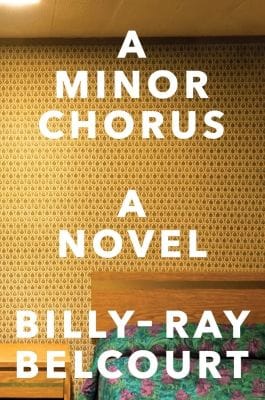
A Minor Chorus by Billy-Ray Belcourt
2022 | W. W. Norton | 176 pages
Belcourt’s novel follows an unnamed narrator, a queer, Indigenous grad student from rural Alberta, working on his dissertation in Edmonton but hungering for new ways of thinking and being. This is a text that blatantly ignores many of the spoken and unspoken rules of English-language literary fiction. It leans into the enthusiastic academic language of its narrator, who often tells rather than shows, and speaks at length and directly about politics, enumerating the ways in which his existence is colored by colonization and Indigenous genocide, which exist as daily realities in the physical, mental, and emotional space around him. Its shape is fluid in the direction of its narrative (stopping, starting, and taking detours according to the whims of its narrator) and on the page itself (assuming different forms, including verse). The central thread is the narrator’s project of interviewing people from his hometown as research for writing a novel, and the result is the titular chorus of voices, alongside the main character’s journey into his own personal history. Belcourt writes, “I wanted to take a sledgehammer to the past to let in the shimmer of a light I didn’t know was there all along. It seemed unavoidable that I now wanted my writing not to advance an institutional body of knowledge, as is the case with a dissertation, but instead to invent an exit route, to make something out of nothing, to prop up a landmark for a place that was nowhere and everywhere.” —Elisabeth
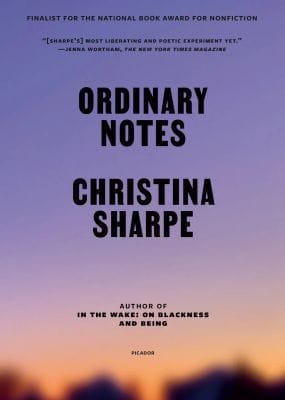
Ordinary Notes by Christina Sharpe
2023 | Picador | 392 pages
A blend of memoir and literary/cultural theory and analysis, this uncategorizable series of notes draws from Toni Morrison, Henry Louis Gates Jr., Roland Barthes, Dionne Brand, Saidiya Hartman, and many more legendary thinkers. The majority of the notes revolve around the concept of memorials and museums dedicated to atrocity; Sharpe records visits to the Whitney Plantation Museum, Birmingham’s Legacy Museum, and the Nazi Documentation Center and Nazi Party Rally Grounds in Nuremberg, among others. “The architecture of the memorial stages encounter,” Sharpe writes, “Spectacle is not repair.” What is the purpose of collecting and displaying artifacts of the horrors of slavery, or the Holocaust? Who is the intended audience for such displays and what are they meant to experience? In a scene that is almost comically representative of her point, Sharpe is walking in a “graveyard” at the National Memorial for Peace and Justice in Montgomery that is meant to reference the victims of racial lynching when she is approached by a white woman who robs the moment of its serenity by pausing to address Sharpe: “Excuse me...I’m so sorry about all of this.” Art and iconography accompany the text: one page juxtaposes the famous photo of Elizabeth Eckford being harassed by white teenagers protesting the integration of Little Rock Central High School in 1957 with a photograph of yelling white men carrying tiki torches at the Charlottesville Unite the Right Rally in 2017. —Lisa
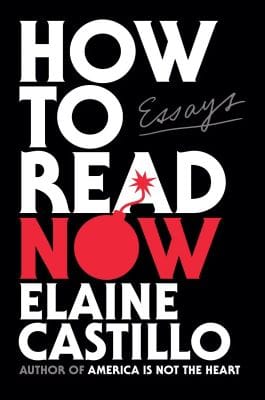
How to Read Now by Elaine Castillo
2022 | Viking | 352 pages
It’s hard to sum up a text that gets so hilariously at the heart of so many terrible truths in American reading, publishing, and criticism and does so in such an entertaining manner. In the tradition of Toni Morrison (whose influence is acknowledged) and other literary critics who have addressed the ways that the ingrained racial dynamics of American history have not just formed an inevitable part of its art and larger culture but been integral to their formation, Castillo dissects the relationship between power and literature, in her own trademark way: “It's not a question of bringing people out of their ignorance—if only someone had told me that Filipinos were human, I wouldn't have massacred all of them!—but a question of bringing people out of their deliberately extensive education.” How to Read Now is a book that I generally recommend for everyone, because I think everyone should have to reckon with the ideas presented in this book, and Elaine Castillo deserves the sales. But I hope it especially continues to find its way to people of color directly affected by mainstream (white) book culture—authors, critics, those in publishing—and its persistent fragility masquerading as intellectualism. —Elisabeth
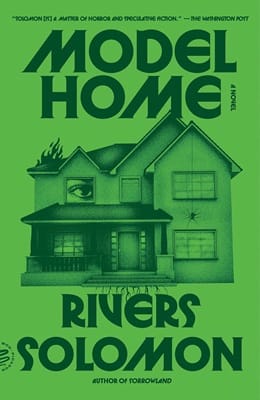
Model Home by Rivers Solomon
2025| Picador | 304 pages
“Maybe my mother is God, and that's why nothing I do pleases her.” This enrapturing introduction sets the mood for the remainder of Solomon’s literary horror story, a Locus Award finalist, which teases the reader with the promise of a haunted house tale while also calling into question how many of the plot’s mysterious goings-on are supernatural. Model Home follows Ezri as they return from the UK with their daughter Elijah to Texas, where they grew up—Black and queer in a racist white neighborhood, with their sisters Eve and Emanuelle—and where their parents have now died in an alleged murder-suicide. Despite the heavy, terrible, and at times sickening details of the plot, which twists into the past to reveal connections between Ezri’s childhood and visions that now haunt them, Solomon’s novel also paints an appealing picture of characters working to build a life of mutual care and support, where therapy, chronic illness, queerness, and nontraditional family are all treated as normal, natural realities. At the same time, Model Home is dramatic in ways that show refreshingly little respect for the dull decorum of conventional realistic fiction, and occasionally extremely funny. —Elisabeth
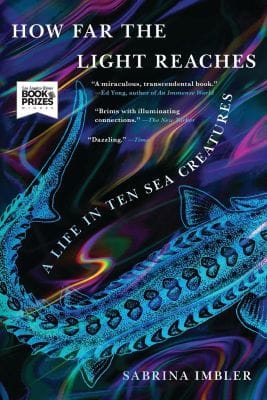
How Far the Light Reaches by Sabrina Imbler
2022 | Little, Brown Paperbacks | 288 pages
Sabrina Imbler’s debut essay collection draws on the author’s experience as a science writer published in the New York Times, The Atlantic, and other outlets, expertly crafting connections between animal and human behavior. Perhaps most striking is the second piece in the collection, “My Mother and the Starving Octopus,” in which Imbler reflects on the purple octopus that scientists observed brooding over her eggs for four and a half years on a sea cliff off the coast of California: “She did not move. She did not eat. She shrank.” Imbler connects this unusual behavior to a traumatic childhood experience in which their mother, who suffered from disordered eating, imparted devastating lessons about how food and weight are tied to a person’s worth. They also comment on how this experience intersected with their feelings about being mixed race: “I sometimes wondered if I were full Chinese, not half, thinness would have come naturally. I never considered this obsession a disorder; eating disorders were for white women, said the movies and the magazines and the clinical papers.” On that subject, the essay “Hybrids” subverts the common tropes of writing about being mixed race, beginning with its humorous opening lines: “This essay will not end with me folding dumplings. It will not end with me eating dim sum with my Chinese grandparents and my white dad, ruminating on how a family like ours wouldn’t have been acceptable a century ago.” —Lisa
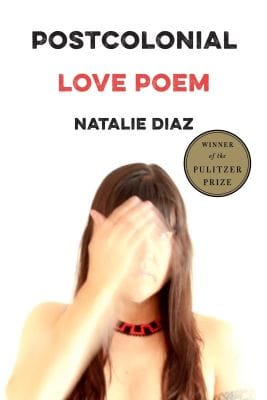
Postcolonial Love Poem by Natalie Diaz
2020 | Graywolf | 80 pages
This Pulitzer Prize winner from Natalie Diaz, who is queer and Mojave, is in my poetry collection Hall of Fame. It swings like a pendulum between expressions of grief and sexual desire, which actually are not diametrically opposed at all. The poem “From the Desire Field” is outrageously hot, even as it veers into the mental and emotional exhaustion of otherness—demonstrating that the pleasure of sex, in part, is to be rescued from the confines and limits of oneself: “My mind in the dark is una bestia, unfocused, / hot. And if not yoked to exhaustion // beneath the hip and plow of my lover, / then I am another night wandering the desire field.” “American Arithmetic” features the most overt discussion of the state-sanctioned violence against Native people, noting that while making up just 0.8 percent of the population, Native Americans “make up 1.9 percent of all / police killings, higher per capita than any race.” Other poems address the colonial violence of the reservation, and the poet’s brother’s mental illness, a subject also addressed in her first collection, When My Brother Was an Aztec (2012). Postcolonial Love Poem became an instant classic in the canon of Indigenous American literature when it was published and, for me, also a classic in the canon of queer eroticism. May I also highly recommend listening to David Naimon’s interview with Diaz on Between the Covers. —Lisa
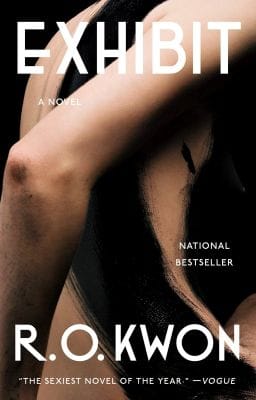
Exhibit by R. O. Kwon
2024 | Riverhead | 224 pages
Exhibit, like Kwon’s first book The Incendiaries (2018), deals with faith and the loss of faith, a subject that seems to only occasionally be addressed with real gravity in American fiction. This novel is somewhat more complex in its themes, and its beautiful, odd layering of language gives it a denser, more compact feel as it tells the story of a Korean American woman, Jin, reckoning with desires and frustrations in her career as a photographer and in her marriage—the angst of how fundamental parts of her feel incompatible with the world around her. Upon returning to it a long while after having read it for the first time, I was struck anew by the language and how insistently it retains its shape. I appreciated this bit of dialogue between Jin and Lidija, a dancer she meets at a party, which captures a muddled but significant exchange that might actually happen in this environment while infusing it with a stylized aesthetic, its lilting rhythm peppered with internal rhyme:
“I didn’t bring a tripod,” I said. “Plus, high, I have lying sight. I’m gilding the image.”
“I had my head dyed.”
“I figured. Lidija Jung. You’re Korean, right? So am I.”
“I am, but no, I just did it, and had it shaved. It used to be long, black. Like you. But I have to get it long, for ballet.”
The depth of the book’s emotions, the pacing of its drama, its philosophical seriousness, and its unabashedly expressive phrasing remind me a little of James Baldwin’s Giovanni’s Room, though it is very much its own creature. I found myself thinking that I’m grateful to own a copy of this short, gorgeous novel in hardcover, whose small solidity and striking jacket image and design (by Vi-An Nguyen and Eric Traore) give it the feel of a miniature art book, because it’s such a pleasure to just be able to pick it up and read it at any time. I’m sure the paperback has its charms, too. —Elisabeth
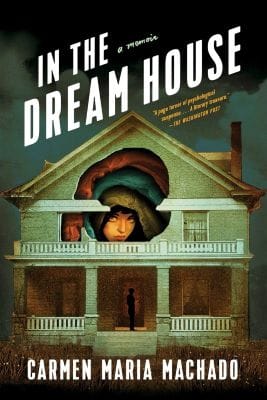
In the Dream House by Carmen Maria Machado
2019 | Graywolf | 272 pages
Carmen Maria Machado’s memoir was rightly recognized as revolutionary in that it depicted, in exacting, disturbing detail, an abusive relationship between two women. Both the text itself and the critical analysis that followed noted that sapphic relationships are commonly believed to be exceptionally harmonious—just two gals talking about their feelings all the time. Two marginalized people are not supposed to behave this way, as Machado writes: “...the whole world was out to kill you both. Your bodies have always been abject. You were dropped from the boat of the world, climbed onto a piece of driftwood together, and after a perfunctory period of pleasure and safety, she tried to drown you.” Of course the rosy picture of tender solidarity people imagine is often not the case in reality, and the fact that there is no framework for understanding queer abusive relationships makes it difficult to recognize one when it’s happening to you. While Machado doesn’t address it overtly, the specter of the girlfriend’s upper-class whiteness is threaded through the story (in one key scene in which the girlfriend breaks up with her as an intimidation tactic, the girlfriend is in Colorado skiing with her family, a trip Machado was not invited on) as a representation of the power imbalance in the relationship. Like Sharpe does in Ordinary Notes, Machado draws from culture and literature to make sense of her personal experience, referencing Stith Thompson’s Motif-Index of Folk-Literature, Dorothy Allison, Gaslight, and Star Trek, among others. —Lisa
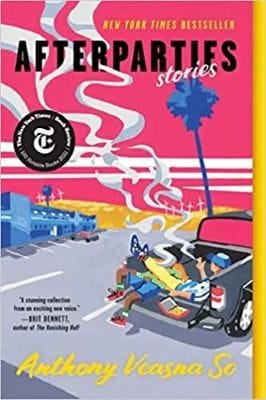
Afterparties by Anthony Veasna So
2021 | Ecco | 272 pages
This collection contains a rich variety of stories featuring Cambodian American characters that include elements of suspense, coming-of-age, and family drama. “Human Development” in particular is a story I think about frequently, that often comes unbidden into my mind to interrupt (or maybe even contribute to) whatever I’m doing at the time. It follows a young high school teacher, a Cambodian American man named Anthony, who begins dating an older Cambodian American man, a tech guy named Ben, who is fascinated by the statistical unlikelihood of them both being Cambodian gay men. The narrator, who is planning on centering his course for the year on Herman Melville’s Moby-Dick, is rubbed entirely the wrong way by Ben, whose continued comments on the significance of their shared heritage irritate him, but he remains oddly drawn to him. This is a patently hilarious plot but even a barebones description like the above gives a sense of its deep inherent tension and profundity, and I knew that I would love the story as soon as Lisa told me about it when she was reading it back at the time Afterparties was first being published. It explores identity and meaning, coincidence, and the fragility of life. (Anthony Veasna So died in 2020, before the release of this book. Another posthumous collection of his writing, Songs on Endless Repeat from 2023, features essays and cultural criticism.) —Elisabeth

Red Paint by Sasha taqʷšəblu LaPointe
2023 | Counterpoint | 240 pages
This stirring memoir by LaPointe engages with several subjects simultaneously, with one strong throughline being dealing with personal and generational trauma as a survivor of childhood sexual abuse and a person of mixed Indigenous (Coast Salish—Upper Skagit and Nooksack) heritage. It also delves into her lifelong love of punk rock and David Lynch’s Twin Peaks, and with it her fraught marriage to a man she describes as looking like Agent Dale Cooper. But what I remember most vividly about reading this book is LaPointe’s depiction of her relationship with her ancestral history in the Pacific Northwest, including the story of her ancestor Comptia Koholowish, a woman whose entire village died of smallpox. LaPointe details the surreal experience of living in a settler-colonial society as an Indigenous person, intertwined with her personal search for healing. In an interview in High Country News about the book, she said, “When non-Native people think of the Pacific Northwest, they think of, obviously, how beautiful it is, and the music scene and Microsoft — things that put the Pacific Northwest on the map for them. I felt it important to write a memoir that celebrated those things but then tied that to the undercurrent — that it is a very Coast Salish story.” —Elisabeth
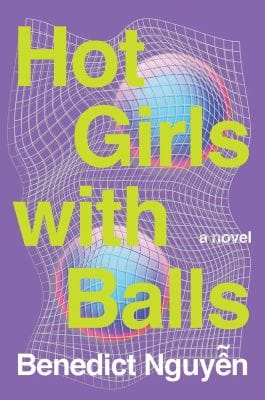
Hot Girls with Balls by Benedict Nguyễn
2025 | Catapult | 288 pages
This one will not be out in paperback until July but it is profoundly worth including on this list! Benedict Nguyễn’s debut novel takes place in an alternate universe where volleyball explodes in popularity while people are stuck inside during the initial outbreak of the “COVIS” pandemic. As if that conceit weren’t outrageous enough, Nguyễn’s two leads—Six and Green—are both Asian trans women playing in the professional men’s league. And they’re in love! The story of their relationship—along with their social media prowess—has brought even bigger audiences to volleyball, and the novel centers around how the two balance their personal lives, their professional lives, and their statuses as multiply marginalized celebrities who are treated like tokens by the league. The book’s title tells you most everything you need to know about its wild sense of humor, but Nguyễn’s approach to portraying the complexities of life when one is meant to be a shining representative of one’s race and gender is satire at its finest. A hilarious send-up of respectability politics. —Lisa
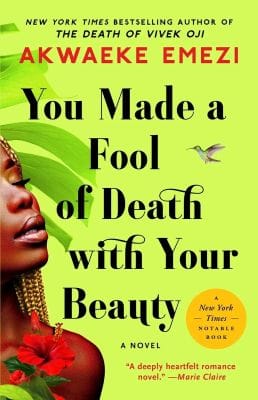
You Made a Fool of Death with Your Beauty by Akwaeke Emezi
2022 | Washington Square Press | 304 pages
Sticking to the “one book per author” rule I like to implement for all reading lists, I was trying to decide between Emezi's The Death of Vivek Oji (2021) and this one, and ultimately chose this one because, while it may appear to be a less serious book and has generated controversy on at least one front, it’s undeniably a more celebratory book, even in its title, and like many of the books on this list it is defiantly joyful. You Made a Fool of Death with Your Beauty, a 2023 NAACP Image Award Nominee, is a messy age-gap romance between Feyi, a young bisexual widow making a living as an artist in New York, and someone who she “shouldn’t” be attracted to but definitely is. It unfolds like a highly entertaining TV series, with an episodic feel and atmosphere by way of exquisite food and a lush Caribbean setting (the screen rights have been purchased by Amazon and Michael B. Jordan’s Outlier Society). By some metrics, this novel follows standard romance tropes, but it also complicates them. Similarly to how Solomon’s book implements often-overlooked practical realities for its characters in a way that models community and care, Emezi’s includes discussions of therapy and STI testing, and portrays a variety of different kinds of supportive relationships. —Elisabeth
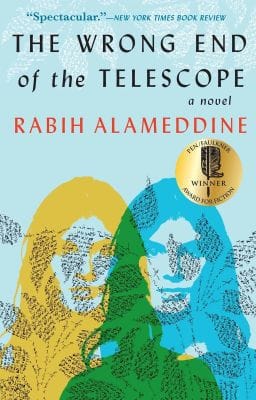
The Wrong End of the Telescope by Rabih Alameddine
2022 | Grove Press | 384 pages
Winner of the PEN/Faulkner Award and written by now-National Book Award winner Alameddine, this playful but deeply resonant piece of metafiction is narrated by Mina, a doctor who travels to Lesbos to assist with the refugee crisis (the timeframe for this book appears to be 2015–2016). A Lebanese American trans woman, Mina has been living in the US with her wife, estranged from her family. She mockingly addresses as “you” an unnamed friend of hers, a writer resembling Alameddine who also went to Lesbos to help refugees, but fell apart emotionally after arriving there, and who has asked her to write “the refugee story” because he can’t. The Wrong End of the Telescope gently skewers narratives driven by misguided notions of empathy and sentimentality while also plainly telling stories of refugees, focusing in particular on the family of Sumaiya, a Syrian woman attempting to hide her liver cancer from her husband and children. Alameddine brings together characters’ vastly different, vivid lives and lets them exist together on the page without attempting to resolve the dissonance of their experiences, which speak for themselves, and their shared story is a wholly original delight. —Elisabeth
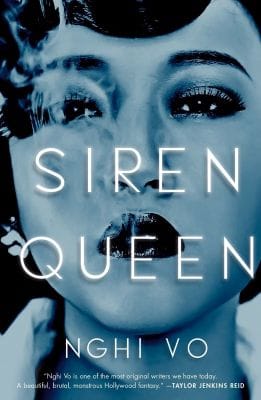
Siren Queen by Nghi Vo
2022 | Tor | 304 pages
This intricately imagined, atmospheric fantasy of Golden Age Hollywood follows a queer Chinese American actor as she strives to build a career in the movies, blending recognizable nostalgic elements of the time with horror, monsters, and magic. The language is intentional, strange, and wonderfully dramatic in both description and dialogue, and the story in some general ways points to the life of Anna May Wong, who has become a popular figure for fictionalization in recent years, though it is wildly inventive and clearly unbound by any particular facet of historical fact. (A contemporary book that focuses on Wong in a more direct, realistic way is Amanda Lee Koe’s 2019 novel Delayed Rays of a Star.) This is Vo’s second novel, her first being another sort-of-historical story in the form of a retelling of The Great Gatsby with Jordan Baker as a Vietnamese adoptee, The Chosen and the Beautiful (2021). Vo has in fact published multiple award-winning novels (and more that have been finalists for multiple prizes) since the start of the pandemic in 2020, and she has also been seen wearing a KN95 at book events and making statements on social media about public health relatively recently, and we love both of those things for her, and us, and everyone. That’s how you do it, folks. 10/10. —Elisabeth
Who Even Reads is an independent publication run by two hardworking editorial professionals. We write about books from a liberation perspective, with a socially conscious focus that's both fun and serious, covering mostly new releases. Your donations subsidize what we do. Learn about us.