“I want to throw myself in front of a speeding car”: Claudia Rankine's Triage and the Toomuchness of It All
How can one live like this, Triage asks, at the same time it declares the question beside the point. What is the alternative?

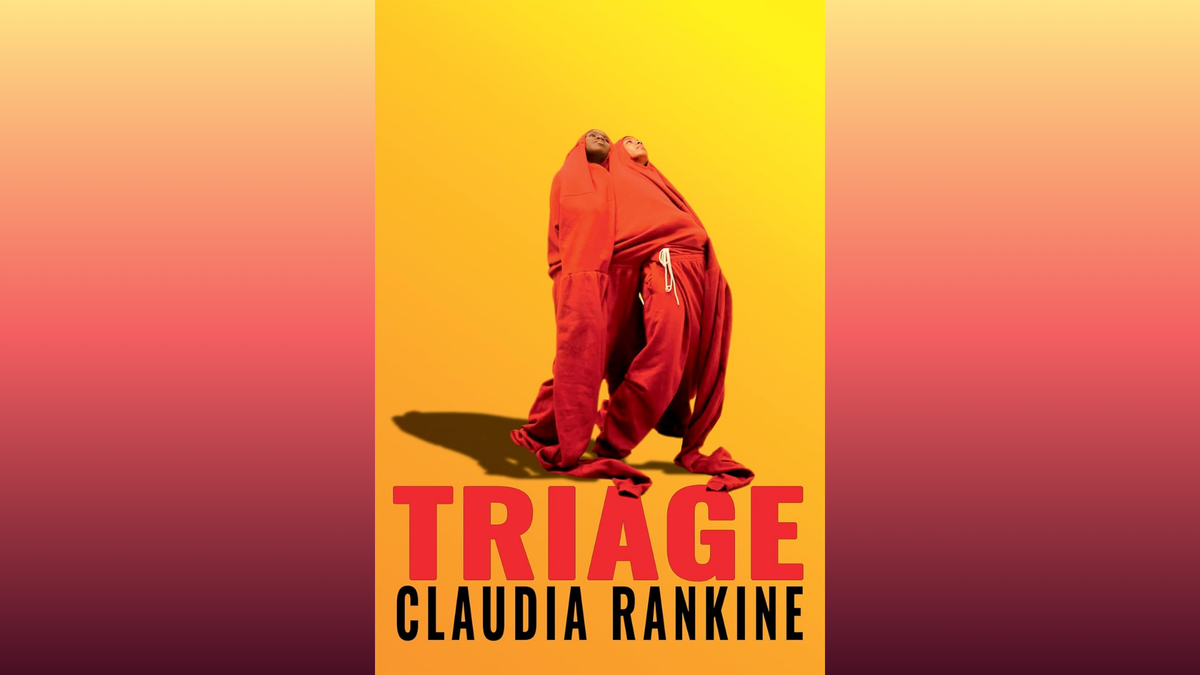
The inciting incident that kicks off Claudia Rankine’s Triage—an indefinable, restless, remarkably astute book that reads more like fiction than her previous work—is the narrator attending a reading by an old friend, called “the theorist” throughout. During the Q&A portion of the reading, an audience member asks how the theorist feels “given what’s going on in the world.” The theorist responds, “Sometimes I want to throw myself in front of a speeding car.” The narrator is bothered by this not so much because her friend is expressing a death wish but because it seems like an unusually simplistic take for the person she knows: an idealist who typically experiences strife and suffering as a call to action.
“Sitting in the audience, I experienced the theorist’s wish for a crash as something like homesickness, seeded with the Greek algos, an intense suffering for a return. But a return to whom or what?”
My girlfriend and I have frequently discussed a particular annoyance we have with a certain caliber of white liberal who simply can’t believe what is going on in the world these days, who believes Trump is the embodiment of evil, and that going to No Kings protests, voting, and “when they go low we go highing” their way through the world is the only solution. In reality, Donald Trump is not the puppetmaster engineering genocide, disenfranchisement, bigotry, etc., but a bland empty space, an inevitability born from a system that was always designed to create someone like him (many someones, really) to perpetuate its grotesque cycles. I think this is what the narrator is gesturing toward when she comments on her friend's rather pat expression of disillusionment. She is expecting something more complex, something that captures the reality that people like her, and the theorist, have always knowingly lived under the thumb of white supremacy and capitalist oligarchy and have never, unlike some people, been able to pretend otherwise. If the theorist truly feels like jumping in front of a speeding car, haven't they been feeling that way their entire life?
Later, the narrator returns to this sentiment:
“When the theorist recounted their wish for an end, my heart, initially, deadened. Why the drama? Their very presence at a microphone suggested they wanted to live. They ought to have realized by now, we, have always been living collapse. Someone else had always controlled the route, its vehicles. We were either on the curb attempting to cross or in the middle of the road, hoping, haunted or hunted.”
Over the course of the book, we see the evolution of the relationship between the narrator and her theorist friend, whom she met in college, after having witnessed them rip misogynist posters off the wall in the library. Their years in academia, and beyond, have been characterized by periods of closeness, and then distance, both literal and metaphorical. And while part of the drama of Triage is in tracking how this relationship changes, yearns to change, and in some ways can’t change, the central conflict is in the two characters’ alternate dispositions, which represent two potential attitudes toward a world like ours, spinning rapidly through a seemingly endless whirlwind of ever greater catastrophe (speaking of being dramatic).
The theorist, we learn, was born in Ramallah, in the West Bank. We are not given as many details about their biography as the narrator’s (though we are also given only the barest sketch of hers, as she seems to prefer to leave the past in the past), but the theorist’s globe-trotting experiences have made them a person of action (somewhat ironically, given their line of work). In contrast, we understand the narrator was abused as a child and has been saddled with the inherent trauma of living as a Black woman in America, and that these experiences have made her cautious, and most importantly, self-protective. We see this both in the arm’s length at which she holds the world (including, perhaps especially, the theorist) and in her more reserved, contemplative attitude toward politics and ideology. There are multiple scenes in which the theorist confronts the narrator about her inaction, and the narrator admits that she has watched the theorist “taking on” systemic injustice, while she protected herself. “My own life, in its way, fought for its silences, routines, and quietude even as Audre Lorde’s truism, ‘your silence will not protect you,’ ran on repeat in the muted hours.”
In addition to the drama of this relationship and its contradictory attitudes about how to live in the world, Rankine does what she has done in her other most recent, critically acclaimed books, Citizen (2014) and Just Us (2020): she tracks the most urgent issues of our time, crafting a narrative of disparate threads, including references to the genocide in Palestine, climate collapse, and the rollback of basic human rights. Also like these other books, Triage’s references to authors, philosophers, and artists could be collected into an excellent reading/viewing list for understanding how the world we live in now came to be and how we might potentially go about changing it.
How can one live like this, Triage asks, at the same time it declares the question beside the point. What is the alternative? And throwing one’s hands up in despair at “all of this,” the “toomuchness” as Rankine describes it, is a convenient way to avoid having to actually do something uncomfortable.
Triage is an exceptional work of cultural theory that is deeply poetic in its execution—a pastiche of quotes, visual art, and philosophical inquiry crafted into an immersive and compelling narrative. The reader tracks the relationship between the theorist and the narrator over time with some desperation, the sense that if there is a resolution here, it might tell us something about how to be in the world now, it might conjure greater possibilities than seem available in the “toomuchness” of our daily lives. Rankine asks the reader to move beyond the state of self-triaging in response to the daily outrages meant to keep us distracted and feeling helpless, and into the state of steady action and construction of a new world.
The final pages come about as close to a direct recommendation for how to live in the world as a philosopher like Rankine is likely to make, and they include one of my favorite lines from the book: “On occasion, reality turns to us, a slight smile ghosting its lips, and mouths, for fuck’s sake, do something.”
Who Even Reads is an independent publication run by two hardworking editorial professionals. We write about books from a liberation perspective, with a socially conscious focus that's both fun and serious, covering mostly new releases. Your donations subsidize what we do. Learn about us.