"You make a little space for yourself as a weirdo": An Interview with Patricia Lockwood
"Citadels, stacks, rat piles of books": We talk to Patricia Lockwood about judging the Booker, her new double poetry collection Agate Head / Stone Soup, her novel Will There Ever Be Another You, and more.
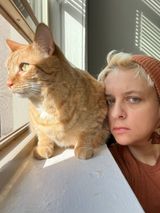
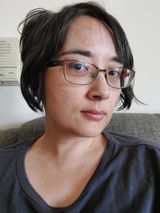
Lisa and Patricia Lockwood became friends in their senior year of high school in Cincinnati and regularly frequented a coffeeshop called Buzz, which was located near the University of Cincinnati, along with Lisa's high school girlfriend, whose name has been anonymized as Amy in this interview, and another friend of Lisa's. Tricia refers to the group collectively as the Lesbian Wolf Pack, and she references these outings in her novel Will There Ever Be Another You in the chapter "Hashish in Marseilles."
We recently talked to Tricia about her new double poetry collection from Penguin Poets, Agate Head / Stone Soup, as well Will There Ever Be Another You and her other novel No One Is Talking About This. We also discussed the ongoing pandemic, the process of judging the Booker Prize, altered states of reality reached during chronic illness, and much more.
The interview began with Tricia discussing her rattail, which she has decided NOT to cut after the Booker ceremony as previously planned. She explained that it had gotten quite voluminous for a rattail and described it as a "ducktail" with "terraces and big swoops and like curls and billows." She also says she was unprepared for how "extremely magnetic it is to women." Then we got down to business.
Disclaimer: Some links in this post are affiliate links and Who Even Reads may earn a commission if you click and buy.
Lisa: I'll start by asking you to explain how we know each other, and how your family is coping with the roller coaster ride that is the Cincinnati Bengals season so far?
Patricia Lockwood: Oh my god, did you see the picture of Joe Burrow [going around] just being like, it's not Armageddon. It's so sad. I think they're actually taking it a little bit better this year because we kind of know what we're dealing with at this point. I feel bad for Baby Girl, cause he also understands what he's dealing with now, and it's hard to keep your level of like, I don't know, effort going when the organization is such that it is.
Okay, so we know each other as members of the Lesbian Wolf Pack. How would you characterize it? Like West Side [Cincinnati]. We were the Buzz coffeeshop gang, and yeah, we were just like running the city. It was the first time I really understood that like, I was not supposed to have coffee, constitutionally. And I would hang out with you and Amy, and first of all, we would play chess, and the chess never went anywhere. No one could win those games. And then, you got free refills. So I would just go and I would start to become completely mentally a lunatic, and like maniacal. And eventually I was like, oh, it's because of the coffee. The coffee is the reason. You'd go there to like, smoke cigarettes and go out of your mind from the free coffee refills. But we don't even have places like that anymore!
Elisabeth: So do you remember how the two of you actually met?
PL: Yes, Lisa, you've said that you don't remember as much stuff from high school. So I went to a new school, Mother of Mercy, senior year of high school. And so Amy [Editor's note — Lisa's girlfriend] went there and I was in government [class] with her. I had been raised in this insanely conservative home. And so I had to be deprogrammed and reprogrammed. Amy would be like, across from me, like, what are you talking about!? Oh, this normal thing that everyone says, and she's like, no, that's not true. So she was part of my deprogramming. And then we were also in art class. And I really remember her because she had a great eye.
L: She was very talented.
PL: She was like, a great, fully formed artist at that moment in time. And I was doing these little things where I was like drawing a little thing of like an outline of a woman's head on a face. And it was like so not bold or cool in any way. And then Amy would be like, well, I forgot to do my portfolio, so I just got up this morning and I made something, and then she would show you like twenty things and you'd be like, wow, that's really good! I probably saw pictures of you before I actually met you, because she would use you as a life studies [model].
But it was kind of like, we would drive around—that classic high school pastime. And then we would go insane on the coffee. I never looked around and was like, why am I the only insane one? Everyone else seems okay, but I'm not okay.
L: I was stoned a lot.
PL: Yeah. But Amy had great taste and she was always, like, introducing me to things. I was very fortunate early on to have had cool friends. Even in eighth grade, I remember there was this one girl named [Ed.— redacted] who I was like, obsessed with, and she's so offline and I've never been able to find her again. She did a book report on Lorrie Moore's Who Will Run the Frog Hospital? in eighth grade. And the book had come out that year, and I was like, how did you find that? So it's almost like, little sprites or emissaries from the fairy kingdom who come and they like, educate you about like, music and movies and things like that. [Ed.— She describes another member of the Lesbian Wolf Pack introducing her to Georgia O'Keeffe and having to explain to her that the paintings looked like vaginas.] But yes, the Lesbian Wolf Pack. I was adopted as this little mascot, or like, a stray dog or something, very clearly, like, IQ-compromised, who was just like, being adopted for the short haircut.
Because we did it in 2015 onward: we were like, we are going to pay attention to what's happening in this particular online space every single second of the day and we're always going to know every single thing that's happening and that's going to be how we're doing something or we have some control. And it wasn't, and we didn't, and I was like, I'm not doing that again.
L: I do remember taking you seriously as a writer at that time.
PL: Yeah. I was like, well, I know how to do that, but all my information's wrong. So I'm going to have to get up to speed here. And that's what the Lesbian Wolf Pack helps you do. Now I have like one billion nieces and nephews, so I get to be the person, in the educational role. It’s very gratifying. I was visiting the University of South Carolina this past week in Columbia, and they put me in a room with these students. And first of all, I was never in a university setting myself. So I don't know what those classes are supposed to look like. So I just kind of get whisked into these environments where I'm set down, and occasionally there will be like, a student that's so huge, like seven feet tall. And I was like, I don't know what I'm supposed to be telling you. He had this tiny little red notebook and he's writing my statements in it, and he's making, you know, the listening face. And I was just like, I don't know exactly how I get to be doing this. But it's a full circle thing. Now, they listen to me. I mostly just go to the classrooms and I'm like, THEY’RE LYING TO YOU! Which I think serves a function.
L: Absolutely. It does.
E: What I'm enjoying about this is this being kind of evidence that Lisa was actually really cool in high school which is something that we've argued about because I'm like, you've obviously just always been a really cool person, that's just who you are, and she doesn't get it.
PL: Yeah. Like Amy was cool but Lisa did not even try to be cool.
E: Yeah, that's what I'm saying.
PL: And I'm just like, okay, there's a cool girl, and she kind of showed us all up in that way. But maybe the secret is to like, be so high that you're not remembering any of it, and you're just kind of like, hanging out.
Here we digressed, with Tricia and Lisa talking about high school and personal things, and then Tricia's cat Fenriz (who has an amazing cartoon meow) wandered in front of the camera, creating an additional holdup. We had a brief, unavoidable-feeling discussion about how domesticated cats like Fenriz and Miette don't fully understand what sex is before we finally got started with the serious questions.
E: In the introduction to Agate Head, you talk about how being offline informed your return to poetry. You also mention getting into agate cutting and metalsmithing (subjects that appear in your new poems, and in the case of metalsmithing, in Will There Ever Be Another You), and you compare tilting an agate back and forth to reading. I was wondering if you also felt that there was something about the physical and tactile nature of these activities that informed your return to the genre of poetry, which arguably also offers a more physical and tactile form.
PL: Yeah, and I was writing them out longhand in a notebook. And if you go to the notebook that I was keeping at that time, which is like this red Moleskine that I call Rosarita, the poems will just appear on the page totally intact. Like sometimes with little insets on the side. But pretty much exactly as they ended up in the book. So a couple things happened.
It was the inauguration and I had Covid again and I was like watching the TV and I was like, oh none of this makes any sense. I was trying to read some headlines, I was like, nothing makes any sense. Nothing that's going on is in any way legible or comprehensible to me. So I was like, okay, I'm just going to go off the internet. Because we did it in 2015 onward: we were like, we are going to pay attention to what's happening in this particular online space every single second of the day and we're always going to know every single thing that's happening and that's going to be how we're doing something or we have some control. And it wasn't, and we didn't, and I was like, I'm not doing that again. I'm just absolutely not capable of doing that again.
She's like, I just think that this would be a really great cover. And I was on mushrooms and I was like, yeah, IT LOOKS REALLY GOOD, GIRL. So it wasn't what would have been the most logical or like most obvious cover for an Agate Head / Stone Soup. But I was really happy with it ultimately.
So I tuned out and I walked out and it took probably from that point maybe two months; and the other things that were going on at the time is we were doing the agate cutting, I was working on the Sylvia Plath piece for the LRB which entailed, as it always does for me, just like going through all of her fiction, letters, biographies, poetry, all of that stuff. I just was reading her very deeply and then—sorry, [Ed.— to Fenriz] you're very, very cute.
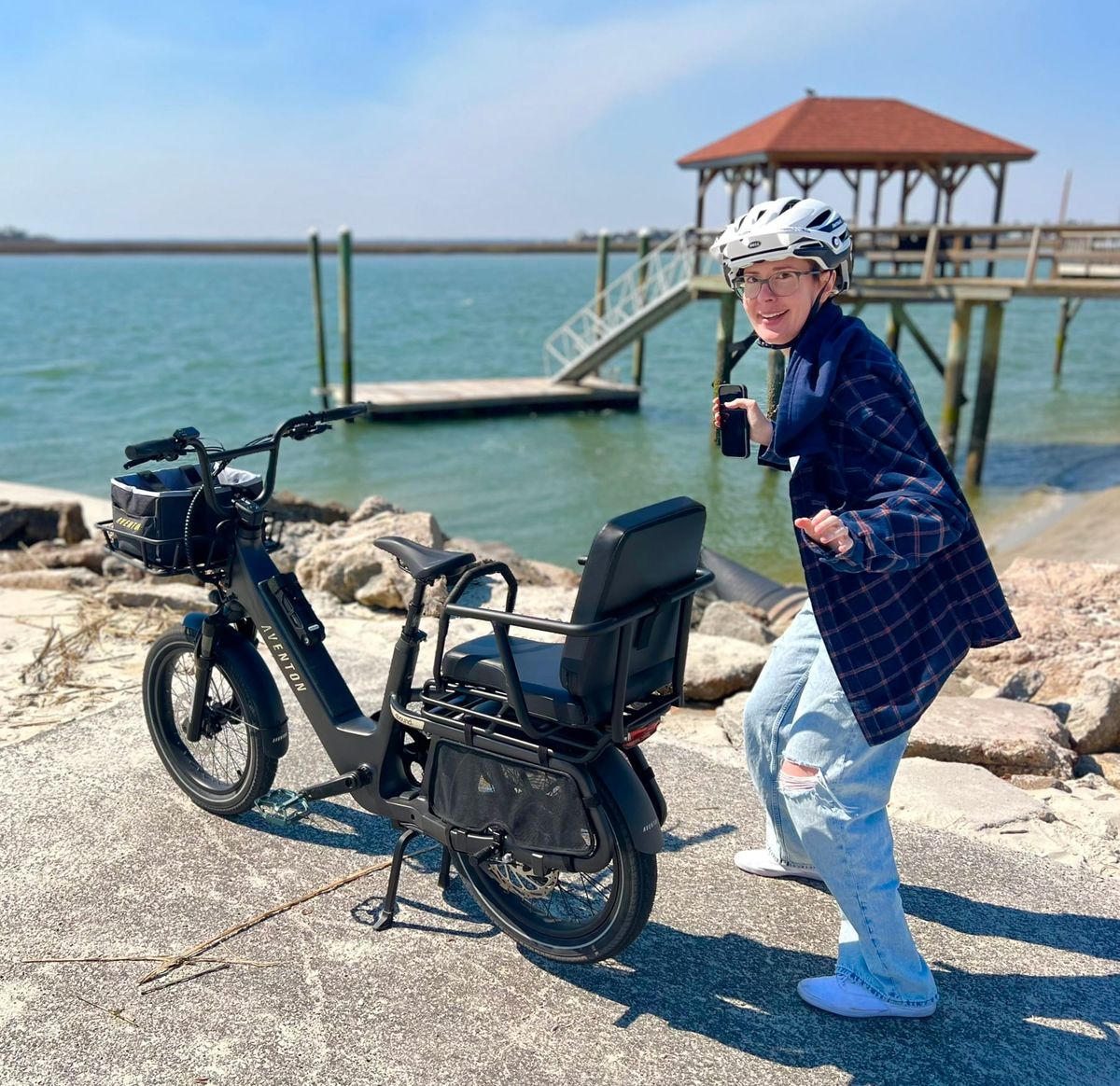
We were doing the agate cutting. I was doing the metalsmithing classes. We were also doing something called the Bicycle Built for Two, which sounds like I was doing something to pedal it but I wasn't. I was in a baby carrier on the back just getting carried around.
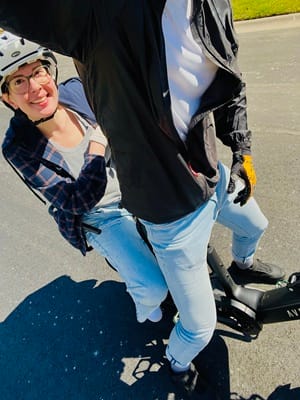
L: I’ve got to see a picture of this.
PL: I'll send you one. I'm just like in my little cage, and one time we did get in an accident because we slipped on a vape cartridge. It was Easter Sunday. I didn't put a leg down, which is good because I would have broken that leg. So I just kind of fell really slowly sideways and I hit the ground and all these people come over and they think that I'm dead. Jason's like, oh god I've killed my wife. I was fine. I was protected by my baby carrier. It was not even a problem. I was so hopped up on adrenaline that I just jumped up and this man had come from a bar across the street to see if I was okay and he held out his hand and I grabbed it and shook it with great panache. That is all in the poem “Polish Flint.”
I think all of those things, with the addition of one more thing, which is Cat TV. It is like a 24/7 livestream of a stump with some birdseed and nuts on it, and in the background are all of these, what I would describe as meadow nature sounds. So I sometimes wonder if I didn't trick my brain slightly into thinking that I was Wordsworth out for a walk in the Lake District or something like that.
So it was one of those things where it was a convergence of a bunch of really weird things. You could never plan it. [Ed.— describing our view on the camera] Huge, heaving side of a cat.
It led to this kind of season, which they're very rare when they come along in a writer's life but you recognize when you're in them, and you're like, okay don't do anything, just keep doing what you're doing, don't question it too much, just wake up every day and do the reading, do the writing, go for your little rides, go to your class, cut your agates, and just keep writing the poems as long as they last. That's what I did.
L: That kind of feeds right into the next question we were going to ask, which is, how far into the writing of these poems did you actually realize you were writing two books? And how do you tell your publisher about this project, or any of your projects?
PL: Penguin Poets for a long time was just my editor on Priestdaddy and No One Is Talking About This, Paul Slovak (and on Motherland Fatherland Homelandsexuals), so he was in charge of that as a side gig while also like being in charge of Viking or whatever, so it was this very unusual situation, where it was in his hands for a long time, and he would write me every year and be like, any plans for a new collection? And I was like, mayyyyybeeeee, but really I didn't have anything, or I had maybe half a plausible collection of poems that will now probably go uncollected because I started doing this instead. But these were written so quickly and at a pace, again, of like two, three poems a day sometimes, there's thirty-one or thirty-two poems on each side, [I] pretty quickly figured out that it was just either going to be something like Diane Seuss's Frank sonnets, which is a pretty hefty collection that states from the outset that it's 108 sonnets, or that cool book that Eileen Myles did for Wave like a decade plus ago called Snowflake/Different Streets, and that's a tête-bêche, and I was like, let's do something like that.
At the time I thought they had invented it and that it was just a made-up thing that Eileen did for this particular collection but no, it is a French thing, and it's old, and there's a bunch of really cool-looking ones, so we had the entire collection before I even went to them and then I was like, here, I have this double collection, and it was unusual in that it was submitted by my agent. My agent was really funny because she like, loves to get me money, but I was like, this is a poetry collection. She was like, I'm going to get you this and this and this, and I'm going to negotiate, and I was like, this doesn't even work that way; we're in this for the love of the game! She negotiated that and it was never even a question, they were just going to let me do what I wanted. Now the cover art was a little more interesting. I assumed that it was going to be like either side would be like what an agate looks like. [Ed.— She shows a couple of agates, including the uncut Agate Head.]
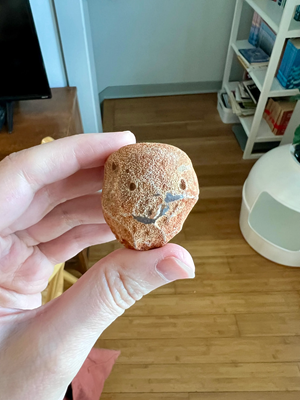
E & L: [marveling sounds]
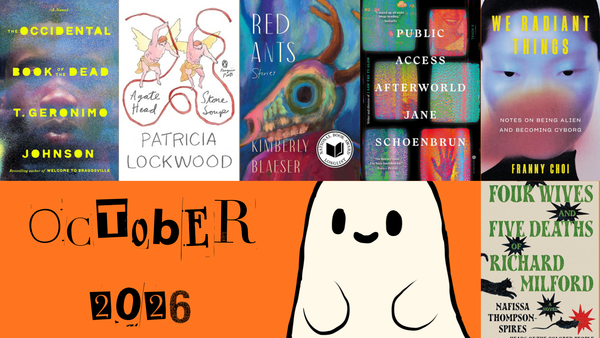
PL: But the designer, she was like, I was so moved by the poems that I painted this watercolor and it'll go from this side to this side [of the book]. And I was like, that's beautiful, but it's not what I was thinking. And so then she came up with some other ones. And it was just like, a Hail Mary. She was like, I went to this outsider art festival over the weekend and actually bought this painting of the little fucked up cherubs. She's like, I just think that this would be a really great cover. And I was on mushrooms and I was like, yeah, IT LOOKS REALLY GOOD, GIRL. So it wasn't what would have been the most logical or like most obvious cover for an Agate Head / Stone Soup. But I was really happy with it ultimately.
They didn’t put up any fuss. Also, I'm not like an enfant terrible, or a diva, or anything like that. But I did start out as a poet. So you make a little space for yourself as a weirdo, you know, like they've never really had problems with me doing like lyric essays as chapters or something. Like No One Is Talking About This is formally very weird. And that’s always been okay. Because like, I'm not going to give you anything else. I'm not going to suddenly present you with a romance between two teenagers in a rustic Irish village. Like, that's not what I write. It's always gonna be something weird. It's always gonna be form-breaking. So I think at this point, they just expect that. Which is a very nice position. I would encourage more people to start out as poets because it gives you that latitude.
So I do think we can be hopeful, even as we sort of are in this weird space with it now where people don't want to consider that it's still happening. And then we have weird things like, oh, ha ha, those lesbians who still want to wear masks at the lesbian bar.
E: We do have at least one more question, potentially, about the poems, but if it's okay with you, we were also going to ask some questions about Will There Ever Be Another You?
PL: Yeah, you can ask anything you like.
E: So, I don't know if you knew this, but Morgan Leigh Davies wrote an article for Current Affairs earlier this year called “We Still Haven't Processed the Pandemic,” and it mentioned your book as the only one that has "delved into the alarming, disorienting experience of living with the condition long-term,” meaning Long Covid. So that article was also a critical look at the lack of diversity in Covid narratives. Lisa and I both still take Covid precautions in our daily lives. And we're in community with other Covid conscious people. We see Will There Ever Be Another You as kind of a hopeful start to more narratives about the reality of Covid as an ongoing illness, both in terms of Long Covid and in terms of the fact that it's still around.
PL: It's out there right now! Check the wastewater levels, baby!
E: Yeah! So, we see it as kind of a possible gateway to stories from more varied and marginalized perspectives, like stories about living with Covid that are not necessarily recovery narratives, stories about people who are disabled and immunocompromised and racially marginalized in various ways that might coexist. So, I guess the question is, do you think about the book in terms of that kind of cultural significance? And can you envision it as something that might eventually be seen as kind of a cultural turning point towards a different kind of future, artistically and socially?
PL: Yeah, well, I mean, it starts with just representing the experience, right? And it's seen as like, you know, I'm like, it's my crazy book, but it really is something... like everyone felt absolutely out of their gourds at that time, completely unmoored from reality. A lot of people were sick early on. And as I was saying with the sort of presidential-inauguration-nothing-makes-sense-anymore, as you say, it continues to be ongoing, and even if you have a quote unquote mild case, you'll still experience these cognitive effects. And I think that a lot of times what people want to present, or the face they want to present in autobiographical writing is not someone who's unreliable, right? Like they don't want to be seen as an unreliable narrator, or a malingerer, or someone who is on the frontier of an illness that we haven't really defined. But the people that I've heard from who were ill in that way, or experienced aftereffects in that way, they were the ones who were like, this is exactly what it felt like. It's the people with [ME/CFS], who have been sick with that for twenty years, who are like, this is exactly what this experience is. I've seen [the book] cited on like hospital websites (the chapter actually about Jason's bowel surgery and subsequent hemorrhaging, they actually put it on the NHS's website to be like, this is what we need to look for in terms of aftercare for these patients). So you do notice that you're being an advocate. I noticed that with No One Is Talking About This too. You don't set out necessarily in the narrative to do that. You're just trying to represent the experience. But it has had those effects.
So I do think we can be hopeful, even as we sort of are in this weird space with it now where people don't want to consider that it's still happening. And then we have weird things like, oh, ha ha, those lesbians who still want to wear masks at the lesbian bar.
L & E: [wincing noises]
PL: Like, so you'll see there are these cultural flashpoint moments, where it's like the conversation is changing a little bit. And we see what leftists do, which I really don't like, where they're sort of like, none of that was necessary, these people are crazy, the people who continue to mask are overreacting, that sort of thing.
And I am like, that's not what it was, man. I was there. You were there too. And you should have been documenting at that time, because what I wrote down was the experience of this, you know?
L: Yeah! Another question that is related to that is, as a disabled person, I see many aspects of my experience reflected in Will There Ever Be Another You. I was wondering if you consider the novel to be a recovery narrative, a disability narrative, or both, and how your relationship with that narrative might have changed over time. And also, again, what was that conversation like with the publisher? Because I know you've talked before about getting a little bit of pushback in terms of like, [Covid] is something that we're not supposed to be talking about.
PL: Yeah. I also just didn't know—it was the book that was riskiest in the sense that I didn't know what the end was going to be. Like, is the ending, does she get well, do I get well? When you're talking about disabilities or conditions that kind of go through flares, or waxing and waning situations, like so much of what I was experiencing was 24/7 migraine, migraine aura. And then when you find something that works for a time, and you're like, oh, I'm free. It's never gonna happen again. It's just not how it works, right? Like, I can go back into it at any time just by eating a tuna fish sandwich, right? Like, if you want to see me go insane again, I'll have a cappuccino and a tuna fish sandwich, gross combo, but that's what I'll do. And you'll just see me exit reality. Once you know that you kind of feel like an idiot. Like, oh, that's what it was the whole time, and I could have been doing these things to kind of mitigate or ameliorate it. But then you're also just like, really angry that there are a lot of people, a lot of people I talked to, I'm like, have you considered it might be this? Are you considering that maybe these are auras or like brain fog states or temporal lobe seizures, things like that. People undergo weird physical states all the time. And they don't necessarily look for an overarching explanation.
They didn't even call it Long Covid then! And there were some competing subreddits. One of them was like r/covidlonghaulers. And I was like, that's not, it doesn't really roll off the tongue.
So yeah, as I was writing it, I was like, alright, I'm writing down everything as faithfully as I possibly can to the sensory experience of it. But what is that gonna look like as a narrative? Do you actually come out? And there is the feeling in “The Changeling” [Ed.— a chapter in Will There Ever Be Another You] like you're never gonna come out of this. And the reader is just like going down into that spiral with you. But you do have to give people something, right? You do have to be like, alright, I'm going to take you down into the snail shell but I will give you something at the end, not necessarily like hope or resolution, but like...I'm still going, right? Sometimes narrative is just proceeding down a path, right? Or it's just chronology. It's the fact that it's one day on top of another. So yeah, so it was really experimental, and I know that I would occasionally send my editor, or my agent something and they were like, you need to like, give me, I need a handhold here, I need something that will keep me in reality. And I was like, well, why would I give you that when I was not in reality for like, you know, four or five years. And I don't think you should sugarcoat it. I don't think that I should be like, oh, haha, it was actually really funny at the time. Like it wasn't at all. I was totally out of my mind. I couldn't read, I couldn't write.
And there were all of these other physical things going on, that even now, if I talk about them, they'll get you like a side eye from a doctor because they were so strange.
But in reality, people are experiencing things like that all the time. So I was really interested in kind of like, insanity narratives, and like the disbelieved woman narrative, or asylum narratives.
Jason walks by and finally scoops up Fenriz and carries him off.
He’s such a baby, he loves his papa.
But yeah, you know, people go through these things. The narratives that I think are really useful to people are things like Leonora Carrington's Down Below, or I Never Promised You a Rose Garden, where it's like, you're just going to come into it with me. And I'm going to state these things as facts. You know, these sensory disturbances or derangements were what I was experiencing as reality at that time.
L: As you know I have also been dealing with migraine with aura, and I find it fascinating that some people don't interrogate that. I’m constantly reading Reddit searching for answers. What you went through is my worst nightmare, where later you realize you could have been doing this thing all along.
PL: Like, am I allergic to dairy?
L: Yeah, like, I don't want to be gluten free! But then there are people who are sick and they don’t know why, and they don’t care.
PL: I also [had the feeling] I need to know what this is, but it was really early on. They didn't even call it Long Covid then! And there were some competing subreddits. One of them was like r/covidlonghaulers. And I was like, that's not, it doesn't really roll off the tongue. But like, we didn't even know what it was called when I was writing that thing for the LRB, “Insane after coronavirus?” I was like, if I say that like, this happened to my joints, or that this happened to my heart, things that, you know, pretty quickly were established as aftereffects. I was like, they're going to think I'm insane and then they won't listen to anything I say.
Here we had a protracted back and forth about Lisa’s and Tricia’s various migraine symptoms and treatment regimens. Tricia does not eat dairy or gluten and has tried a low-carb diet and this has largely resolved her migraine issues. If you are really interested in the minutia of this part of the conversation, feel free to send us an email.
PL: I don't know why we treat it as this condition that's not serious, chronic pain, or migraine.
L: I haven't been able to work since July.
PL: Exactly how, how would you be able to? And it’s like, if you help me with this or if you approve this medication, then I might be able to contribute to the American workforce, which is like, me writing my freaky little novels on my phone or whatever [laughs]. And then I'll be like, you know, a member of the workforce. Nobody wants me in the workforce.
L: No. You belong on your little bicycle. On your little thing on the back of the bike.
PL: There are some people that you look at them and you're like, no, uh-uh. Don't even bother clocking in. Just go get on that little bicycle of yours.
L: That's all you need to do. Okay, can we switch to Booker?
PL: Yeah. We're nearing the homestretch.
L: Yeah. It's exciting. So take us through the process of being a judge: how many books did you read, how many did you finish/not finish? Were they all physical books? Did you have a big pile of books?
PL: We did, but we had digital copies too. So here's how it went. It started after Christmas of last year. So from then to like September or whatever, we read 163 books. And when that was over, the thing that I didn't know about was the call-in process, which is, you scan the first chapter, or ten pages or fifty pages, of other books that the editor—in a lot of cases, these were big books and we didn't understand why they were put with the call-ins. But the publishers are basically taking a gamble, which is that the books they submit in the official sort of 163-books period are books that we might not pick up otherwise. Whereas if there's like, a big book from a previous winner, or someone who they think we're going to want to read it anyway, they'll put those in the call-ins so that they kind of get more [submissions]. They're playing the system.
So you could have a little bit of the relief of like, venting about them, or being like, listen to what he does with his—there was some insanely bad sex. There was ultimately some good sex toward the end, but it was like, we really, we were parched in that desert, there was just no one, no one was writing the good sex.
And I will say that there were lots of ways that publishers tried to play the system by aiming books at us. They'd be like, oh, Tricia wants a priest book or Jarvis wants a book about bands [Ed.— fellow judge Jarvis Cocker fronts the Britpop band Pulp]. In almost all of those cases, we were like, that's exactly the thing we don't want to read. Or it's the thing that we'll notice the most mistakes or artificiality in because we know those things really well. So don't do that, publishers! So yes, at the very end of it, we had to scan like 137 more. And then we each chose ten to officially call in and then two to recommend to the other judges. So we ended up reading, you know, like twenty, twenty-five more. It was a lot. Jarvis was like, on world tour, reading on his Kindle in a bathrobe in a tree house in France or whatever. And I noticed that when I was on the road too, and I was reading things digitally, I didn't like the books as much, or they didn't impress me as much, with a couple exceptions. You really felt more rewarded reading the physical copies, which meant that our home was just like citadels, stacks, rat piles of books all over the place.
It was a nightmare for Jason who has what is known as M-O-M, multiple object madness, where he can't have too many things.
L: Oh my god, I have that.
PL: Yeah, so he like, looks at a thing and he’s like AAAAAH! Too many things! Whereas I like to live in my rabbit warren with my papers and my notebooks, and like, a cat on my pussy, and the canyons of books all around me. But I was doing a lot of traveling and stuff. And sometimes you would read a book and be like, yeah, that's not hitting, and then everyone else would love it, and you would think, is that because I read it digitally? The longest one I called in, which was like 1300 pages, I read digitally. And that was password protected and watermarked diagonally on every page. And I was like, you cannot DO THIS TO PEOPLE. It was just absolutely deranging.
A lot of times the day just went down as reading books. There were days where if you got behind, you would read like two or three books in a day, or if you're trying to knock them out, you would do fifty pages of one and you're like, well, that's definitely a no. And you could tell pretty quickly, like if you're a sentence-based reader, or if you really care about the sentence level, you would be able to tell within twenty-five pages, many many fewer in most cases. But, it's human nature to want to continue and see what's going on in the story. And so sometimes I'd be like, oh, this is terrible, but I’ll just keep reading and figure out what these girls are up to! There was momentum carrying you along sometimes. And we had, like, an email thread, or kind of like a group chat, where we would talk about the books, and if we encountered like a really bad sex scene or something like that, then we would exchange those. And so there was sometimes an incentive to go a little bit deeper into the bad ones too. So you could have a little bit of the relief of like, venting about them, or being like, listen to what he does with his—there was some insanely bad sex. There was ultimately some good sex toward the end, but it was like, we really, we were parched in that desert, there was just no one, no one was writing the good sex.
L: I'm not surprised. Is there any contentious gossip about like, you know, Mary Beard, I threw a cup at her and—
PL: Yeah. There's nothing like that. What did turn out to be true is that I'm super bossy, but it was like, a productive bossy style. I was like, I feel like we can actually streamline this system for efficiency a little bit more. Like, I don't think we need necessarily to discuss these for three hours. I think if we pay attention to what people say, we kind of know where they stand, and then we can eliminate things more quickly. Cause sometimes, you just read it, so you want to hang on. You're like, well, I don't know what I think about that. Or, there were books that you could feel like you weren't quite ready for them. Like you'll like them next year when you read them, but like, you weren't quite in that place to appreciate them just because you were looking at so many things and trying to enter so many different universes. But no, it was more funny stuff, like Jarvis can't read books about bands. Mary doesn't like fantasy. She doesn't like, you know, we don't like books with maps and family trees.
So it was really kind of like, personalized individual stuff. We really had some fantasy haters, which I thought was interesting. And then there was sort of like, the poet side—me and Raymond Antrobus are poets. And then, you know, Mary Beard and Rebecca [Liu] were more informational readers, I would say. And then Jarvis could fall on either side, but he mostly more went for the poet weird stuff, the fresh stuff. So you would sometimes have to like, coax a little bit with the stuff that was a little bit more experimental or beautiful to be like, it is accessible. People do like to read poets’ novels. There's a sort of, anxiety about whether things are accessible for the general reader. But I think that the idea we have, maybe particularly in the UK, of the general reader is just kind of wrong. You know, people are already reading these books. And if you're talking about poets’ novels, something like Martyr! is a poet's novel. No One Is Talking About This is a poet's novel. Black Bag is technically a poet's novel, right? So it's not always what you think it is. And you can't assume what people want to read about or that they're not up to the challenge of particular books.
L: I just finished The Disappearers, and [when I started it] I was like, first of all, this book is 600 and something pages and I don't like that; and secondly, it opens with a cast of characters that's like six pages long. I was like, oh, fuck this. But oh my god, it was amazing.
PL: Yeah, you think you won’t be able to keep up but one of the great things about that book is you don't really have trouble with that. I sort of had that thought going into John of John too, where I was like, if this is one of those villages where everyone has the same name, I am so screwed. But it's the skill of those storytellers that you are kept abreast of all the doings and you're able to remember everything and like, keep a playbook of who's who.
There does seem to be kind of an issue where if you get recognized for the longlist or the shortlist, you're more likely then to be subsequently recognized for the longlist or the shortlist. Whereas there are people who definitely belong on this list who just never made it in the first place and continue not making it and it sucks.
But yeah, there were some where it was like, well, no wonder my book was longlisted or shortlisted, it’s like 200 pages. It's like got all this air in between, all this space. When a book like that comes along, you're like, oooh, a treat for me. A treat for me. Because you know that you'll at least be able to read it, if not, like digest it or necessarily decide what you think about it, within a day. Whereas The Disappearers, you're like, oh, I know I'm in for like probably two days. So I did that one in two days. And that's not ideal. You know, you want to give a book like that a little bit more time and attention, but again, a testament to his skill and also to the sort of raciness of the patois, like it really carries you along, like it's so fast. I thought that that was a particular standout quality of that book.
L: Yeah, it was so good, I loved it.
PL: If you meet him, he is, he's just a very funny guy. Jason read that book first and he was like, calling down the stairs, Marlon wants to fuck Michael J. Fox!
L: Yeah, there are so many excellent lines in that book. It's just, it's fantastic. It's very funny.
PL: And being able to balance the two sort of extremes of like, the maximalist violence, and then also just like very funny, pithy observational comedy. He's an unusual talent. I would say we have a very diverse representation of like people's abilities or particular strengths. Like very few of us, I think had even read Elizabeth Strout and we were all really like, oh, okay, I guess she can really like do the thing. Like she really knows how to write novels that are titled after women's names. I hadn't read any of Doug Stuart's books, but I was like, oh yeah, he can just really do the thing. So it's a little bit easier, maybe, when you're evaluating previous winners or previous longlistees and shortlistees. But sometimes, some of those we got, like previous winners even, you were like, oh damn, NO, you know. So it's possible, too, that reading those, you could be a little bit harder on them as well, where it's like, that's not really up to the standard, is it?
L: Right. So I read The Disappearers, and I read Helen of Nowhere, and a couple more, but what’s unmissable on the list?
PL: I would definitely do...the ones that were not as well-known in America were Black Bag, May We Feed the King, and The End of Everything. May We Feed the King is Rebecca Perry's first novel, and she's a poet as well, and The End of Everything was kind of a strange case where this dude has been writing very influential science fiction for sixty years, and somehow it had not made its way over here, so I thought that was really interesting to encounter. And then Black Bag, again, a poet. So yeah, I would read the ones that are lesser known in America.
L: I've heard a lot about May We Feed the King.
PL: I think you'll enjoy that. Then, too, she's written a really good sort of, it's an essay, it's kind of like a sort of Eula Bissian, Maggie Nelsonian type thing. It's called “On Trampolining.” She was a competitive trampoliner as a girl. And it's like kind of this really great lyric essay about it, but it is out of print now. I'm hoping that they'll reprint that, because that was really good.
But [May We Feed the King] was interesting, because you think of all historical fiction as being like Hilary Mantel. And Hilary Mantel was a god, right? Like, no one can do what she did.
L: I love those books, yeah.
PL: Yeah, exactly, and it's just like, we didn't know how good we had it. No one can do it like that. And it's like that, except it's more like spotlit dioramas, or a lot more intercuts of darkness. It's a more subtractive approach. So I thought that was really interesting, because it's like, you really do feel the loss of Mantel. And sometimes it's true that you just did not know what you had. You're just like, oh, I assume that other people will be able to write like this in the future. It's not necessarily true. So yeah, Rebecca Perry is exciting on the historical, sort of experimental front, for sure.
The longlist was a little bit more cutting edge or experimental than the shortlist. Because you do have to, there's a certain point at which you're just like, well, this is just a very good book, like the Elizabeth Strouts or the Douglas Stuarts, where it's a little bit more like a normal thing you can give your mother-in-law or something like that. You have to recognize you can't punish people for being really, really good at that kind of writing, [which] is the kind of writing that most people do want to read. It would be a little bit perverse to get to that stage and be like, these masters of the art are like, we're not gonna recognize that.
...it wasn’t until we were finished that I sat down and crunched the numbers and saw how few entries there had been in particular demographics. I did talk with Ray about it extensively to get a broader context for the UK publishing scene, and he said there’s very little institutional support for writers of color.
There does seem to be kind of an issue where if you get recognized for the longlist or the shortlist, you're more likely then to be subsequently recognized for the longlist or the shortlist. Whereas there are people who definitely belong on this list who just never made it in the first place and continue not making it and it sucks. And so it was really good to get Gwendolyn Riley on the longlist, because she's just been putting out these books and these are books that belong on a longlist and a shortlist. And it just kind of hadn't happened yet. So yeah, so it was good to be able to get a couple people on there, like a Makenna Goodman. You always are reading the Fitzcarraldos with an eagle eye, because they have just an amazing curatorial and editorial sense.
So there were presses you looked out for, but for me, I wasn't as familiar with the UK presses and I mostly write essays about dead people. So it wasn't like I was au courant with all of these authors, right? So some of them it was like, oh yeah, I guess this person who's like eighty and they've been writing this way their entire lives, they really do know how to do it! It's nice because it is also flattering to you that you can come along and be like, oh, that is really good. This thing that everyone else has been recognizing as good for a long time, I also can recognize that that is good, or I would pick this out of a slush pile. It's good to know that about yourself and it's kind of reassuring, because you do start the process thinking like, am I up to this weird task?
But I did go back and read the David Szalay, Flesh, [the winner] from last year, because I was like, would I recognize that? And that's one of those books where within the first twenty-five pages, you don't necessarily know if you would have passed it on. But when you read the whole thing, you're like, oh, it was so masterfully done. And I remember every single tiny plot twist. So that could induce you at times to read on a little bit farther, right?
L: Yeah, I think I would struggle with that. But, you know, they presumably hired you for a reason and, you know, want you to do the thing that you do.
PL: For my McDonald's salary [laughs]! Yeah. I don't even know how much it is. I was like, I should just donate it to the Black Panthers, or like John Birch. Everyone is like, yeah, it works out to much less than minimum wage. And it does. But it was also a one in a lifetime experience. And especially with the people we had. Mary was a very interesting chair. You didn't know sort of what she was gonna be like in a room because she's like, irascible. You know, she's been doing this a long time and she's given to uttering pronouncements. And she knows, I think at this point, what she likes. So we knew that that was gonna be interesting.
And then it was kind of like, you were looking around at the others like, what are they gonna like? If everybody goes for this book that I absolutely hated, that's gonna be a problem for me because then I'm gonna know that I don't trust their taste. So there were some entries pretty early on where I was like, oh, I can trust them, because they all hated this.
And then you had ones that were sort of like, we weren't reading with an eye toward this, but there were ones that were like, you know, Islamophobic or racist or ableist and that sort of thing. And it was good to be able to talk about that also and be able to call that sort of thing out as well.
The following question occurred to us after the conversation was over and was sent and answered via text.
E & L: The lists are overall predominantly White (particularly when compared to, say, the National Book Award lists). Do you attribute this to anything in particular (such as the greater focus on UK titles), and was there a dialogue among the judges about institutional Whiteness (i.e., lack of equitable opportunity in publishing and the wider literary apparatus, etc.)?
PL: Yes, I do attribute it to the new decision by UK publishers to focus mainly on submitting UK acquisitions by UK authors. It was the sort of thing that [I] noticed in a subterranean way as [I was] reading, but it wasn’t until we were finished that I sat down and crunched the numbers and saw how few entries there had been in particular demographics. I did talk with Ray about it extensively to get a broader context for the UK publishing scene, and he said there’s very little institutional support for writers of color. Opening submissions back up to more American entries—I’m talking on the part of the publishers—next year would of course partly alleviate the problem but not solve it. Still, that would be my advice to the UK publishers going forward.
The groups it seemed to disadvantage the most were Black women and Latina and East Asian authors.
L: So what's left to do? You have the ceremony, when is that, November?
PL: November 9th. It's a very hot ticket. We were just confirming whether Jason would in fact be allowed to be my plus one. So yeah, it's hard to get in. And they do the full dinner and ceremony and stuff. So for my year, 2021, it was like, masks on, social distancing in the BBC theater, no dinner, and just like people crammed in a room for the after parties, which seemed to negate the effects of all the distancing we had done earlier. So no one really knew what they were doing. We had to ride a loser bus to the after party. But my year was also like, we wanted Damon [Galgut] to win. They had been stringing him along for like thirty years. He'd been shortlisted a bunch of times. There's also a curse if it's your first novel. So that's something to take into advisement as well. There have been people who have won it for a first novel that have not been able to produce again.
L: Fascinating. And I was wondering if it was like the Oscars and stuff where sometimes a book will win where it's like, we all agree that this may not be this person's finest work, nevertheless.
PL: Right, it's kind of like a valedictory type thing. Yeah, I think that that can happen sometimes. Although maybe more so in the past. I think if you look at like historical wins, you're like, what? Was that really the best book [that] year? But I mean, you can do that even in a distance of just a couple years. Like we can look back now and be like, oh, people continue to read this book, but I don't hear people talking about this book as much. So it's definitely a thing.
And the Booker is like, you know, we're doing this to accelerate the process by which a book becomes a classic. You can't do that. These happen by very mysterious means and processes, and I don't think that we get to influence them in that way. There's some other, like, spirit in the world that's in charge of that.
So it felt, I don't know, curious, investigative, which is very alive in that sense, right? Like in the sense that detectives have a reason to hit the pavement in the morning, right? They've got a job to do, they're like going out, they're on the scent, they're on the trail. And it kind of just felt like that. It was like, okay, this is our job right now, and we're gonna do it. Me and Olivia Benson.
E: Ok, we have one more question. You mention, I think, both in the intro to Agate Head and also as recurring subjects in the poems, both Elizabeth Bishop and Sylvia Plath, and I think possibly some other poets, but we were basically wondering, about their actual direct influence on your work, and also if there was anyone else you were reading at the time that you feel like the book might be in conversation with.
PL: Yeah, I do talk about this in the intro because it needs a little grounding, a little context, but I was writing a Sylvia Plath essay, so that makes sense. But what I went on to read from that point was like, well, who are the people who really like gave me ideas or made me really excited when I was a teenager? So I was really going back to that like Barnes and Noble shelf that's like that wide or something [Ed.— holds hands about a foot apart]. It's not like, the deepest cuts, it's not necessarily like the most interesting, or the people you read a lot later on, but they are the first people that you kind of felt that spark with. [I'm] talking about the writers, like the Bishop types, Wallace Stevens, the New York School people—who are a little bit fetishized too just for aspects of their life or their circles. They were really running around together. They were getting up to some crazy stuff.
I was at the Morgan Library when I was in New York recently, and they had a Peter Hujar exhibit, they had the John Ashbery exhibit. And like everybody, they all knew each other, you know? And they were going to like, vacant lots to take pictures of like, industrial bleakscapes, and that sort of thing. They were like, always doing something. And so there was an aspect to this book where I was like, okay, I'm not gonna be embarrassed about going back to these teenage high school influences, or these people I loved when I was young. But I'm also not gonna be embarrassed about bringing my friends into it as a project, and like quoting them, or using them as material, or letting them kind of just walk in and out of the poems.
So it was very much about those early influences, but it was also like, how do we keep it really alive and very of the moment so that, you know, in fifty years people feel like it is a New York School thing and it's like, here's that character popping up again, or like, now they're going to eat here. And so I think that it sort of began in the Modernists, went back to people like Hopkins and Herbert, and then sort of flash forward a little bit to the New York School poets because they were the ones who were just like, they didn't care if they were getting awards or, you know, recognition. I mean, they cared, but they were also just doing the thing they were doing, right? And they were doing it together, and they were talking to painters, and they were talking to playwrights and photographers. And I kind of wanted a little of that sense that like, the other arts could come in, other people could come in. It could be like really alive in the sense that it's preserving these impressions of the people around me as I'm writing them.
L: That's great. Who’s your favorite New York School poet, do you think?
PL: You know, I am a Kenneth Koch person actually.
L: That’s what I would have guessed.
PL: He was willing to take a really small idea that was kind of weird, like the boiling water, just like, an important moment for the water is when it boils, and kind of taking it to a very extreme illogical end point, right? Yeah, and if you do that, if you take this little idea about like, a rock, you can follow it somewhere, just like follow it all the way to the end, and if you go far enough, you're gonna end up somewhere really surprising. So I was trying to do that, like I wanted to surprise myself, and I wanted to see where things led.
So it felt, I don't know, curious, investigative, which is very alive in that sense, right? Like in the sense that detectives have a reason to hit the pavement in the morning, right? They've got a job to do, they're like going out, they're on the scent, they're on the trail. And it kind of just felt like that. It was like, okay, this is our job right now, and we're gonna do it. Me and Olivia Benson.
L: [laughs] Yeah.
PL: Yeah, so, when it came out and I held a physical copy of it, I'm like, this just feels good. Sometimes you put something out in the world and you're a little scared of it. [With] No One Is Talking About This I was like, ahhh, I was scared to see my name on the cover, because what it contained was obviously very like heavy, deep, intense experiences that I hadn't really processed yet. But it felt like in Agate Head / Stone Soup that it was a lot of the experiences of Will There Ever Be Another You, but I got to really address them with like, comprehension and clarity in a way that I didn't get to in Will There Ever Be Another You. So it just, it feels, it's a good book to hold. I don't know, it just feels like a positive one I put out there, you know?
L: Yeah, for sure.
PL: Add a little point to the score. I don't know about sports. Go Bengals, right?
Who Even Reads is an independent publication run by two hardworking editorial professionals. We write about books from a liberation perspective, with a socially conscious focus that's both fun and serious, covering mostly new releases. Your donations subsidize what we do. Learn about us.