Books We Like the Looks Of: New Releases in October 2026
It's fall! We look at new releases from friend-of-the-site Patricia Lockwood, Franny Choi, Jane Schoenbrun, and more.
It's officially fall! The best season! For books and otherwise. We have another excellent list of new releases this month, including a brand new poetry collection from friend-of-the-site Patricia Lockwood, who has graciously agreed to do an interview with us, so look out for that later in the month. We also have more coverage planned for We Radiant Things and Red Ants.
We made a new friend of the site last month: Sigrid Nunez wrote in to let us know that she loved our piece on the crookie in "Mother-Daughter Story" from her recent collection It Will Come Back to You. She also noted that her editor at Virago said it was "one of the best pieces of literary criticism she'd ever read." Not sure if this was sarcasm or not but we'll take it.
Congrats to the Books We Like the Looks Of authors from this year who made it to the shortlist for the National Book Awards: Valeria Luiselli for Beginning Middle End, Morgan Thomas for Mad Eden, Julián Delgado Lopera for Pretend You're Dead and I Carry You, and Camonghne Felix for Let the Poets Govern, which we also reviewed!
What can we say, we know how to pick them. Please subscribe to Who Even Reads.
Disclaimer: Some links in this post are affiliate links and Who Even Reads may earn a commission if you click and buy.
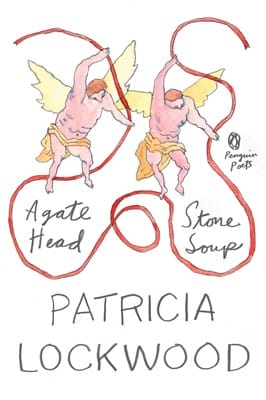
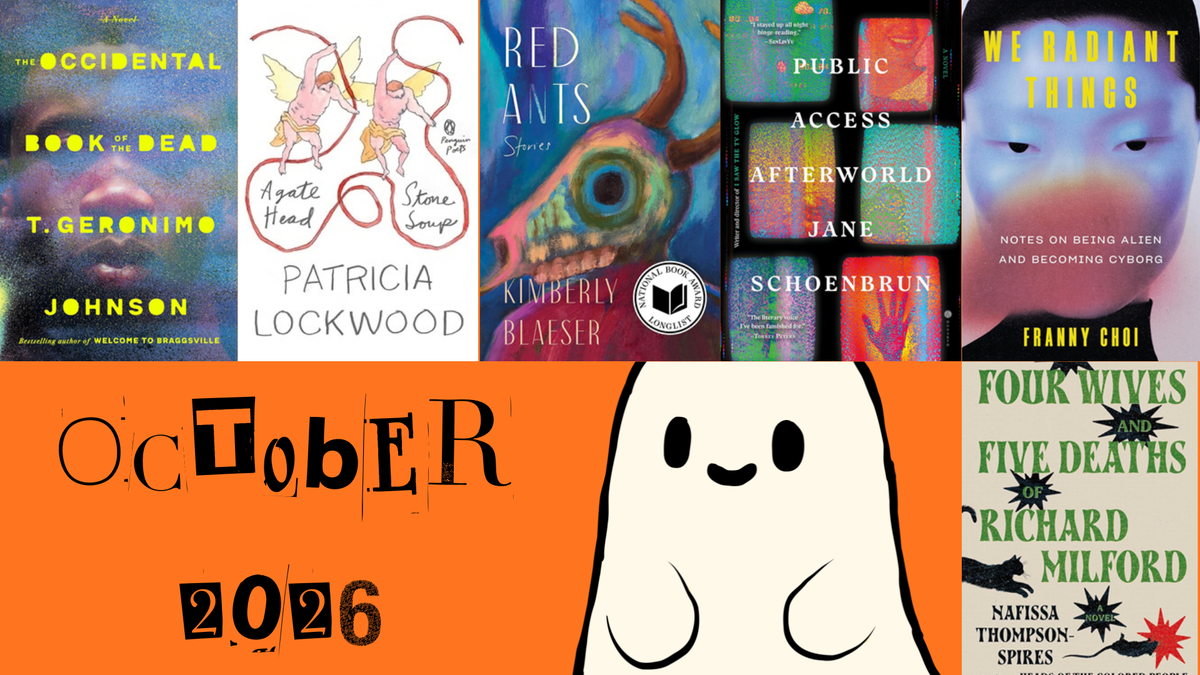
Agate Head / Stone Soup by Patricia Lockwood
Oct 6 | Penguin Books | 160 pages
This double feature collection is Lockwood’s return to poetry for the first time since Motherland, Fatherland, Homelandsexuals (2014), and comes at the heels of back-to-back successful novels, the Booker Prize finalist No One Is Talking About This (2021) and Gabe Hudson prize-winning Will There Ever Be Another You (2025). Lockwood explains in the introduction that this return to her genre of origin was precipitated by an immersion in Sylvia Plath for a London Review of Books essay, and an exodus from the internet, which meant, “I was hearing my own voice in the morning before it was crowded out by a hundred others.” The internet’s loss is poetry’s gain. The collection intersects with Will There Ever Be Another You in content, which is to say both tread the ground of Lockwood’s most entrenched subjects of consideration: rocks, literary geniuses, illness, her family. In “5-600 Dollars’ Worth of Fine Olive Oil,” Lockwood describes her father’s newfound penchant for drinking expensive olive oil. (Readers of her 2017 memoir Priestdaddy will recall her father’s refusal to pay for his daughter to go to college.) “The whole house glitters with my education. / Guitars, stair-climbers, ‘custom lingerie / From Connecticut,’ terriers descended from / Toto, mandatory, the $40,000 piano,” Lockwood writes in the poem, an anthem for Millennials living like a mouse in a matchbox eating eating ramen noodles out of an old shoe whilst watching Boomer parents hoard wealth, jobs, and housing. It's a brilliant double collection demonstrative of profound maturity in both technical skill and emotional relay, and conversational enough that it's an easy entry point for those who don't typically read much poetry. You can read Lockwood's poem "The World" on the LRB website and "Sensual Songs for Eight-Year-Olds" on LitHub. —Lisa
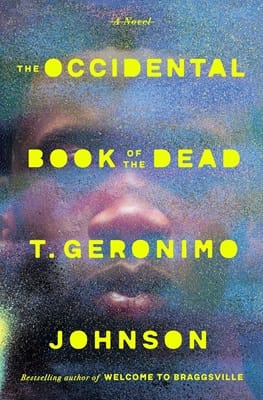
The Occidental Book of the Dead by T. Geronimo Johnson
Oct 6 | William Morrow | 672 pages
Suspenseful metafiction is one of my favorite subgenres, and the excited comparisons of this book to Percival Everett, Susan Choi’s Trust Exercise (2019), Ralph Ellison’s Invisible Man (do you really need the Bookshop link to Invisible Man? You can get Invisible Man anywhere. I could walk outside my apartment right now and look to the right of the dumpster, like on the northwest side of the dumpster, and there’s gonna be a copy of Invisible Man laying on the ground), Colson Whitehead, and many others are intriguing, along with examples of the striking, uncanny wordplay that goes into Johnson's worldbuilding of an off-kilter reality (you had me at the setting, Atlantis, Gorgeous). It addresses American anti-Black racism through what seems to be an alternative 1990s-2000s and the life of a Black cop (“peace officer”) named George Washington Jonson. The book pulls a second-act “different version of these events,” a device that can be exhilarating when it works well. Creepy, confounding, socially relevant, provocative, nearing 700 pages—The Occidental Book of the Dead looks to be all of these things and more. —Elisabeth
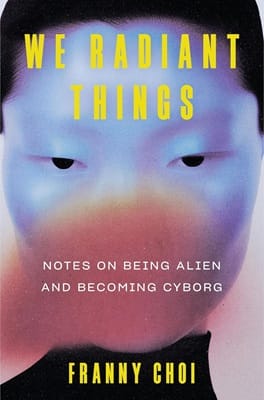
We Radiant Things by Franny Choi
Oct 6 | Ecco | 192 pages
In this essay collection, poet Franny Choi puts the “creative” in creative nonfiction with a veering-towards-multigenre examination of the relationship between robots and East Asian women in American pop culture. In the spirit of the book itself, which among other things looks at the ways Asian Americans have historically had to perform “humanness” for white society, I’m loath to make any ingratiating effort to sell this beautiful work—relevant enough to the experiences of East Asians in the West to also be relevant to anyone who sees us as relevant—as “universal,” but I will say this: We Radiant Things’ seemingly niche subject is a subtly drawn hinge on which the world turns; it has haunted me my entire life, and it should haunt you too. And you know what? That’s all I’m going to say. To find out more, read my review, coming soon. You can also find a sample on the publisher’s page. —Elisabeth
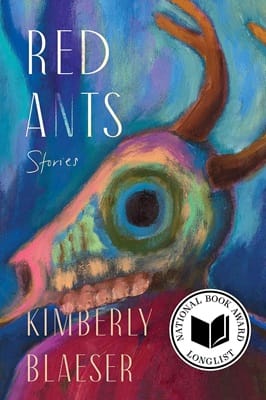
Red Ants by Kimberly Blaeser
Oct 6 | Counterpoint Press | 272 pages
I was so pleased to see this one show up on the National Book Award’s longlist! Blaeser is Anishinaabe, and an enrolled member of the White Earth Nation, and the stories in this collection capture reservation life from a realist perspective (including incidents of environmental encroachment, addiction, harassment from law enforcement, as well as tribal ceremony, customs, relationships, etc.), and through various lenses of genre. In fact, it is almost infuriating how easily Blaeser tries on different genres and themes: “River Dreams” is a pitch perfect noir murder mystery about corrupt authorities; “The Making of Monsters” is action-packed climate fiction about the Mishibizhii, a panther river monster that dwells in Lake Superior; the title story is a pitch-perfect coming of age. “Translation for Dummies,” only four pages and written from the perspective of a dog, is an exemplary piece of craft they’ll be teaching in writing seminars ten years from now. In a starred review for Red Ants, Booklist writes, “Blaeser is an artist at the height of her craft.” Couldn’t agree more. —Lisa
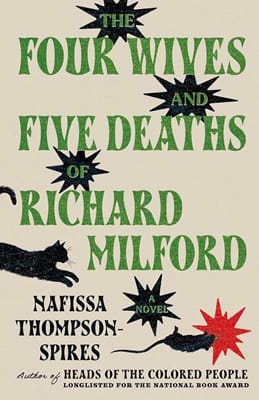
The Four Wives and Five Deaths of Richard Milford by Nafissa Thompson-Spires
Oct 6 | Scribner | 176 pages
Nafissa Thompson-Spires’ story collection Heads of the Colored People (2018) was a finalist for the National Book Award and the winner of multiple other awards. Her debut novel promises to be explosive, and not just because of the cartoon violence on its cover. The Four Wives and Five Deaths of Richard Milford follows conflicting accounts of the demise of the title character in the 1920s, a man who struck it rich when he found oil on property he inherited in an all-Black town in Oklahoma. Four women he was involved with (including the one he was actually married to) and his cook all say they tried to kill him, putting a bizarre spin on the usual circumstances of a murder mystery. Set in a time and place heavy with history, not long or far from the Tulsa Race Massacre, this book, according to Publishers Weekly, “is enriched by commentary on capitalistic excess and male chauvinism, and by its exploration of the limits of individualistic social theories put forth by such Black leaders as Marcus Garvey and Booker T. Washington.” —Elisabeth
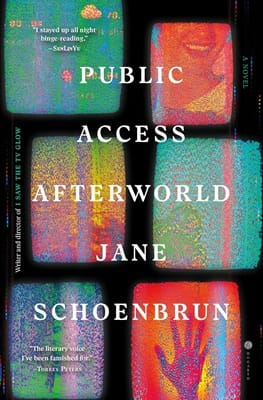
Public Access Afterworld by Jane Schoenbrun
Oct 27 | Hogarth | 608 pages
I’m dying to read this book. This is Jane Schoenbrun’s first novel, after the resounding success of her films I Saw the TV Glow (2024), a psychological horror story about trans identity, and more recently, Teenage Sex and Death at Camp Miasma (2026). The book revolves around a television station that is rumored to be broadcasting from an alternate dimension. A timeline set in 2009 follows a pair of teenagers who have tapped into the channel before one of them disappears. A second timeline in 2026 revolves around a trans woman who finds evidence pertaining to the disappearance and investigates. It sounds, like Schoenbrun’s films, to be a hallucinatory and terrifying trip into the unknown and the depths of the human psyche. Public Access Afterworld has shown up on a ton of “most anticipated” lists for the year and racked up starred reviews, with Publishers Weekly calling it “a great American novel of the 20th century’s digital echoes.” —Lisa
Who Even Reads is an independent publication run by two hardworking editorial professionals. We write about books from a liberation perspective, with a socially conscious focus that's both fun and serious, covering mostly new releases. Your donations subsidize what we do. Learn about us.