Review: Camonghne Felix's Let the Poets Govern and the Scam of Representation
Felix stresses that real, substantial change isn’t instant, nor does it happen without us—without people. But real change is happening, will happen, must happen despite the liberal cynicism and fear that will tell you it isn’t, won’t, can’t.

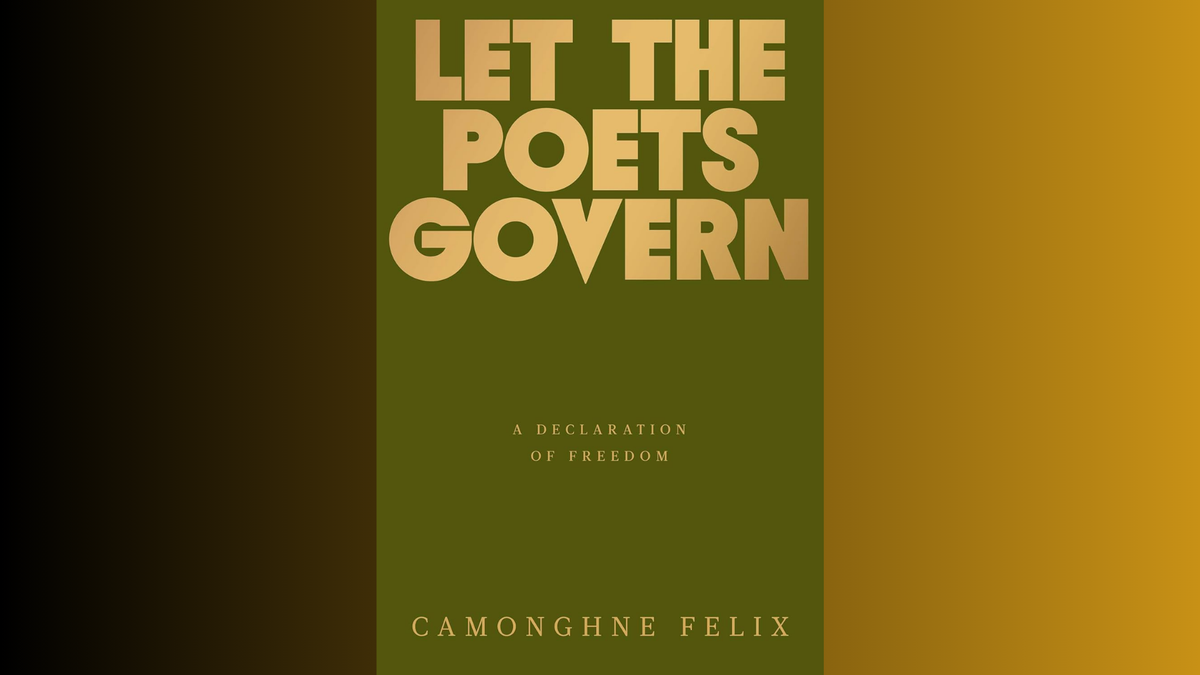
Judging from its title, Let the Poets Govern by Camonghne Felix has the air of a revolutionary text. A reader might expect it to be a forthright call to action with clear specifics about how to dismantle our current society and build a new, better, kinder, more sustainable one. It is these things and it isn’t—or it is, but not necessarily in the way you might expect.
In this book, Felix, a poet who worked as a speechwriter for Andrew Cuomo and on Elizabeth Warren’s presidential campaign, explores her reckoning with the hypocrisy of the Democratic Party and in particular its endorsement of Palestinian genocide, her upbringing and Grenadian family history, the onset of her understanding of systemic antiblackness in the United States and elsewhere, her education via Black poetic tradition and radical Black thought, and her experiences with political organizing, among other topics. She begins this exploration with her participation in protests following the killing of Trayvon Martin, then the murders of Michael Brown and Freddie Gray. Felix reflects on how she could not reconcile continuing state-sanctioned violence against Black Americans with the supposed value of representation politics, with the idea that President Obama’s election was a win for Black people and a progressive agenda. Throughout the book, she focuses on two main ideas: the necessity of moving outside the established structure of power in order to change it, and the power and utility of poetry.
Felix examines the role of poetry and poetics broadly, citing relatively contemporary poems (including ones by June Jordan, Mahmoud Darwish, and Gwendolyn Brooks), the legacy of the African American lullaby, the racist history of the “Eenie Meenie Miney Mo” nursery rhyme, as well as political rhetoric and legal documents, such as the 1452 and 1455 papal bulls, which essentially “authorized” the colonization of West African territories and the enslavement of their people. One of her key assertions is that poetry itself is neutral, that it can be harnessed for all kinds of purposes. Her argument reveals something hidden in plain sight: poetry isn’t called “poetry” when it’s being used by a government, when it’s being used by institutions for the purpose of power declared to be self-evident and God-given. But it can be called this when it’s being used by the people those in power want to paint as small and insignificant, as wielding only art and theory and ideas that have no real-world value. Hired by Cuomo’s office because she was a poet in what appears to have been a cynical PR move, Felix felt condescended to and not taken seriously. Her role had clearly been designed to be an insignificant one with built-in limitations.
Possibly my favorite part of the book is when Felix tells the story of how, during her first year of high school in the Bronx, she became disillusioned with the educational system and began skipping class on a regular basis. This isn’t a story of consequences but of freedom. At DeWitt Clinton High School, where enrollment is majority Black and Hispanic, and where Felix describes students being heavily policed by security staff in an overcrowded and underfunded environment, she became fast friends with a girl who convinced her to slip out in the middle of the day. The girl asked her what she would most like to be doing right then, and Felix told her that she would like to be eating a bacon, egg, and cheese sandwich in the sun and talking about the boy she was dating. I was struck by the detail of this question being asked and the answering, that the girls didn’t just skip school because they didn’t want to be there but that one asked about and the other considered what she would most like to be doing, and that this thoughtful collaboration constituted an infraction, truancy. I was also struck by Felix’s curiosity about life outside at a time of day when she was supposed to be inside: “I didn’t know what the world was like during these hours I never got to see.” Describing the subsequent escape and how this escape became routine, Felix writes:
“By our own will, we were let free into the void of the world-at-noon, where we could be real people among real people … We were the kinds of kids that some people called bad kids, but we had no shame about our delinquencies, no shame about having escaped. We lived in the fullness of life, outside time, and became who we were going to become under the slow certainty of day.”
This experience she describes is specific to her rejection of the particular parameters she was placed into as a Black teenager, and it reflects how institutionalized education is an arm of the carceral state, how it is in the business of denying autonomy to Black kids in particular as part of the legacy of institutionalized slavery. Elsewhere in the book, Felix examines the language and history of American policing—how it was born from slave patrols, populating structures created to enforce systematized enslavement.
Felix describes the American education system as “[conventionalizing] institutional harm and the radical loss of sovereignty that all students must undergo to be in line with the institution, to be in the good graces of the institution in order to receive, in return, more access to the institution and the optimisms it draws us toward.” This assessment is apt, but I was most affected by her portrayal of its reality through her own teenage memories, which bring to mind the overwhelming, viscerally numbing feeling of being a young person trapped in a classroom on a beautiful day. This highly relatable experience powerfully draws attention to the institutionalization of the mind and the body and the essentially forced but often willing complicity of adolescents. How we are all taught early on to ignore our most basic needs and desires.
When I was in high school, I was positioned to be the type of student who, at first glance, could have been (and probably was) used as an example of a good, lucky kid with a bright future, pitted against students like Felix and her friends: Asian, well-behaved, quiet, attending a majority white school in the suburbs. But while I benefited from and enjoyed some aspects of a well-funded education, I was not a grateful or happy student, and I was always aware, on some level, that the system functioned not for me but for itself. I went to college—for poetry—but dropped out. I understood later, as an adult, that the reason why poetry had turned to dust in my hands, the reason why I had never been able to settle into academia, to find a mentor, is that no one had taught me about power. I was shunted into what those around me considered a very good liberal arts education, but it was lacking in a real understanding of what literature could do between people, what it could do between me and the world. It was learning about my relation to power, to history, that helped me begin to understand what the point of language could be, that made me a real reader and a real writer. It was understanding what it meant not just to be, for example, queer or Asian, but to be a part of these communities and their roles in historical and contemporary society—how to be queer isn’t just to have desires that run counter to the norm but to be seen as threatening heteronormative expectations that many people’s comfort depends on, how to be Asian in America isn’t just to come from a certain ethnic background but to have whiteness try to weaponize you against Blackness, a phenomenon that has historical precedents in exclusion and in slavery.
As Felix demonstrates, there is a lot of resistance against this kind of exploration of power and identity, this kind of understanding of oneself in the world. Part of the problem with a politics of representation is that it is blunted on all sides; representation stands not as a point on a map that fills in part of a picture, but as an end in itself. The system promises that it will manufacture change, that only it can do this, while also suggesting that the truer idea that change comes from within people is a hoax. Felix stresses that real, substantial change isn’t instant, nor does it happen without us—without people. Change, she suggests, is sold at the price of submission to institutions, to larger frameworks—and even then it’s a scam, results never materializing, as those frameworks are self-serving, themselves antithetical to change. But real change is happening, will happen, must happen despite the liberal cynicism and fear that will tell you it isn’t, won’t, can’t.
Because Let the Poets Govern is written from a very personal perspective, and because it connects so many threads, some readers may feel that it skims along the surface of its subjects. But Felix is putting her own understanding on display, demonstrating, in bits and pieces, how she has learned to interact with the world through poetry and her own mind. The book is straightforwardly informative and accessible, and parts of it read as standard narrative nonfiction, but it’s also a multi-genre work with an intentionally conceived structure. Chapters end with erasure poems created from legal and political documents—the 1740 South Carolina Slave Code, No Child Left Behind, the British White Paper of 1922 on Palestine. These are texts that have done real damage, had real, devastating effects on people’s lives, and they have been able to do so because of the power presumed to exist in them.
Felix’s erasures are a form of interaction with that power and of reclamation, and a form of redefinition. They transform the original texts and incite them to do things they were never intended to do. They break poetry out of the box where poetry is meant to remain, to exist as only that which is already labeled “poetry.” In a recent interview with Electric Lit, Felix said, “I try to introduce people to poetry, not as a thing that you do, but a thing that you engage with and observe.” The idea that poetry can connect a person to others, to themselves, and to the world, rather than existing only—as is popularly conceived—as a neat, condensed extraction of one’s own experience, something taken from the world, is on abundant display here, and continues to echo beyond the book’s pages. If Let the Poets Govern doesn’t include precise or prescriptive directions, it’s because it strives to sharpen one’s understanding rather than dictate or assume. It’s a “teach a man to fish” document. It’s a work for this moment in time that, unlike much else about this time, seems likely to continue to resonate in the future.
Who Even Reads is an independent publication run by two hardworking editorial professionals. We write about books from a liberation perspective, with a socially conscious focus that's both fun and serious, covering mostly new releases. Your donations subsidize what we do. Learn about us.