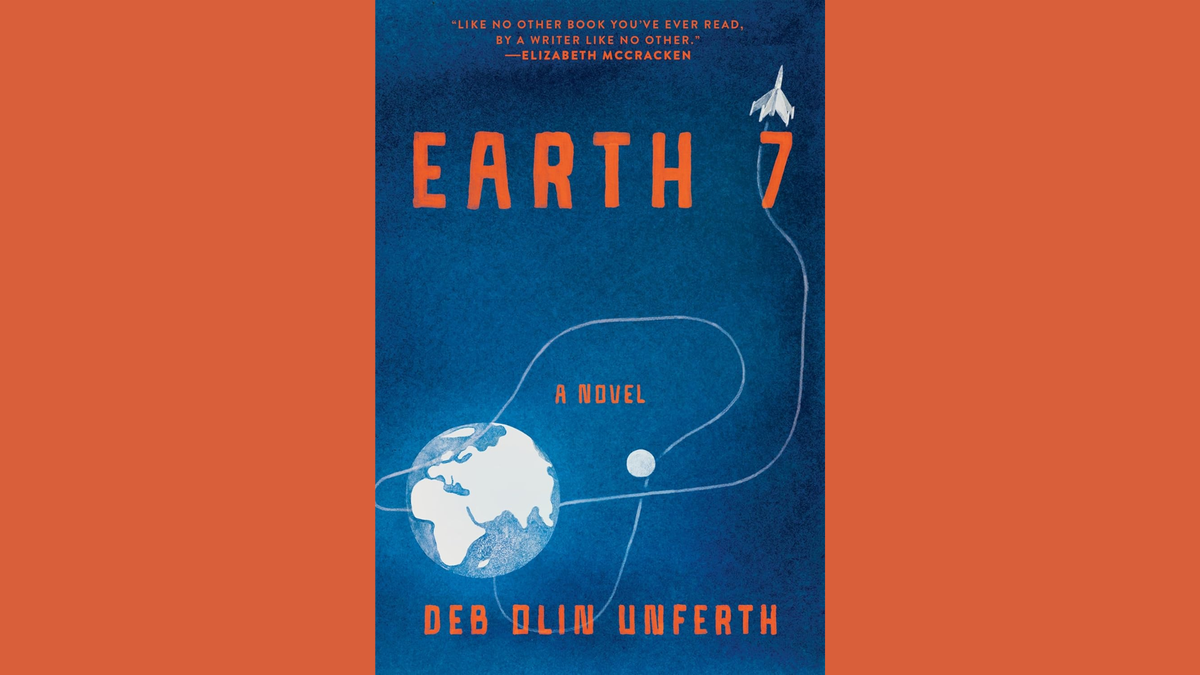
Review: A Shot of Urgent Hope in Deb Olin Unferth's Earth 7
Earth 7 really sings in small moments that show deep respect for life, for its remarkable diversity, its endurance and durability. Unferth’s admiration for the inhabitants of Earth, its many creatures large and small, is infectious, at times exhilarating—a shot of urgent hope.

“Ah, masses. How the scientists dreamed of masses, certainly more than of gerbils or giraffes. Hordes of humans, like the anthill, only squirmy and rebellious, teeming with freedom and madness and meds. What could it have been like? To have bodies everywhere on a landscape? To have cities—like a space station, but open to the air, and to have millions, billions, of people, going in and out of doors, bumping into each other, all wandering different directions … pursuing whatever they pursued?”
This quote comes near the end of Deb Olin Unferth’s spare and opaline novel Earth 7 (publishing June 9), about a future in which climate crisis and unexplained “depopulation” events have left the world dramatically altered and minimally inhabited. A colony of Earthlings and their descendants living on Mars isn’t faring much better. We’re introduced first to Rosemary Stein, a scientist working for a facility that is attempting to catalog the DNA of every species of life that ever walked the Earth for preservation and for potential future reanimation. At the beginning of the novel, Rosemary, a rather prickly non-people person, moves into a pod deep in the ocean with her young daughter, Dylan. The relocation is permanent, and Rosemary does not seem to recognize that depriving a child of normal socialization with peers can have a detrimental effect.
As Dylan grows up and begins thinking for herself, she rebels against the isolation of her upbringing and also the futility she sees in her mother’s work—whatever Earth once was, it will never be that again, and no amount of collecting and filing away of samples of the past will bring it back to glory: “A new beginning was not on the way. The end had come and gone. She was part of the rubble.” And it is Dylan’s viewpoint, more than any other, that prevails over the course of Earth 7.
By the time she reaches adolescence, Dylan is fueled by a desperation to return to land. Her life is so wholly confined by her setting that she, and we, can easily forget the actual nature of that confinement. “I can’t just live here forever … I can’t never see Earth again,” she tells her mother, who responds, “There’s so much that humans never saw again. Everything … Anyway, this is Earth.”
But some people in this book are truly not living on Earth; Dylan meets a man online named Zee, who is living in the Mars colony. Zee also longs for Earth, and they loosely plan to make it there together, but this is not to be.
Instead, Dylan goes alone and sets out on a rather solitary life working at the lab of her mother’s employer as a groundskeeper. It becomes less solitary after she goes on an employer-enforced resort vacation and meets Melanie, a bartender, who is believed by the majority of the guests to be a robot because of her flawless appearance. She is not, however, a robot, but a flesh-and-blood human modified by experimental plastic surgeries performed while she was participating in a reality TV show. In addition to the lifts, tucks, and rejuvenating injections, the show’s surgeon installed a device in Melanie’s face that may or may not provide eternal life. It might also cause her face to explode. The uncertainty of her physical existence has made Melanie allergic to intimacy, but in the world of this book—and in this way it is not so different from our own—uncertainty is perpetual and all-consuming. Thus Earth 7 has something to teach us about living on Earth right now—that finding a way to continue living, and loving, is essential.
“Dylan had been willing to accept the deal: live in the desert in a block of concrete and steel, sweep the sparkling sand … she had no ambition, domestic or otherwise. Her one goal had been so elemental and achieved years ago: to leave the pod. But then she’d met Melanie, and now she wanted more.”
After some initial hurdles to Melanie and Dylan getting together, we follow them over a span of decades as they live in domestic harmony in a hut in the desert near the lab. Dylan, once so dismissive of her mother’s work, finds herself committed to a project that is not dissimilar, and which will ultimately bring her back in touch with Zee.
This is Deb Olin Unferth’s third novel; her second, Barn 8 (2020), is an electrifying, in some ways brutal novel that changed me. I will say without mincing words that I found Earth 7 disappointing, in part because I was expecting a similar experience—readers without that expectation may feel very differently. It’s a slower, more contemplative story and there’s nothing wrong with that. But when I began to really interrogate what I found lacking here, I decided it comes down to the fact that this is not a political book, and books addressing a dystopian future like this without reckoning with how we got there can feel incomplete. If we ever come to live in the world Unferth imagines here it will be because of white supremacy, capitalist oligarchy, and the cynicism that prevents some people from thinking they can make a difference—that prevents some of us from being stewards of the Earth, from prioritizing public health and protecting the disabled and chronically ill, from carving a better world out of the ashes of this one. Earth 7 occasionally gestures toward these precipitating causes but does not explore them in any kind of detail or place any kind of value judgment on those responsible, nor does it substantially account for the fate of people who would have resisted this new world order.
There are references to the political—frequent mentions of “the company,” a nebulous enterprise that appears to have monopolistic control over virtually every facet of public life; the allusions to “depop” events, which may or may not have been human-generated; references to the days of capitalist over-consumption; Melanie’s former reality show is obviously meant to evoke the toxic beauty standards of patriarchy. But these don’t combine to create any kind of political narrative connecting the world of the novel to our own.
That said, while Earth 7 is not political, it is philosophical. I appreciated Unferth’s illuminating, thorough examinations of different viewpoints, particularly around the concepts of preservation and nostalgia. The book takes place at a time in which Earth as we know it is not even a memory for those still living, but a memory of a memory passed down through generations. Having been born on Mars, Zee longs for an Earth he has never known, and can never know. His job involves traveling there to collect various ephemera for something more akin to a museum than Dylan’s mother’s scientific preservation. It’s not unlike the way people view eras of history they didn’t live through as the platonic ideal, such as American conservatives’ chronic fixation on the 1950s–1960s, which conveniently ignores the wars, social unrest, higher taxes, and greater government oversight these eras were defined by.
While the book doesn’t deliver on the political message I was looking for, it comes through in its depictions of the redeeming nature of human relationships, and its profound respect for the great projects of humanity—past, present, and future. It asks deep, unanswerable questions about what life is and what is worth maintaining. Is life consciousness? Even if that consciousness has no body to live in, for example, or no means of communicating with other consciousnesses? Dylan thinks, with borderline derision, that, “Her mother believed in life, the abstract concept, not lives, the individual entities.” Having lived through what we might call an apocalypse, her mother’s belief system is understandable. Earth 7 asks the reader to consider this dichotomy carefully, to examine their own prejudices in favor of one or the other.
As in Barn 8, Unferth captures the dynamism and sheer joy inherent in the lives of creatures that some of us might deem small or insignificant in comparison to the human animal, as in this description of the tardigrade:
“Desert tardigrades come out of tun like Superman ripping off his glasses. They get busy immediately. They meet, fuck, have babies, live, in a matter of a day. And in their brief window of frantic, ecstatic activity, they feel all the joy and pain of any other creature ... Desire, wonder, fear—the desert tardigrades would say they know them all, or their own private Idaho of them.”
This is where Earth 7 really sings—in these small moments that show deep respect for life, for its remarkable diversity, its endurance and durability. Unferth’s admiration for the inhabitants of Earth, its many creatures large and small, is infectious, at times exhilarating—a shot of urgent hope. This book might not restore your faith in humanity, but it will restore your faith in the value of having faith, which may be the first step in determining what is worth preserving and what can be left behind in the old world.
Who Even Reads is an independent publication run by two hardworking editorial professionals. We write about books from a liberation perspective, with a socially conscious focus that's both fun and serious, covering mostly new releases. Your donations subsidize what we do. Learn about us.