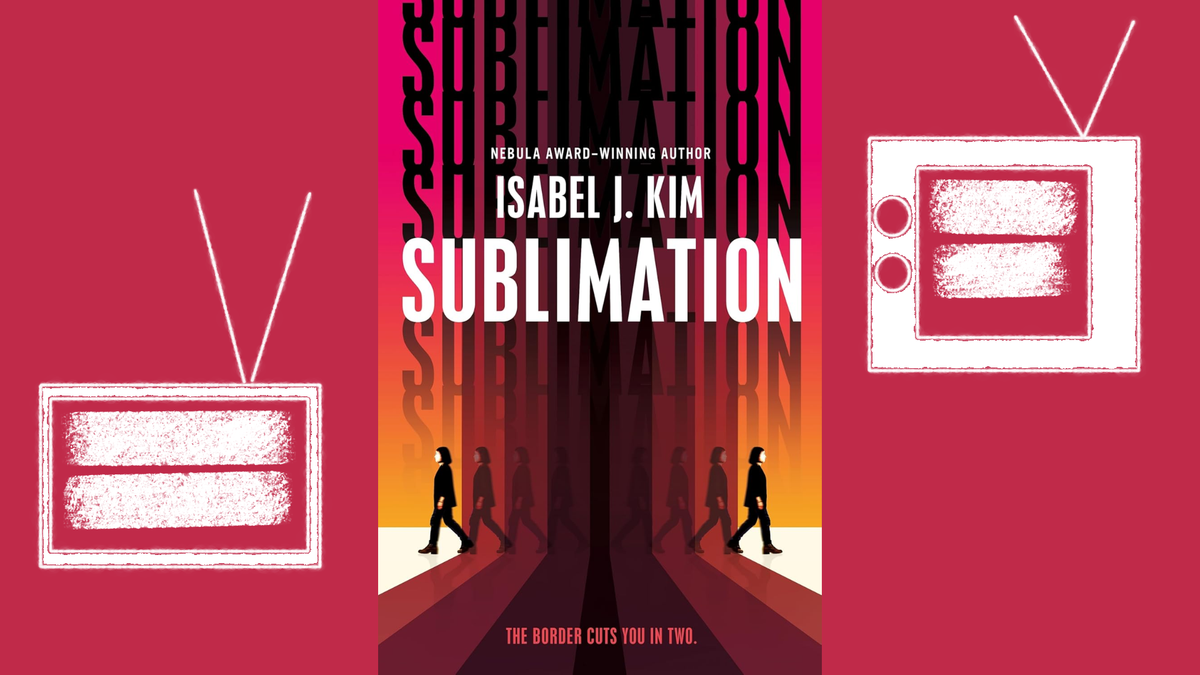
Sublimation by Isabel J. Kim and Wild Speculation on Universal's TV Adaptation
Every detail and plot turn in Sublimation is clearly part of a meticulously well-considered arc. I’m very curious what the adaptation will be like. Whitewashing would be a disaster in this scenario, given the significance of instancing as metaphor for diaspora.

A practicing lawyer, debut author Isabel J. Kim began collecting acclaim in the early 2020s for her short fiction: a Shirley Jackson Award for “You’ll Understand When You’re a Mom Someday” (2021); Nebula, Locus, and BSFA Awards for “Why Don’t We Just Kill the Kid in the Omelas Hole” (2024); and most recently “Wire Mother” (2025) was a finalist for the 2026 Locus Award for short fiction and the Hugo Award for best short story (the Hugo Awards will be announced August 30, 2026).
Thus it is not a great surprise (though still pretty remarkable) that she reportedly scored a seven-figure deal from Tor for publication of her first three novels at a competitive auction. Nor is it a surprise that the first of these novels, Sublimation, has attracted widespread attention in the months before its release. Nor is it a surprise that it's fantastic.
Sublimation’s plot centers on the concept of “instancing”—which in the universe of the novel is the term for what happens when a person leaves their country of origin, sometimes temporarily, sometimes permanently, and splits into two versions of themselves. One version goes forward, to the person’s destination, while the other stays behind. We learn that the probability of instancing when traveling is unpredictable, but that it is rooted in psychology, and in yearning. A person is most likely to instance if they do not believe they will be returning to their origin point, don’t want to, or if they feel ambivalent.
We first meet Soyoung, a twenty-nine-year-old Korean woman living in Seoul, whose instance is living in New York City as Rose, having moved to the US with her mother when she was eleven. Soyoung calls Rose and invites her to Seoul to attend the funeral of their grandfather, at his behest. While awaiting her arrival, Soyoung tells her best friend, Yujin, that she wants to ask Rose if she would be interested in reintegrating. An instance and her original self can be reintegrated through physical contact, even accidentally, and we learn that a tech company called Mergebreak has made a fortune inventing a bracelet that prevents this from happening. We also learn that Yujin has his own instance in the US, who goes by YJ, and that YJ works for Mergebreak.
Rose comes to the funeral and experiences a great deal of existential confusion about being back in Seoul, among family and friends she either barely remembers or doesn’t know at all. Being a Korean person in Korea is a foreign experience to her, and this aspect of instancing is of course analogous to the way many people living in diaspora feel upon returning to a place they once lived, or have only lived via a family member’s memories (a subject we discussed at length in our interview with Kenan Orhan, author of The Renovation). She is a stranger in a strange land, yet not a stranger at all—to leave and then return inevitably brings with it the feeling of uncanny valley. This is a book about assimilation and what it does to even a willing participant.
After the funeral, Soyoung becomes carried away by the prospect of merging with Rose and grabs her impulsively, forcibly reintegrating with her. Now narrating as Soyoung-Rose, she immediately regrets doing so. In the days that follow, she happens to see YJ on a TV news broadcast about a new technology his employer is preparing to release called Mitosis, which can separate two instances after they have merged. On a whim she flies to New York to ask YJ if he can get her into a clinical trial for Mitosis so Soyoung and Rose can separate.
After the inciting incident, chapters alternate between Soyoung-Rose, Yujin, and YJ. We learn that after Yujin instanced to attend college, the two versions of his self concocted a plan to eventually reintegrate—after YJ had acquired dual citizenship in both Korea and the US, because this would make him exempt from his otherwise mandatory term of service in the Korean military. But when Soyoung-Rose arrives in the States to seek out YJ’s help, she learns that he is having second thoughts, that he’s no longer sure he wants to become Yujin again, or for Yujin to become him, adding a further wrinkle to the web of bodily autonomy involved in this concept. Both versions have free will, they both have rights. But it seems obvious the version who stayed behind would feel like the “original” person, the most important person, the one who should get to decide.
With its tachycardic pace and largely straightforward plot structure, Sublimation has the hallmarks of a typical thriller, but it is deceptively political and unapologetically philosophical. In the novel’s second half, we learn that Mergebreak is not only releasing Mitosis as a product for purchase, they also have a contract with the government to put Mitosis machines in every airport in the country. Soyoung-Rose realizes immediately, with horror, the implications of state control over instancing: the government could wipe the phenomenon from the face of the earth in a second.
Thus Sublimation becomes a taut, elliptical story about autonomy and borders, about how the state will always yearn for power over that which it can never control—a person’s deepest desires, clandestine movements, aspects of identity. It’s easy to imagine what might happen if instancing existed in our world. In the US, if the current administration were in power, it’s likely that immigration would cease entirely; perhaps the borders would be permanently closed even to international travelers.
Every detail and plot turn in Sublimation is clearly part of a meticulously well-considered arc. Kim is the kind of author who makes you want to discuss her “craft” and “skill,” who makes you want to ask her a barrage of questions about how she did this. The novel is compared to the Apple TV show Severance in its marketing materials, but it is far from derivative, and in fact the concept behind this book is even more compelling than that of the show (which I enjoy!).
The careful crafting of the universe includes interludes featuring cultural and literary theory in which the narrator remarks on the significance of instancing in books, media, and myth, a fun means of integrating this phenomenon more fully into the world of the novel, and making that world more immersive for the reader. We learn, for instance, that the Bible says that Adam and Eve instanced when they left the Garden of Eden, that Odysseus “does not instance leaving Troy, though he instanced when leaving Ithaca,” that, “The oldest reference to instances is a line in Hammurabi’s Code translated as the foreign brother-self will receive no inheritance.”
Shortly after Kim’s contract was signed with Tor, Universal picked up the TV rights, at another competitive auction. I’m very curious what the adaptation will be like. Kim is signed on as an executive producer, suggesting that there will probably at least be one voice in the room arguing to hew closely to the source material (although Lindy West along with other authors who have EP’d shows based on their books will tell you their input is often ignored). The book is very Korean in focus, with the first few chapters set in Korea, among largely Korean-speaking people. Whitewashing would be a disaster in this scenario, given the significance of instancing as metaphor for diaspora. With the immense popularity of Korean cultural products in the United States over the last several years (skincare, K-dramas, K-pop, etc.), I feel reasonably confident the studio and showrunner will maintain this focus, even if they limit the Korean dialogue and Korean-specific cultural references to some degree.
With Universal owning the rights, the most likely streaming service is Peacock, but they could choose to sell to Netflix or Amazon Prime, both of which have a solid history when it comes to high-concept science fiction. I could see Sublimation being stylized in a similar way to the first season of Prime’s Mr. & Mrs. Smith series. Netflix has swung big with shows like Black Mirror and Sense 8 but both of these have had their problems and Netflix has also produced some serious duds in the genre. As far as casting I could see Justin Hong-Kee Min (Ben from The Umbrella Academy) playing Yujin/YJ. My first choice would be Wi Ha-joon from Squid Game and Little Women but he may not have the English fluency for YJ. For Soyoung/Rose I would pick Ji-young Yoo or Yerin Ha. I loved Ha in Bridgerton and I think she is probably capable of the more subtle range of acting Sublimation will require.
It’s kind of funny that the central conflict in Sublimation becomes preventing government institutions from gaining the ability to eliminate instancing entirely: “Imagine a world without instances. A world where leaving is perfect absence, where there is no ghost left behind...a world where desire doesn’t matter, where there is no blunt knowledge of the implicit truth of the human heart.” Instancing is a form of self-knowledge, and the characters in the book are appalled at the notion of living as we do, without that knowledge, without the ability to become someone else. As a practical person, Yujin/YJ’s story in some ways intrigued me the most—he’s gaming the system! He uses instancing to maximize his personal achievements and avoid military service. But the trajectory of this part of the story, and Soyoung-Rose’s journey, demonstrate that there is no accounting for free will. One emerges from Sublimation not quite sure whether to heave a sigh of relief that instancing isn't real or to pine for a plane of existence where a vacation always has a chance of becoming permanent.
Who Even Reads is an independent publication run by two hardworking editorial professionals. We write about books from a liberation perspective, with a socially conscious focus that's both fun and serious, covering mostly new releases. Your donations subsidize what we do. Learn about us.