Names Have Been Changed by Yu-Mei Balasingamchow Explores One Woman's Lonely Version of "Be Gay, Do Crime"
Balasingamchow’s novel speaks to realities of queerness, marginalization, criminality and criminalization, of what not being able to live openly or straightforwardly does to a person and perhaps can’t be—or doesn’t need to be—undone.

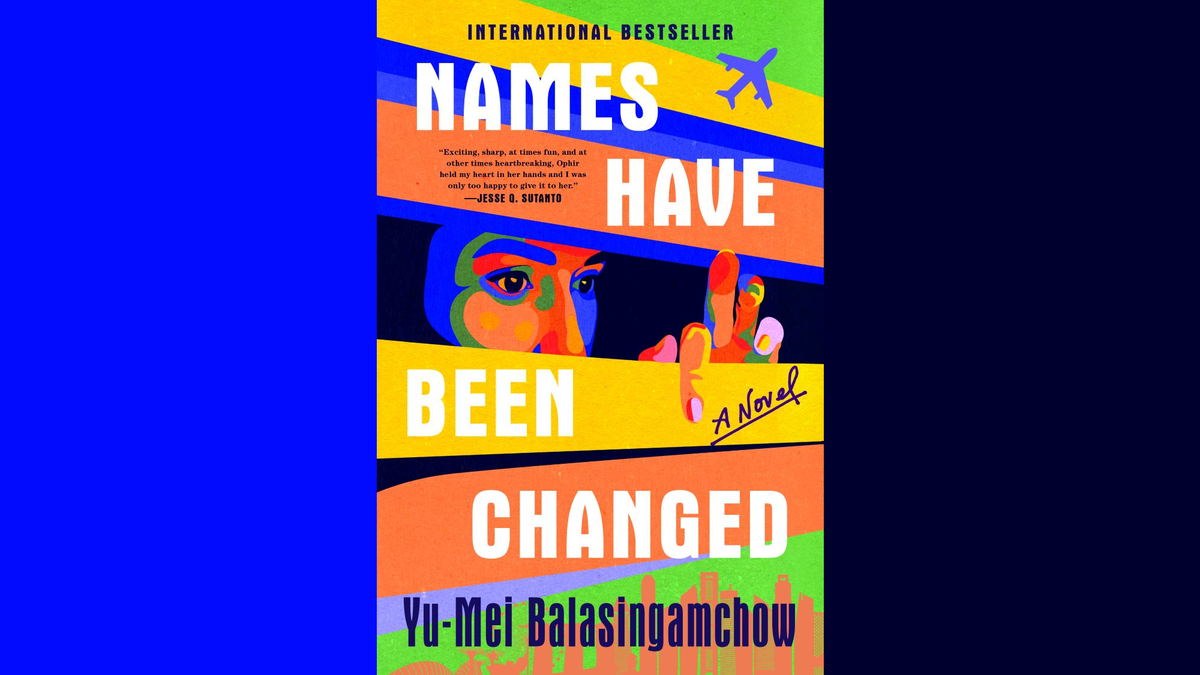
Names Have Been Changed by Yu-Mei Balasingamchow is, from the outset, a fun book. The main character, who refers to herself as Ophir but makes it clear this isn’t her real name, tells her unusual life story via a podcast she’s recording from an unknown location during the lockdown stage of the Covid pandemic in 2020. The colorful tone of her narration and her easy knowledge of world travel at first lend her a certain romantic allure. But her story isn’t a romantic one, even though the trouble Ophir initially got herself in that set her off on a globetrotting journey was born of a semi-glamorous idea: a desire to fund a lifestyle of luxury and ease, if only in the short term.
She tells her audience briefly of her youth in Singapore, and how she got caught up in a money laundering scheme with her best friend that she didn’t admit to herself was criminal until it was too late. Upon learning that her arrest was imminent, she immediately skipped town, severing all ties with friends and family—perhaps most significantly with her brother Jacob, whom she communicated with after that only in short bursts via non-traceable emails to let him know she was safe. This event set the tone for her life, an existence on the run from the authorities, to Tokyo, and London, and elsewhere, of assumed names and menial jobs in different parts of the world, of pretending, with the help of her talent for accents, to be anything but Singaporean, to be anything but herself.
Ophir's fugitive reality is full of everyday dreariness and loneliness, as her contact with others is by necessity mostly limited to casual sex and job-related interactions, with the main exceptions being a coworker she falls in love with early on and an employer who becomes a close ally. But her story is exciting to read, and she’s an entertaining, engaging narrator. Names Have Been Changed doesn’t quite have the car wreck appeal of something like the TV series Euphoria, with the high-risk/high-payoff lifestyles its characters misguidedly attempt to dabble in, nor does it have the sleek assurance of a morally gray character like Tom Ripley, or, to mention a more recent literary example, the covetous calculations of someone like Tara in A Splintering by Dur e Aziz Amna. What it does have is some of the appeal of these types of stories mixed into a more likeable and relatable protagonist.
Because far from being the jet-setting international criminal you might expect in a suspenseful story about a woman with a questionable past, Ophir is a kind of everywoman, a person of the people. She’s flawed, hapless. It’s exactly because she was naive in her youth and aspired to the ideals glorified in movies and television all around the world that she finds herself resigned to a lifetime of working in kitchens and the like. She’s bisexual, she’s multiracial, and aren’t we all—just kidding, but in a certain statistical sense the true everywoman is probably a queer service industry worker of global majority heritage. While Ophir’s story itself may be unusual and retain a gloss of adventure, her daily experiences align with those of racially marginalized immigrants. Her everyday life and relationships with others are shaped by work. Her immediate concerns are things like having enough money, getting medical care, avoiding encounters with the police.
As you probably know if you’ve been following Who Even Reads, we’re very interested in the interactions between literature, the publishing industry, and the past and present of the ongoing pandemic, and we aren’t the only ones. A recent piece by Morgan Leigh Davies in Current Affairs addressed the shortcomings of literature in this area, observing that “COVID has primarily been represented in fiction as an emotional problem, not a sociological or medical one.” Davies makes it clear that this is in part a failure of publishing to represent marginalized experiences—those of essential workers, for example, or of people living with Long Covid.
It’s interesting to view what Names Have Been Changed offers in this regard. Ophir has to work “at a job that wants me there every morning, even in the midst of this blasted pandemic when we barely know anything about the virus that might kill us” (with the larger context being it’s still a job she seems grateful to have), a perspective that diverges from fiction mainly concerned with the tedium of lockdown. As she narrates her life, she frequently references someone named Tina, who is eventually revealed to have played a more significant role in her story than she at first lets on. Tina, we are led to believe, is resourceful and savvy when it comes to the logistics of security, and she continually helps ensure Ophir’s freedom and survival. She is one of the rare people who really knows and cares about Ophir, which is shown through how in addition to keeping her safe from discovery by the authorities, she keeps her safe from the virus, providing her with respirators and insisting that she take precautions. We see Tina’s mind at work, how she understands breaking a chain of transmission in the same way she understands covering one’s tracks with a burner phone. Her seriousness reflects the belief that it is possible and worth it to think hard and make sacrifices to protect someone, to have standards for what people can do to keep each other safe, even as Ophir and other characters may not always care so much about their own safety or comprehend what is necessary to protect themselves.
Ophir’s story suggests that people make their own choices within a vast network of light and darkness, but that there isn’t necessarily a moral weight to the clarity of light or the obscurity of darkness, as we are often encouraged to believe. Despite her occasional longing for a world in which she made the “right” choice to serve her time in prison—a world in which she would still be home in Singapore, living a simpler, open, and publicly approved life—it seems unconvincing that this decision would have been a clear-cut good, for her or for anyone.
Names Have Been Changed reminded me a little of Wong Kar Wai’s Happy Together, about a gay couple with a rocky relationship from Hong Kong visiting Argentina, where they become temporarily stranded after having broken up and run out of money. It’s a gorgeously shot film featuring young, beautiful people adrift in the world, focusing on relationships and directionless early adulthood, but like Names Have Been Changed, it also shows how easily material circumstances encroach on one’s intentions, how much of human existence is defined by money and violence and bodies and power and physical realities and borders.
Balasingamchow’s novel explores the way hiding or repressing one’s identity can be defining, how living on the run can be both damaging to one’s sense of self and an experience that simply steers a person’s life arc in a certain direction. It speaks to realities of queerness, marginalization, criminality and criminalization, of what not being able to live openly or straightforwardly does to a person and perhaps can’t be—or doesn’t need to be—undone. Interestingly, Ophir’s queerness is one of the few aspects of her identity that she doesn’t feel compelled to repress, though it's worth noting that the question of "coming out" is relatively non-applicable to her; this contrasts with how other characters find themselves struggling to live with their sexualities in a world she has long since left behind. In this way and others, her story intriguingly probes the question of how and why a person might cultivate and even come to prefer an existence in the shadows, outside of normal society, regardless of how they got there.
Who Even Reads is an independent publication run by two hardworking editorial professionals. We write about books from a liberation perspective, with a socially conscious focus that's both fun and serious, covering mostly new releases. Your donations subsidize what we do. Learn about us.