Indie Bookstores Promoting Masking and Covid Consciousness in 2026
The trajectory of Covid awareness may not go exactly as many expect, and in the meantime, bookstores are one of the community spaces that can offer a transition point to a different possible future.


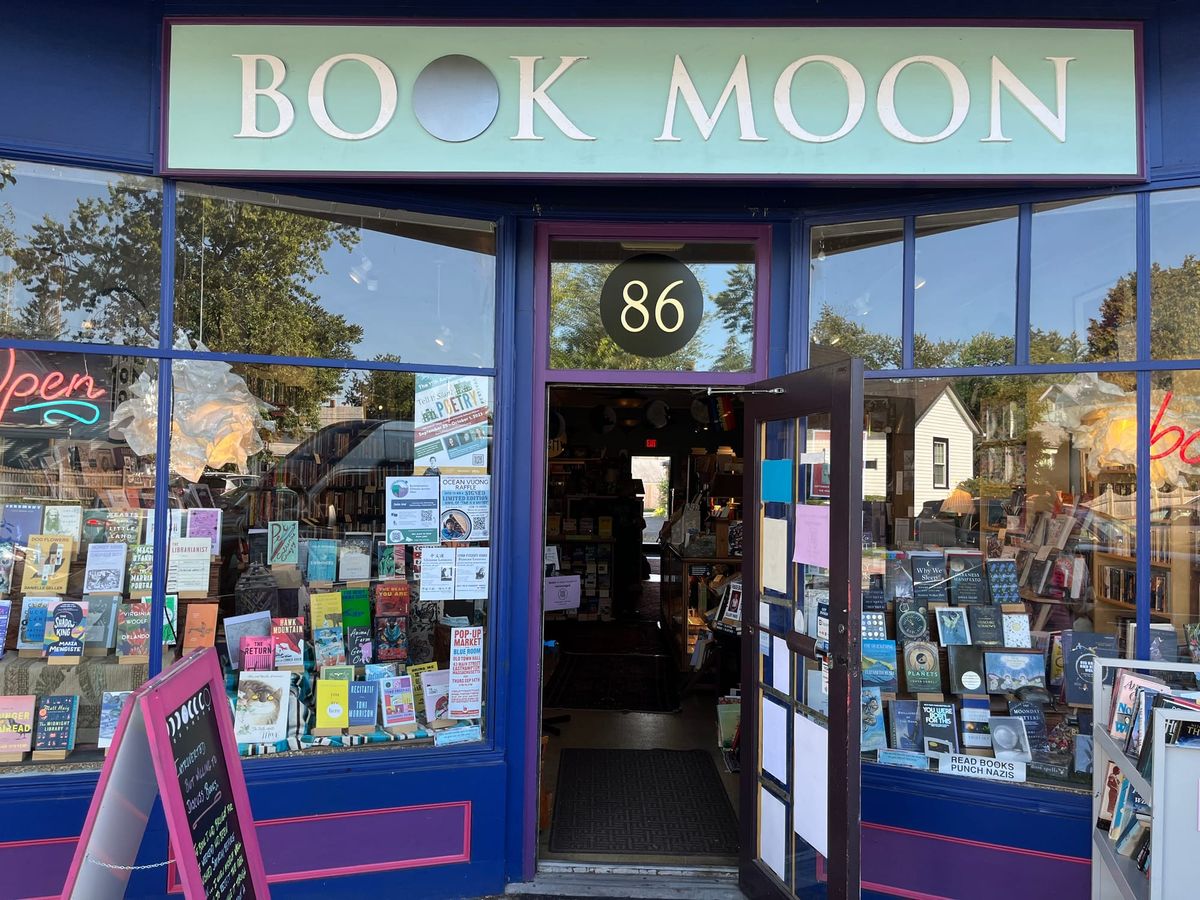
In October of 2019, just months before the Covid pandemic hit, acclaimed author Kelly Link and her husband, writer and editor Gavin J. Grant, opened Book Moon Books in a charming one-floor space on Cottage Street in Easthampton, Massachusetts. In 2021, Gavin began experiencing symptoms of what turned out to be Long Covid. In the years since then, he has been severely limited in his everyday activities. “I can do a couple of hours at the store and then am exhausted so I work from home (flat as I can possibly get on the couch),” he tells us via email. “I am not able to be on the schedule as my abilities fluctuate from day to day.”
Gavin and Kelly have continued to run Book Moon with mitigations intended to protect themselves and others from the known and unknown dangers of the ongoing pandemic. "We encourage masking as an easy method for individuals to support the common weal," Gavin says. "A good percentage of Covid-19 cases are asymptomatic so people may have the virus and unknowingly be infecting others. We have free surgical masks just inside the door and provide N95s for those booksellers who choose to wear them. Kelly and I always use nasal sprays and mask in any indoor space." This makes theirs one of a number of independent bookstores that still requires or strongly encourages masking in an effort to keep its staff and the general public safe. Recently, we searched out as many of these stores as we could and contacted booksellers like Gavin and Kelly directly to get a sense of their reasons for continuing mitigations and their experiences doing so.
We limited our search to stores within the United States, and were also limited by the amount of information we were able to find within a reasonable time frame, so we believe that the number of bookstores (and other community spaces) with masking policies and sometimes additional mitigation measures extends far beyond those that will be mentioned in this article. In communicating with booksellers, we also discovered evidence of a much higher level of Covid-consciousness and desire for health protections among the public than the overall tenor of mainstream media and prominent conversations suggests.
The Reality of Covid in 2026: Bookstores as Knowledge in a Time of Misinformation
Gavin mentions that he is one of two booksellers at Book Moon with Long Covid. “[W]e keep trying to spread the word that despite vaccinations, wearing masks, and running Corsi-Rosenthal air filters, getting Covid once can completely change your life,” he says, “... for those that come in, we try to be a respite from misinformation and a source of peace and community.”
Nialle Sylvan of The Haunted Bookshop in Iowa City shares a similar sentiment: “As a bookstore, we don’t merely have a responsibility to keep our patrons safe. We model lifestyles that are safe and healthy, and we promote good sources of information. We’ve found Violet Blue’s book, The Covid Safety Handbook, very helpful both for sharing information and for starting conversations. Our primary goals in continuing to use these mitigations are: to demonstrate how easy our mitigations are to use, to offer a safe place for those still practicing mitigation during the ongoing pandemic, and to share facts and strategies with our community.”
Bookstores, libraries, and educational institutions are expected to be fonts of information and knowledge, but this doesn’t mean that the kind of public health concern demonstrated by these sellers is the norm these days—far from it. The vast majority of public spaces, including bookstores, reflect the common misunderstanding that the Covid pandemic is over or at least no longer a real threat, though people continue to develop Long Covid at a high rate and vaccines offer limited protection. Even those who have some understanding of the dangers may still feel that there’s no point in trying to start or engage with community efforts to mitigate spread, and that the general public is never going to accept these efforts on a larger scale. Many may assume that even if some businesses and individual people are still taking Covid precautions in 2026, these actions are bound to gradually taper off, and so it isn’t feasible or realistic to expect or ask for this kind of accommodation as a member of the public, or to try to provide it to others. And we have noticed, even in the course of researching this article, that some spaces have recently relaxed their Covid mitigation policies, possibly due to a fear of losing sales.
But the trajectory of Covid awareness may not go exactly as many expect, and in the meantime, bookstores are one of the community spaces that can offer a transition point to a different possible future. The reality of the virus is being suppressed right now by government policy and media distortion, as is explained in Violet Blue’s The Covid Safety Handbook, referenced by Nialle. Blue compares current misinformation around Covid-19 to fear-driven false narratives around the AIDS epidemic, writing, “[T]he world seems to be stuck with a US CDC-led response to COVID-19. … And we know the mass disabling event of Long COVID will only amplify the scope of America’s ongoing COVID-19 disaster. Long COVID has never been a metric of the pandemic. But it must be. It’s more important than ever to understand that the US CDC represents a complete misunderstanding of public health and social contracts.”
"[P]eople are still getting sick and even dying ... We believe in science, and we believe in helping other people, and masking in the store is one small way we can bring those two beliefs to bear." —Sarah, BookWoman (Austin, Texas)
Many people are clearly not thinking of Covid awareness as something that will ever swing back in the other direction. But if we are in a middle phase now, an era where this particular reality is not in the public consciousness but will be later by necessity, it is what we do now that matters most. Current actions, like those taken by the booksellers mentioned in this article, are what will make the difference in saving and bettering individual lives, in raising public awareness, in determining how soon people who have already been disabled by Covid get the care and attention they need. And some are determined to hold the line.
Nialle, “a recreational JAMA and NEJM reader since childhood” (“yes, really; my stepmom was a doctor, and I am voraciously curious”), has kept up with newly published studies, and elaborates, “Acting on that professional, peer-reviewed information is important to me, both because of the health effects of that action and because I object to the anti-intellectualism and anti-professionalism we’re currently seeing in America. Professional organizations aren’t perfect; neither are KN95 masks; but both have done an immense amount of good. We should value the good, even when it’s not perfect. … I have had numerous people ask ‘what the off-ramp is,’ and while it would be nice to be able to scale mitigation measures up and down as needed, the lack of tracking, testing, and accessible booster shots make determining when we can scale down impossible. … It’s regrettable that the public trust in medicine and the leadership in the last year have so negatively affected perceptions of our efforts. Nobody wins in this scenario.”
Informed booksellers like Nialle are in a unique position to bring books like Blue’s to the public at a time when they are sorely needed. Many people rely on internet searches and online communities for news and information, and while these channels can connect to solid resources, they have always had their limitations, and have arguably become less reliable in recent years due to the stagnation of social media, the rise of AI content, and the spread of unhelpful and inaccurate framing of subjects like Covid in news media. Add inconsistent and confusing public health messaging to the mix and a presidential administration determined to slash medical care and other public services, and it’s possible (and has become normal) for even people who consider themselves leftists and progressives to underestimate the significance and ongoing nature of Covid as a phenomenon.
Danielle at Golden Fig Books in Durham, North Carolina (which also has a location in Carrboro), tells us that when customers encounter the store’s mask policy, they generally either are happy to mask up or are curious about the reasons behind it. “These are perfect opportunities to bring others into the conversation,” she says, “so that they can go home knowing that immunocompromised folk are still at risk for not only COVID, but other communicable diseases as well.” Junk, representing another North Carolina store, the radical collective Firestorm Books in Asheville, notes, “COVID and other respiratory illnesses are still prevalent and causing long-term harm in our communities.”
Sarah at BookWoman in Austin, Texas, a feminist and queer-owned bookstore, describes how the store’s mask requirement is linked to the current reality of viral spread: “[T]here are still regular spikes of COVID in Austin (and across the US), which are largely ignored, but people are still getting sick and even dying from COVID and other communicable diseases. We believe in science, and we believe in helping other people, and masking in the store is one small way we can bring those two beliefs to bear.”
The Political Consciousness of Bookstores Encouraging Masking
Information and education is given direction by political consciousness and it is impossible to talk about Covid consciousness responsibly without talking about disability justice and how systems of oppression like white supremacy and capitalism promote the deprioritization of marginalized lives. As Danielle, Junk, and Sarah point out, while it is a particularly damaging phenomenon that has changed the social landscape, Covid is only one reason for masking policies. It presents a broad potential danger to everyone, but many face more general access issues in public, which is something the pandemic has shed light on. In the earlier days of the pandemic, disabled and immunocompromised people experienced a more accessible world via accommodations that briefly were normalized due to the perception that they were necessary for everyone—virtual events, community masking, the ability to work from home. Now, many of those accommodations have been scaled back in an effort to “return to normal,” leaving disabled people behind—particularly those who are marginalized racially and in other/additional ways. What is considered normal and whose normal takes precedence is a statement about whose lives are valued.
"[I]t has been very difficult to sustain the mask policy due to the vast majority of customers being uninterested in bringing and wearing masks ... this has resulted in us having to provide masks to the overwhelming majority of event attendees, who unfortunately often do not put their masks on during the event. This has been very frustrating and disappointing, to say the least." —Courtney, Call & Response Books (Chicago, Illinois)
“BookWoman is an intersectional feminist bookstore,” says Sarah, “which means we care very much about marginalized people's ability to access information, resources, and community. There are a lot of ways we try to live out that mission for folks of many different identities, but we have had considerable feedback from many immunocompromised customers and community members that requiring masks in the store is the only way to make BookWoman safe for them to shop in.”
Junk shares a statement with us that Firestorm put out back in 2022: “As anarchists we espouse an ethic of freedom, including the freedom to take risks with our lives and bodies. But a refusal of simple precautions like masking extends individual risk to our entire community. Getting ‘back to normal’ has stripped millions of people of their freedom, in the most profound and existential sense... When you walk into our bookstore and we ask you to put on a mask, it isn’t to satisfy some regulatory requirement, it’s out of a deep love for our community, for our immunocompromised co-workers and neighbors, for our exhausted friends in clinics, and for everyone who will be impacted by the next variant. Put on your mask!”
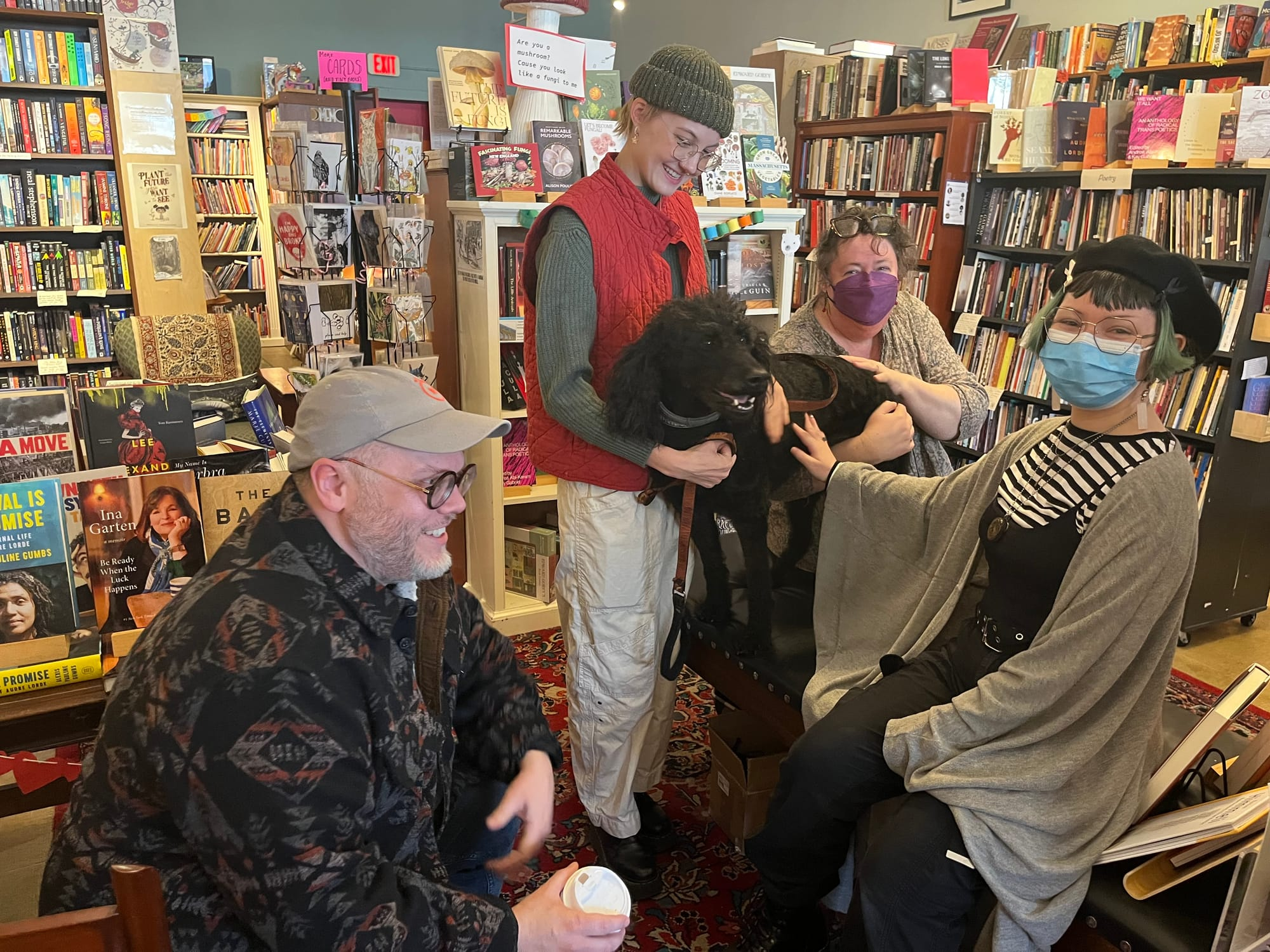
Independent bookstores have often served as hubs of political action and community care. For stores that still have masking policies in place, Covid mitigation practices often appear amid a larger framework of intent to be a safe, accessible, and politically transformative space. Moon Palace Books in Minneapolis, for example, which gained national attention earlier this year for being a center of resistance against ICE occupation, still advertises a mask requirement for everyone entering the store. Trans-owned feminist store A Room of One’s Own in Madison, Wisconsin, states, “Masks still required, dogs allowed,” on their website.
(While we made direct contact with the stores more prominently featured in this article, we weren’t able to independently verify the masking policies of all stores mentioned, so it is possible some information may be outdated.)
In Chicago, we’ve been lucky to find not just one but several stores with masking policies. We’ve attended events at Women & Children First in Andersonville, a self-described trans-inclusive feminist bookstore that prioritizes centering marginalized voices—masks here are “strongly encouraged” in-store and required for most events. Skunk Cabbage Books in Avondale, which runs community workshops and book clubs with an environmental focus, states that they require masking during events, that they use a far-UVC disinfectant system and HEPA air filtration, and that all of their staff wear KN95 respirators or better. Call & Response Books in Hyde Park, a Black woman-owned store with a thoughtfully curated selection focused on global majority authors, asks attendees to mask at events.
The Hardships of Masking Policies for Bookstores
While booksellers maintaining such generally unpopular practices clearly feel strongly about the importance of what they do, putting their values and beliefs into practice often comes with obstacles. Multiple factors likely play into how those obstacles present, including the culture of the store and surrounding population, the location, and the size of the space. Neighborhoods in big cities tend to see more tourists and other "outsiders" who may walk into an unfamiliar store with a sense of entitlement and a primary expectation to be served, rather than with the intention of contributing to a community, or a willingness to adapt to the norms of the space. Smaller stores in particular may not have the staff or resources to deal with customer refusal to comply with a mask policy, a frustration expressed by Courtney at Call & Response.
“The [mask] policy has been in place to make sure that we, as a small but mighty two-person team, are protecting our own health both for our own sake and to be able to continue to run the store, and also to protect the continued health of our community members,” Courtney says. “But, being transparent, it has been very difficult to sustain the mask policy due to the vast majority of customers being uninterested in bringing and wearing masks even when our event listings have explicitly told guests to bring their own masks (primarily, this has been an issue for author events where we're seeing folks who are not as familiar with our space). With the exception of our regularly occurring events such as trivia night and book club where people respect this ask, this has resulted in us having to provide masks to the overwhelming majority of event attendees, who unfortunately often do not put their masks on during the event. This has been very frustrating and disappointing, to say the least—and because I run the majority of our in-store events by myself, it is beyond my capacity to continually ask people to put on their masks and also run checkout, make sure run-of-show is operating smoothly, and beyond.”
The expense and waste of providing masks is a common (and constant) issue for stores with masking policies in place. Even KN95 and N95 respirators, which are much more effective at stopping transmission than surgical masks, can be relatively inexpensive for individuals, who can buy them in bulk and rewear them several times (generally up to around forty total hours) before throwing them away. Some people even use permanent respirators that only require you to swap out the filter. This means that a person taking responsibility for themselves can walk into a space with a masking request at no expense to those hosting the space and little expense to themselves, while providing premium protection to everyone. But when booksellers can’t trust customers to show up for browsing and events with a mask and feel forced to provide them, the expense for one-time uses can get out of control. If bookstores are able to provide respirators, they can encourage reuse, as Nialle says The Haunted Bookshop does, but in many cases this isn’t feasible, particularly when there is already major resistance to masking and whatever masks are provided are likely to be wasted anyway.
Courtney adds that “many times people simply discard the distributed masks on the floor or in the trash without having ever used them, which is its own separate sustainability issue.”
"I could not stand it if someone else got Long Covid due to my (in)actions." —Gavin, Book Moon Books (Easthampton, Massachusetts)
Sarah says that if BookWoman had more resources, the store would “exclusively offer KN95 (or even N95) masks, rather than the variety of disposable masks we currently offer,” explaining, “Approximately 75-90% of our customers come in without masks, so nearly everyone takes one each time they come in the store, and masks are quite expensive these days, so it takes a lot of resources to keep them stocked. We sometimes receive donations, which is awesome, but we still purchase the majority of them ourselves, so we are somewhat restricted by budget and what people sometimes donate.”
Booksellers in less densely populated areas, where events and patronage are likely to be more limited to local community, generally seem to have had an easier time with customer behavior regarding mitigation practices, but still report experiencing concerns and problems. Sarah describes having “somewhat regular complaints,” although "probably an equal or greater number of folks sharing gratitude," and Nialle notes “a gradual decline in supportiveness in the last year,” observing that “The few who push back choose more persistent and public ways of expressing their resistance.”
On the one hand, booksellers working with masking policies are prone to experiencing pushback from customers, concerns about losing sales, and the expense of maintenance. On the other hand, they have strong feelings about the importance of masking and the mitigations they want to enact. Because of this inherent conflict and the pressure they face from their opposition to what appears to be the overwhelming public opinion, they may fluctuate in the exact terms of their masking policy, or feel unsure about how strongly they can insist people follow it without substantially compromising themselves or their store.
In cases where they can afford to, some booksellers are compelled to make decisions that they know result in a loss of business or opportunities. Sarah mentions that BookWoman has lost out on event opportunities due to not serving food or drinks indoors: "[T]here are folks choosing to host their book events elsewhere specifically because they want food or drinks served. We are working on some creative ways to make this more feasible while still maintaining masking, but there are lots of variables that change per event, so there isn't a one-size-fits-all solution. All of that to say, we are taking the precautions we can to keep people safe even though we are very likely losing a bit of business, but we see people's lives and livelihoods as worth that risk."
Gavin tells us that Book Moon has stopped hosting events altogether. He sees this as “a loss of sales and community building,” but says, “I can't bring myself to be responsible for gathering people in the store for a long time—even masked and with good ventilation. I could not stand it if someone else got Long Covid due to my (in)actions.”
"[T]he number of people who have spoken to or emailed us privately to express their appreciation is much, much larger than the media coverage would lead the general public to expect." —Nialle, The Haunted Bookshop (Iowa City, Iowa)
For many stores, a move like this, or other mitigations, might not be a viable option, and booksellers trying to do the right thing may find themselves in difficult binds. They may quietly change a masking requirement to a masking request but not want to explicitly advertise that the policy has been changed. We heard from some who expressed doubt as to whether they should be included in this article or whether their policies and experiences were relevant to what we wanted—which they were and are, as we want to bring to light the difficulties faced by those dealing with a fraught situation that often has no easy answers.
Interestingly, one bookseller who wishes to remain anonymous confides that they suspended their masking requirement because their store wasn’t making enough but now they suspect it may not have been worth it because the non-maskers ultimately weren’t contributing much anyway: “[I]t turns out that while more people will come in, the maskless ones don’t spend significantly. So … I feel like we betrayed our trust for no good reason at all, and that makes me think we should reenact the requirement, since it was the right thing to do in the first place.”
What Everyone Gets Out of Bookstores Protecting Community Health
What seems apparent to us in hearing from these booksellers doing the work of mitigation is that their actions, in all cases, are undoubtedly significant, even if it doesn’t always seem that way. They could certainly use more support, but customer feedback aligns with the idea that their efforts are appreciated, even if the level of appreciation might vary depending on the store. Despite the pushback, Nialle says, “I would say that between 90-95% of people who have shared their thoughts about our mitigations have been understanding and kind … the number of people who have spoken to or emailed us privately to express their appreciation is much, much larger than the media coverage would lead the general public to expect.”
Junk reports that while the staff at Firestorm have had their “fair share of pushback,” they also get support and encouragement from those in the community, mentioning, “A very sweet occurrence we encounter are the parents and caregivers coming into the space with kiddos explaining to the littles why we wear masks. It's commonly the same few phrases, ‘We don't want to share our germs’ or ‘We want to keep others safe in case we are sick,’ to which the kiddos are amenable, especially when they get to pick masks with fun colors and designs! For the much younger kiddos, this might be their first time wearing a mask. This is creating normalization of masking, and how this too is another way we care for each other.”
"We want our customers to feel comfortable entering our bookstores: a simple act like wearing a mask can show those at risk that you are in their corner, and also be a part of the risk mitigation needed to keep COVID cases from rising." —Danielle, Golden Fig Books (Durham and Carrboro, North Carolina)
In all likelihood, stores with masking policies are consistently saving, bettering, and extending lives, and in the scenario Junk describes, children are both learning to protect others and to protect themselves. The common narrative is that the only people at real risk for complications from Covid and other viruses are older and immunocompromised people, and this narrative is one that has often been used in a way that is intended to make others feel they shouldn’t care because the dangers don’t apply to them. But not only are “healthy” adults also at risk, Long Covid affects millions of children in the US alone.
Those who feel cynical about the ability of Covid-conscious people and businesses to do anything substantial on a larger scale about transmission long-term should consider that masking and mask policies are also valuable for optics, and, as Junk points out, public spaces like bookstores that encourage masking play an important role in increasing visibility and normalization of masking.
For some stores, signaling solidarity with the most vulnerable is a major goal and intention of their masking policies. Danielle at Golden Fig tells us, “Our request for customers to wear a mask while visiting our locations comes from one primary reason: We want to raise awareness for our immunocompromised community, who have to work hard to maintain a healthy quality of life. We want our customers to feel comfortable entering our bookstores: a simple act like wearing a mask can show those at risk that you are in their corner, and also be a part of the risk mitigation needed to keep COVID cases from rising. As a bookstore, we are committed to [sharing] stories with others. In the case of those still at risk of serious illness, we believe that their stories also deserve to be heard.”
Wearing a mask is a form of protest against the status quo, of public signaling of care to the most vulnerable (who are not always easily known or identifiable), of putting pressure on and holding government institutions accountable for public health, of fighting mask bans that encroach on the protections of all our rights, of refusing to ignore or forget about Covid and “return to normal” without broader protections and resources for everyone—like sustainable solutions such as the cleaning of air in indoor spaces to ultimately slow the spread of viruses and treatments for Covid’s long-term effects.
Also, the importance of slowing the spread of disease to any degree intersects with virtually every other urgent social and political issue because marginalized populations are disproportionately affected by Covid and other diseases—in detention centers; in prisons; in Black, Indigenous, and immigrant communities in the US; in the Global South—and we are all connected by chains of transmission, unless we stop them.
"We're fortunate that the majority of our audience, being a feminist and queer-owned bookstore, understands why we still require masks even if they don't wear them on a regular basis themselves," says Sarah of the clientele at BookWoman. "Most of our customers are happy to do something simple like wearing a mask because they understand why we are asking people to do it, so generally folks don't mind. There are always dissenters, but the vast majority are folks who likely were going to find some reason or another to dislike our store and its mission...but even if they were longtime customers (which we've likely lost at least a few over the years), to us it's about doing the right thing."
How to Help Bookstores with Masking Policies
All the bookstores mentioned in this article can be supported with online orders. We’ve been told direct orders are the best form of support through sales, though you can also buy through their Bookshop links. If you visit any of them, you can reduce waste and financial strain by bringing and reusing your own respirator, and some may be happy to accept donations of masks in their original packaging or donations to cover the cost of supplies like masks and tests. You can also generally contribute to the efforts of people like the booksellers featured in this article by normalizing a culture of consciousness around Covid, disability justice, and public health. Wearing a mask anywhere, as much as possible, is sharing the burden that immunocompromised and other Covid-conscious people and the public spaces that support us deal with every day; more people masking means that we and our communities don’t need to fight as hard to go about our daily lives safely and comfortably.
Below are direct links for online orders for the stores we communicated with for this article.
- Call & Response Books (gift cards)
- BookWoman (T-shirts and totes) (gift certificates)
- Firestorm Books (lots of cool merch here) (gift cards) (Patreon)
- Golden Fig Books (stylish merch) (gift cards) (Patreon)
- The Haunted Bookshop
- Book Moon Books (gift cards) (personalized copies of Kelly's books) (T-shirts and stickers are available in the "About Us" dropdown)
You can also help normalize masking and conversations about mitigations by talking to other people about them. Here are some current resources for sharing, browsing, and learning.
- Gillian Levine’s comic Reasons to Wear a Mask in 2026 is a charming and informative graphic explainer, featured earlier this year on The Sick Times, itself a great general resource for Covid-related news and analysis.
- Gavin has chronicled his experiences with Long Covid on the Small Beer Press website in a series of posts that add up to a sobering, educational, occasionally funny, and deeply personal account of living with this illness.
- Bona Fide Masks is a reliable place for purchasing KN95s and N95s online, including Powecom KN95s, which come in a variety of fun colors and with a snugger size for children and smaller-faced adults (we exist!).
- Here's a simple general masking guide from the World Health Network.
- Positive Deviance is an online magazine focusing on Covid-conscious culture.
In putting together this piece, we came to feel even more strongly about the natural connections between books and reading, bookstores as community fixtures, and the kind of community care that can create a better future. We are so grateful to all the booksellers who contributed to this article, and to all those who are striving in some way or other to make the world more accessible and open to everyone.