Review: No God But Us by Bobuq Sayed and the Refugee Liminal State
No God But Us vividly illuminates what life is like for the many queer refugees who live in liminal space for years, whose only home is the state of uncertainty.
In February I read a quietly brilliant book called The Renovation by Kenan Orhan, who we were later fortunate enough to interview. It’s about a Turkish woman named Dilara living in exile in Italy, who discovers that contractors have installed a prison cell in her bathroom instead of the new shower and sink she requested. Dilara and her family have fled Turkey because her father was deemed a dissident by the authoritarian regime of Recep Tayyip Erdoğan and it was no longer safe for them to live there.
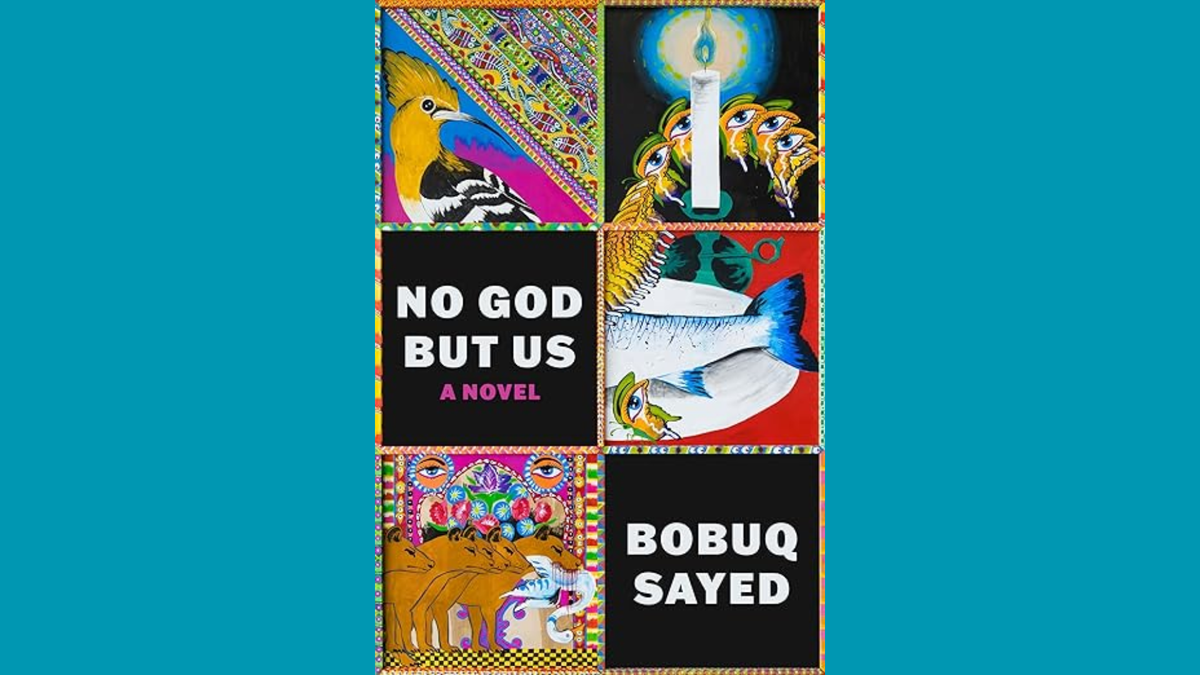
I was surprised to encounter the very inverse of this premise in Bobuq Sayed’s No God But Us (publishing May 26), which involves two gay Afghan men who arrive in Istanbul as refugees, fleeing persecution. Mansur left his home in Tehran after his grandmother learned of his sexuality and insisted his existence in the house was a threat to the safety of his mother and sister. Delbar has come from the United States after his mother, an immigrant with one foot back in her native country via the popular talk show she hosts, discovered he was working the door at a drag bar. He is offered and accepts a room in the apartment of his more liberal aunt who lives in Turkey.
Among its many contradictions, Istanbul is both a place people flee because of persecution and a place people who are persecuted flee to.
It is interesting that one of these refugee characters is escaping the US, the supposed bastion of freedom and liberal policy, since to some of those who would commit violence upon Mansur in Iran because of his sexuality, the United States might be viewed as a Gomorrah, but a lot of queer and trans people living here now feel anything but safe. And as the book makes clear, sometimes your safety as a queer person is just as likely to depend on the family you were born into as the nation whose borders you live inside.
Sayed is careful to avoid tipping the book over into political polemic; the characters in No God But Us are fully realized people with complications, annoying qualities, and poor choices, not tragic figures acting out a morality play. There is a lot of humor in the narration of what is an admittedly dark story. The novel opens with Delbar’s perspective at a Washington, DC, bar’s “Middle Eastern drag night,” and its second sentence is an absolute gem: “Finally, the unimpressed pole dancer tossed her kohl-lined eyes at the storage closet and, inside, I stumbled onto Kreamy Ibrahimi getting her dick sucked.” Soon after, we learn that Delbar’s greatest ambition is to be promoted from cover charge taker to performer—under the name Sharia Raw.
Mansur is a more serious person, in part because he has suffered more than Delbar. His family and home have been taken from him, he is robbed shortly after arriving in Istanbul, the boyfriend he thought he’d found in Tehran has ghosted him, and he is taken advantage of sexually by another refugee grasping at what little power he can snatch up for himself. When Mansur meets Leif, a German activist running an aid organization for queer refugees called Peacemeals, he is wary—both because he has learned to be mistrustful and because he feels uncomfortable accepting charity. But hunger gets the better of him, and he ultimately agrees to come to Peacemeal’s regular free dinners, on the condition that he is allowed to contribute by cooking the food himself.
Chapters alternate with first-person narration from Mansur and Delbar—on different timelines for about half of the novel, as Mansur is initially telling the story of what happened before Delbar arrived in Istanbul, before the two men meet. By the time Delbar arrives on the scene and starts attending the dinners as well, Mansur and Leif are already a couple, much to Delbar’s chagrin. It is clear that Delbar and Mansur develop an immediate connection, and one of the plot’s central conflicts is the will-they-or-won’t-they romantic tension. Sayed introduces a serious ethical dilemma in this situation, in that there is an uncomfortable power gap in the relationship between Mansur and Leif. His response to Delbar’s query about how he became fluent in Turkish, “I’ve always been fascinated with the Orient,” and his offhand comment about how he is “civilizing” Mansur made to another white European friend are certainly intended to make the reader grimace.
So while not a polemic, this is a political book, and the most potent tension revolves around whether Mansur and the other refugees of Peacemeals’ dinners, who develop into a tightknit friend group, will manage to get citizenship in a European country. Istanbul is regarded as a “queer oasis” by some due to its location, and it attracts numerous refugees from North Africa, the Middle East, and Central Asia, among other places, who hope to ultimately secure citizenship somewhere in the European Union. As Öykü Aytaçoğlu and Cosimo Pica explain in their research article “I Won’t Give You a Story of Suffering: Queer Migrants’ Everyday Resistance in Istanbul,” the Law on Foreigners and International Protection and the Directorate General for Migration Management (2014) and other legal frameworks provide some measure of protection to refugees, but these are undermined by Erdoğan’s neoliberal attitudes and policies that infringe on freedom, such as the allocation of refugees to “satellite cities” so they are not all in one place. Being assigned a location far from Istanbul makes finding work, attending meetings with caseworkers, and other life necessities for a refugee challenging. The paper continues:
“It is a contradictory space—a city that, despite lacking legal protections for queer rights and being shaped by increasingly hostile political rhetoric (ILGA 2023), does not criminalize same-sex relationships ... At the same time, İstanbul is home to a dynamic queer cultural scene and a network of civil society organizations, offering spaces of refuge for those escaping more restrictive environments. This paradox encapsulates the broader tensions in Türkiye, where systemic discrimination and exclusion coexist with spaces that offer relative safety and belonging.”
Sayed captures this central tension for refugees living in Istanbul with precision in No God But Us. In addition to the above challenges, Mansur is faced with hostility from the caseworker who is supposed to help him. “You are real gay, or no?” she asks Mansur, before also calling his Afghan origins into question (Afghans are in some cases moved more quickly through the pipeline into Europe because of the decades of war and unrest in their country).
Aytaçoğlu and Pica also write in their paper that “the governance of migration increasingly relies on waiting as a mechanism of control, subjecting migrants to prolonged uncertainty.” This is perhaps the most devastating facet of the novel, watching this uncertainty play out, particularly among the most vulnerable in the Peacemeals group. When one member is granted Dutch citizenship, the group splinters, as Anahita, a trans woman, is unable to hide her frustration, her despair, her jealousy at her friend’s good fortune. “I arrived in Turkey before she did. I’ve waited longer. It’s not her fault I’m waiting so long, but that’s the truth of it,” she fumes. Anahita becomes involved with a sketchy man because he has EU working papers and a passport and begins a scary downward trajectory.
No God But Us also intersects with The Renovation in the recounting of the coup that almost ousted Erdoğan in 2016. In this novel, this incident makes up the climax. The characters become separated amid the chaos and each must fend for themselves as Erdoğan (and his faction) prepares to grasp his power even tighter. It’s a tense sequence of exceptionally skillful storytelling.
According to International Reporting, “15,000 refugees were resettled from Turkey in 2017, less than one per cent of its refugee population.” While exact numbers are hard to come by, this figure suggests a significantly sized population, and reinforces the long wait times suggested by both the research of Aytaçoğlu and Pica and the experiences of the characters in Sayed’s well-crafted novel.
At the end, some get out, and some don’t.
No God But Us vividly illuminates what life is like for the many queer refugees who live in liminal space for years, whose only home is the state of uncertainty. It is also an impressively detailed encapsulation of one of the darkest eras in Turkey’s history (one that continues to this day). But perhaps more than anything, it’s a moving testament to the power of queer community, as imperfect as it may sometimes be.
Who Even Reads is an independent publication run by two hardworking editorial professionals. We write about books from a liberation perspective, with a socially conscious focus that's both fun and serious, covering mostly new releases. Your donations subsidize what we do. Learn about us.