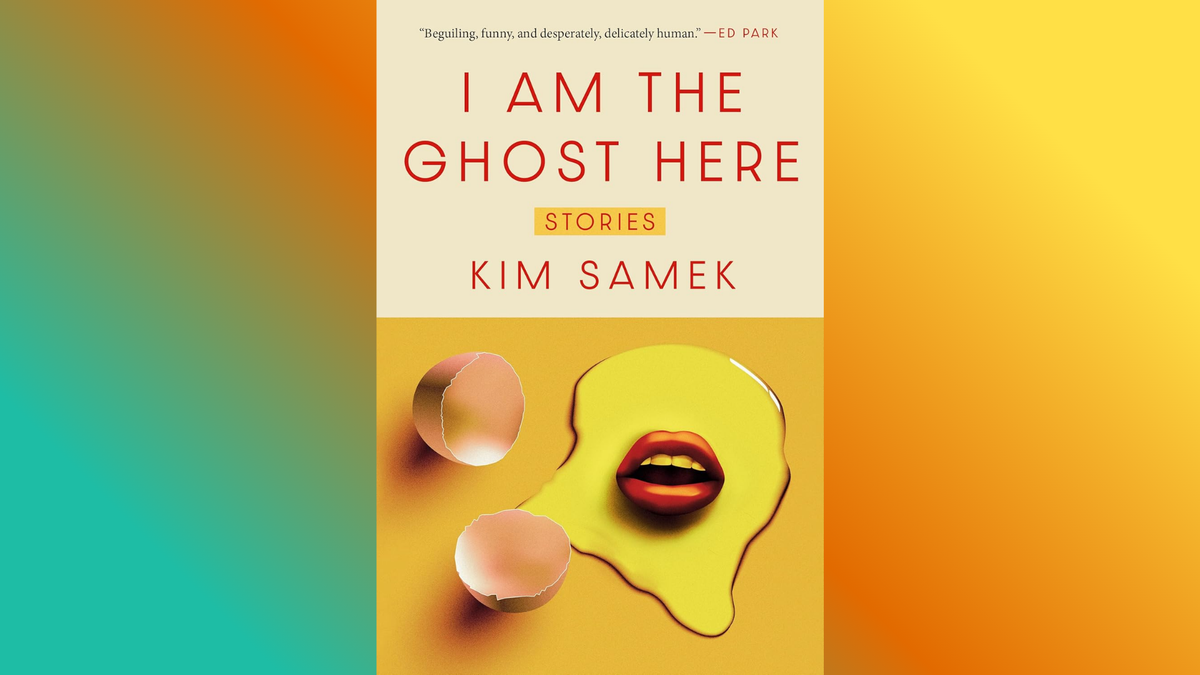
I Am the Ghost Here: Kim Samek and the Ghost of Pandemic Present
Given that many of the stories in Kim Samek’s debut story collection I Am the Ghost Here feature surreal elements, borrowing tropes from science fiction and fantasy, I was surprised to find honest, genuine explorations of the pandemic as a mass disabling event in its fourth and fifth stories.
I have written here before about the dearth of depictions of Long Covid and the ongoing nature of the Covid-19 pandemic in contemporary fiction. It is a subject frequently on my mind, especially when encountering work that feels like it should reckon with this reality, or that almost brushes up against the subject before the situation dissolves, or shoots off in another narrative direction.
Given that many of the stories in Kim Samek’s debut story collection I Am the Ghost Here feature surreal elements, borrowing tropes from science fiction and fantasy, I was surprised to find honest, genuine explorations of the pandemic as a mass disabling event in its fourth and fifth stories. These stories also feature nuanced, in some ways devastating reflections on disability and how its inevitable changes to the body and enforced limitations affect a person’s identity and understanding of themselves.
The story “Return” opens with the narrator explaining that she has recently been diagnosed with lupus, and explicitly declaring it “a rare complication of Covid” (again, I cannot emphasize enough how unusual it is to see this word in a work of fiction). She is spending the evening with her two friends, both of whom are also dealing with effects of chronic illness, presumably as a result of Covid-19. The three decide to experiment with a new piece of technology called Return, which is essentially a rideshare service that takes you back in time: “It promised a night of our old lives: dancing at Club Tee Gee in a striped dress and cowboy boots, a simple joy from an earlier time.” The friends feel uneasy about the prospect both because they have never tried Return before and because the proprietor of the tech is an Elon Musk-esque darling of the alt-right. But they justify it because these are the kinds of ethical compromises one must make when disabled or chronically ill:
“Alice ordered the Return before we could change our minds. She said we were doing it for me. She wanted to see me healthy again. I couldn’t remember what it was like to not feel sick. I wanted to find a way back to my old self so I could be a better mother to Alfie. After failing several drugs, I had lost hope that I would feel better.”
The Return turns out not to be what the women expect at all, and the narrator ends up traveling forward into the future, all the way into her son Alfie’s adulthood. This is a distressing situation for her because she feels like she has lost the chance to observe so many milestones in Alfie’s life.
“Return” is painful to read as a disabled person because it reckons with feelings I actively repress out of necessity. If I spend any length of time contemplating what my body was like before I became disabled—what I looked like, what I was capable of, the things I would do with my body without a second thought that would be impossible now, or would require a tremendous amount of planning for and recovering from—I experience the vertiginous feeling of falling down a well of despair and the terror of uncertainty, knowing I might never pull myself out again. I don’t have children, but I feel constantly like I am losing out on time, losing out on experiences, wondering if I will continue to be capable of less and less as time goes on.
One of the most common conditions people develop as a result of Long Covid is chronic fatigue syndrome, or ME/CFS, which results in almost supernatural fatigue. People can’t get out of bed for days at a time. Being active on social media in the disability community, I see a post almost every day in which someone is commenting on the disparity between what they were capable of before they got sick (so much!) and what they are capable of now (almost nothing). “Return” explores the corrosive nature of these comparisons on a disabled person’s psyche without any pat resolutions or recommendations. The narrator finds her way back into the present, where her son is still a baby and she can still watch him grow up, even if her condition precludes her from attending every soccer game or school play.
“The Sharpest Knife” is, fittingly, more incisive. It begins with the following quote, which mirrors many stories I have heard from people who, for example, followed the specious guidance of the Centers for Disease Control and stopped masking in 2021, only to contract Covid-19 and develop a disabling form of Long Covid (often despite being vaccinated).
“It was my fault for not being careful when the disease started going around. I didn’t take it seriously enough. No one in our friend group had come down with it. I’d read that some people got a cold. Some got no symptoms at all ... It sounded like a made-up disease, something concocted by trolls to mess with us ... I could believe whatever I wanted to believe. I wanted to believe it was safe to go to the Harry Styles concert.”
The narrator of this story, and her husband, and her sister, all contract the disease, which is not named, and all lose an organ; in the narrator’s case it is her heart. It is cut out of her body and she must carry it around with her in a jar. She is initially disturbed at this dramatic change in her life—she was previously working as a gymnastics coach and her disability prevents her from carrying on in this line of work—but she soon develops a lucrative career as an influencer, creating disability inspiration porn by demonstrating her enduring physical prowess via exercise.
When the disease disables her family members, the narrator treats them like her gymnastics students, attempting to inspire them to push past their very real limitations. “We’re going to fight this,” she tells her sister, who responds, “I don’t want to fight.” The narrator performs disability for an audience the only way it is socially acceptable—by showing that she can do anything an able-bodied person can do. When her husband and sister refuse to do the same, she feels scornful. When her husband tells her he’s having seizures, that he thinks he is becoming a robot, she doesn’t believe him.
While the details of this scenario are obviously exaggerated for the narrative purposes of surreal absurdity, Samek captures the brittle reality of disability for many. The narrator’s sense of self is so fragile as a result of her disability that she holds herself to an impossible standard and lashes out at others when they fail to be disabled in a way that conforms to her own identity as a disabled person.
But what really drew me into this story was that opening paragraph, which is such a genuine, accurate representation of how so many people responded to the campaign of misinformation orchestrated to convince them to stop taking precautions to prevent the spread of Covid-19 and go back to participating in the economy. The wealthy oligarch class lost a lot of money during the lockdown stage of the pandemic when people were being told in clear language that it was not safe to go to the Harry Styles concert.
We’re not supposed to talk about, or write about this: the reality that the government has lied to us; that Covid-19 is still very dangerous, even to the vaccinated; that you are rolling the dice on disability or chronic illness every time you venture into public without a respirator mask on.
Samek explores a lot of the elements that make contemporary life feel incredibly precarious: her characters are gig workers trying to get by in a post-capitalist world where inflation rises exponentially year over year; they are brushing up against the worst climate change catastrophes; they are disabled and clinging to functionality. In an interview with The Rumpus, Samek explains the environment in which she wrote most of the stories in I Am the Ghost Here:
“I was really ill when I wrote the book. It made me feel like I had lost agency. It was an interesting parallel because I felt the same way thinking about politics, climate change, all of the anxieties. There was a sense around the time of the pandemic that life had spun out of control, that it was something that we could not recognize—the world moving in a way that we can’t really understand.”
This quote puts the stories mentioned above into a personal context, but it also highlights something crucial about people’s attitudes toward the ongoing pandemic. It does feel like something is spinning out of control, like there is an inevitability, a slow-moving disaster, like we are teetering on the edge of an eroding glacier. The pandemic is a lot like climate change in the sense that people feel they have no agency, no ability to counteract it, but that isn’t true for the climate and it isn’t true for the pandemic either. If it feels like we’ve come to the end of something, start looking for the new beginning.
Samek’s stories, not just the two referenced above but all of those collected in I Am the Ghost Here, celebrate the wonder of human adaptability. While the precarities are miserable and unfair and divisive, while people are messy and imperfect and tired and sick, we adapt. While it can be frustrating when those who can don't take measures to protect themselves and others from the spread of Covid-19, how wonderful to live in a time where those measures exist, where a culture of care and consciousness has sprung up around them, where I can protect myself and be part of this culture. And maybe someone will read this story collection, or this article, or this one, or this one, and decide to adapt.
See our recent interview with author Kenan Orhan for further discussion of Samek's collection, particularly the story "I Am the Ghost Here."
Who Even Reads is an independent publication run by two hardworking editorial professionals. We write about books from a liberation perspective, with a socially conscious focus that's both fun and serious, covering mostly new releases. Your donations subsidize what we do. Learn about us.