A Thing and a Half: An Interview with Kenan Orhan
"Exile is such a strange and absurd situation. I think there are going to be things you miss so much. You start to wonder whether or not it really was worth it. And what you're willing to give up to get some of those things back."
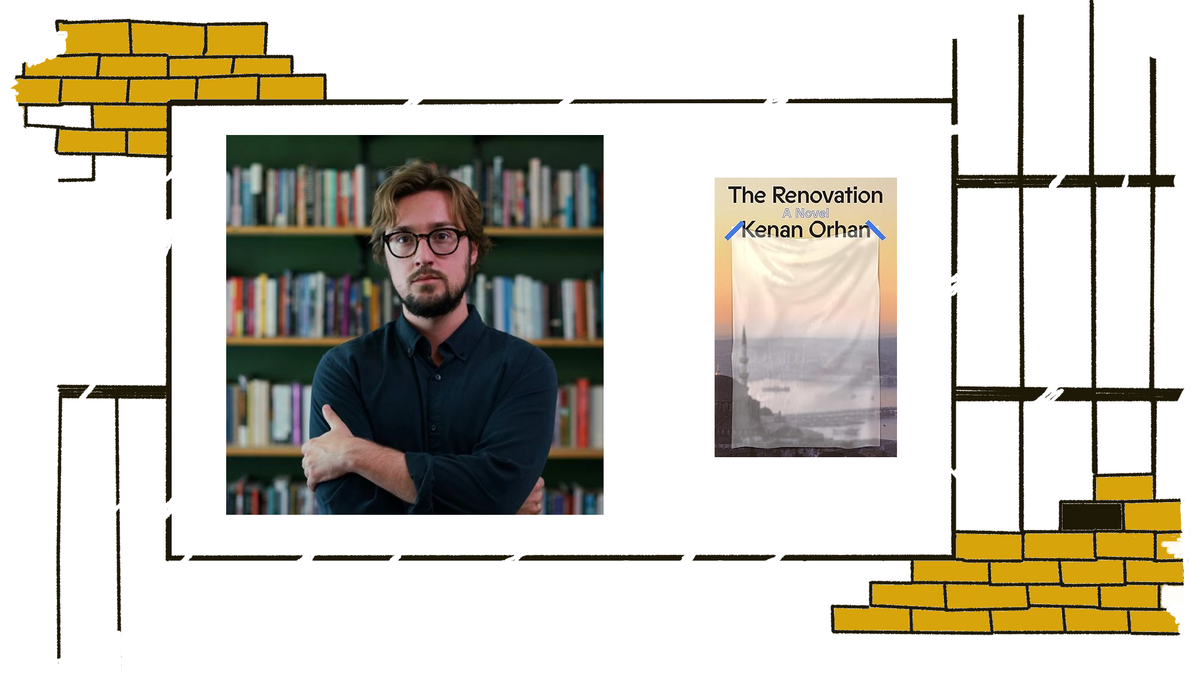
Author Kenan Orhan's I Am My Country and Other Stories, published in 2023, was a finalist for the PEN/Robert W. Bingham Prize and a longlist nominee for The Story Prize. He developed his debut novel The Renovation, featured in our February Books We Like the Looks Of, from a short story originally published in The Atlantic.
The Renovation follows a woman named Dilara, who left Turkey for Italy years ago. As her father becomes unable to take care of himself due to dementia, Dilara and her husband arrange for him to live with them, and they contract the construction of a new bathroom to accommodate this situation. But when Dilara has a chance to look at the bathroom, she finds a Turkish prison cell in its place. Her immediate impulse is to hide this discovery from her husband, and as time passes, the prison becomes something of a refuge for her, an escape from her day-to-day life and a way of returning to her homeland.
We spoke to Kenan about this strange and fascinating story, and along the way discussed surrealism, contemporary Turkish history, second-generation terrors, work by authors Senaa Ahmad and Kim Samek, and much more.
Lisa Butts: The Renovation is about a Turkish woman living in exile, essentially, in Italy, who, after hiring a contractor to install a new bathroom in her home, discovers that they have instead installed a Turkish prison cell. We were discussing how there is a literary tradition involving portals or doors that go into another place, like Chronicles of Narnia, etc. But often, the door provides access to a space that is a respite from the pressures, the challenges of the real world. So, interestingly, it's similar for Dilara, but it's quite different what she's escaping into. So, how do you conceive of this space? How do you view the prison and its significance for Dilara? Do you see it as a fantasy, in the Narnia wheelhouse, or some way for her to engage in a genuine reality that she can't otherwise be a part of?
Kenan Orhan: To work backwards, to the last part of the question, I think it's the latter. I think it's very much she is so obsessed with the reality facing her now, which is, you know, being back in Istanbul. Of course, it's also being in a prison, but very conveniently, it's a one-way prison portal. So she doesn't have to worry too much about Istanbul spilling back into her life in Italy. But my gut is telling me that at first she must have been more obsessed with the reality. And sort of by chance the prison eventually starts providing this magical respite for her. But it was very much a culmination of different obsessions I've had, different interests I've had. Really bad advice I've given some young writers, which is very tongue in cheek, of course, but I think I had said at one point, you know, writing pays so little, you'll never have time to do it. The best thing you can do is to go to a white collar prison for a few months and write in there. I don't really stand by that, but it's weird what someone who spends all day sitting at a desk looking out a window starts to consider meaningful time. I think, similarly, Dilara, who is trapped by constant needs from her father, constant financial needs now that her husband has run off, it's a book about all the sorts of prisons that our lives engage with, whether we are aware of it or whether we are okay with it. I think when you start caring for relatives, when you start caring for loved ones, you are, in a way, entering into sort of a consensual prison. That's such a disgusting term, I can't believe I just said that. But it is, I think. Your life has changed. In the same way, I must imagine, as having a newborn child enter your life. Suddenly, an entire life outside of yours is dependent on you. And that's just, I mean, to me personally, that's horrifying. I'm a very self-centered person.
But what I was surprised by when first formulating this was the dichotomy of a prison being a really cool place to hang out in. Just that natural tension of, that doesn't sound right to me. How can I get away with making it fun for her, or, you know, at least a place she wants to spend time in? In part because I think all good fiction looks at things slightly askew, looks at those natural tensions. And I think this book has the two natural tensions of prison versus willful imprisonment, and then trying to remember and not being able to remember at all. But I'm not sure I answered your question.
LB: Yeah, no, that's really interesting. So in a way, it's basically, it’s a way to escape one reality into a different reality, which is kind of a fantasy.
KO: Yeah, it is, absolutely, yes. Because if she had stayed in Turkey, this prison would be her reality. So, it's weird. Why would you flee a thing, only to be confronted with that thing in your new country, and be like, well, it's okay this time. And obviously for her, it's because it is one-way. She can exit the prison whenever she wants. But also, I think, for people fleeing, exile is such a strange and absurd situation. I think there are going to be things you miss so much. You start to wonder whether or not it really was worth it. And what you're willing to give up to get some of those things back.
I find my work is constantly obsessed with prison. This one was a look at all sorts of prisons, but also, my short stories tend to either not end or end in a situation where somebody is definitely going to prison, or is already there. So I don't know what that says about my understanding of life in Turkey.
Elisabeth Cook: I found that to be one of the most interesting things about the book, the fact that even if it is a fantasy, or there are some aspects of it that are a fantasy, that she's not even experiencing the past. It's the contemporary world in another place that appears to be the actual real place, which is just kind of an unexpected element in that format.
KO: Yeah, I think she definitely would prefer it if she went back to Silivri [Prison] in 2006, maybe, when her mother was still alive. But the prison provides; I think that sentence is in the book. It was always in the back of my mind, but yeah, it's not...it's not a great Turkey that she's escaping into. It's got its political catastrophe. It has its geological catastrophes, its environmental catastrophes. Something I think I kind of wish I maybe had played with is her trying to figure out a way to get her relatives to visit her in prison. But that would have, I think, it spoils a little bit of what you're talking about, which is, it is the prison. It is very much the real Silivri, or now called Marmara Prison, in Istanbul. And the prisoners are very much real women arrested in Istanbul and serving out their time there. But it is also a little bit more than that. I consider myself kind of a student of the surreal and the absurd. I think what I love so much about lightly surreal books is that things are like, a thing and a half, which is just enough to sort of skew the view of things.
LB: Yes, what you just said is exactly why I was interested in this book and that speaks to so much of my preference for reading. I just love something a little bit off in an otherwise very realist environment.
KO: I think it's the most inclusive form of fiction because none of us have been in a situation where our bathroom is now a portal to a prison cell, right? So we're all coming to it with the same experience, which is no experience at all. Which is a really nice way to then kind of trick your reader into talking about exile in a way where they feel it too. When I used to teach surrealism, I tried to kind of get my students on board with this idea that like, you don't have to have been a parent. You don't have to have lost a child to understand what it means to lose something that feels like a part of you, when surrealism starts talking about a guy who's missing the center of his body. And it's like, oh, well, that's weird. We can all kind of start to approach it and it opens you up and it makes you vulnerable to the truths underneath the fiction.
LB: Dilara and her husband and father are essentially forced out of Turkey because her father is an intellectual whose work is perceived as critical of Recep Tayyip Erdoğan, who has been president of Turkey since 2014 (and served as prime minister for a decade before that). The book covers the Gezi Park protests in 2013 and the attempted coup in 2016, the quelling of which cemented Erdoğan as an untouchable authoritarian. His challengers and anyone who could reasonably be inferred to be a dissident are imprisoned with regularity. There is an absurdist humor in the novel to the fact that the prison which Dilara’s cell is a part of is being continually expanded to house more political prisoners. Is there anything you would like to say about your personal connection to these events in Turkish history, or living in exile?
KO: I will respond to the prison part briefly and only really to say that I find my work is constantly obsessed with prison. This one was a look at all sorts of prisons, but also, my short stories tend to either not end or end in a situation where somebody is definitely going to prison, or is already there. So I don't know what that says about my understanding of life in Turkey. But I think that should put for a reader of my work into context, like, why I keep doing this. And part of that is what you say, which is, I think, Turkey from 2012 to 2023, there was never a year where it wasn’t in the top 10 [countries] for imprisoning journalists. I think it spent three years in a row at number one, which is just absurd for a lot of reasons, especially when you consider the history of Turkey being, like, the democracy in the Middle East, this secular republic everyone is meant to look up to. And that's just, I mean, that hasn’t really ever been true. I didn't grow up aware of that. I grew up with an Istanbul that was just visiting relatives and, like, a nice vacation, where you are kind of one of the locals, but also definitely not. So, Istanbul was this weird, happy place for most of my youth.
I think sometimes we as Americans also like to say, where can I see the American in this? And what I hope I've done with Dilara is say, actually, I don't care for you to see the American in this, I care for you to see the person in this.
The Gezi Park protests were a big watershed moment for me personally. I think they were for Turkey as well. Kind of before that, there was a sense that you could do political action through demonstration and achieve some things. And as I sort of dug into why it happened—because it really just sort of crashed through the facade of what I thought Turkey was—when I started doing political research, looking into the history of the Republic, you know, Turkey's thrown more coups than I think I've thrown birthday parties. So it's not like it's a super democratic place. What's weird, I think, is people are obsessed with the secular aspect of a lot of these coups. And more recently, Turkey has dropped the secular ideology behind the growing authoritarianism. So only now are people in the West starting to be like, “Oh, well, I'm not sure about this.”
And I think a lot of my writing is grappling with, almost taking advantage of distance. Almost like that point of privilege I have, of just being a part-time guest of a place, while the rest of my family lives there and experiences everything, made me very uncomfortable. It made me very...I felt like a fraud in some ways. And so I think a lot of my writing was an attempt to both understand and position myself within that as a way to figure out who I am in relation to these things.
But this book was very much a product of my fears for my family. And I don't generally like books that rhyme too much with their authors' lives. So I don't really love that I've done this, but there's a lot in there that are just my own anxieties about my relatives. I don't see them as much. We don't talk as much. They're moving abroad, they're getting PhDs, but the job market's horrible, so they're coming back. I mean, a lot of this is in the book because I think authors should trust their obsessions. And I think when your family is on the line, you start to get very obsessed with the situation. And I think that that's something that can apply everywhere.
I really wanted this book to be about Turkey, about Turks, and those who fled. But also...I think that means it deserves to be considered on its own political terms. I think there's a lot of lessons that Turkey can teach the rest of the world as we continue to descend into these authoritarian regimes. Like Turkey's written a really good playbook for how to dismantle constitutions. But I think sometimes we as Americans also like to say, where can I see the American in this? And what I hope I've done with Dilara is say, actually, I don't care for you to see the American in this, I care for you to see the person in this. That's what I hope her relationship with her father is like, that's what I hope the relationship with her family that's left behind feels like.
I do think what is very interesting for the diaspora is that you have a homeland that can essentially disappear. Barring extreme circumstances, which do happen. Take, for example, Palestine right now, there's a very real chance that their homeland will disappear, or what happened when Yugoslavia collapsed. You’re now no longer with a country...But, you know, barring extreme circumstances like that, the homeland doesn't really go away unless you're the children.
EC: Something that resonated with me personally in the story is that my father's side of the family is Korean, I'm Korean American, and my father and grandmother emigrated here during the war there. I was struck by the idea of this very relatable thing, which was how a person's identity can be bound up in someone else's memories. How a person's conception of a place or culture can be bound up in memories of a family member. So in my case, when my grandmother died a few years ago, I realized that, in a way, the loss of her memories was a huge loss for me in terms of my family history. I was wondering if that was something that you were thinking about intentionally when you were writing, or how that idea informed the book?
KO: Yes, I think, for the diaspora, the homeland is the first generation in a place. We don't really think of it that way. We think of, like, the homeland as the homeland, you know, you're an Italian immigrant to America. The village that their family's from, they reminisce—we do that, me and my family. But I don't actually think that's true. I think the homeland is the first generation. Because so much of your understanding of a place is actually just, like you say, a person's memory of a place. And you sort of cement it with your own experience going there if you have that opportunity. Or you take the stories and create a patchwork identity around them. But especially if it's the kind of immigration where you can go back, I think that starts to create conflict between your own experience of a place and the experience of the place that your relatives knew before they left. And that's very much my experience. I spent a lot of time going back to Istanbul. So when I would then listen to my grandmother talk about different experiences in Istanbul, especially when I was younger, that was just kind of given as fact. Until I had memories of my own, and then she started remembering things that I could remember too, periods, places, people, and they weren't matching up anymore, it creates this weird gap of like, oh, okay, so reality and truth are significantly slipperier than we'd like to admit.
And I don't want to go down that slippery slope of relativism but I do think what is very interesting for the diaspora is that you have a homeland that can essentially disappear. Barring extreme circumstances, which do happen; take, for example, Palestine right now, there's a very real chance that their homeland will disappear, or what happened when Yugoslavia collapsed. You’re now no longer with a country. I think Aleksandar Hemon is an author that happened to, if I remember correctly. But, you know, barring extreme circumstances like that, the homeland doesn't really go away unless you're the children [of the first generation], I think, because really, the source, the pool of reality is the people around you who remember the place, especially if you can't go back. And that's just so moving to me. It's not something that I was worried about until more recently, as more writers, artists, journalists, actors, academics are arrested in Turkey. It started getting weird, wondering, “Oh, should I really go back?” So it felt very suddenly like my grandmother was the last anchor to a place. And that's where this book comes from, is she started to misremember things, and reality sort of unspooled a little bit as dementia started to set in.
I'm probably the most scared of all these coups and authoritarianism. My aunts, I mean, they don't love it, they hate the guy, but they’ve lived through like eight coups. Or coup attempts, or email coups even. Turkey invented the email coup. We're really advanced that way.
And what I wanted to explore in this novel, and what I hope resonates with people, is that fear, that gargantuan fear of suddenly the void is there, because you can't go back and there's no longer anybody you can pillage for that. And maybe that's a grotesque way to put it, but it is self-serving, I think, to keep saying like, “Oh, grandma, tell me about this. Oh, auntie, tell me about this.” I think we don't like to admit it, but it's a form of ownership over somebody else's reality. And maybe there are nicer and more sentimental ways to think about it. Like you're trying to take part in an identity that you hold dear, and it's part of the memories of growing up, you know, eating different foods from your classmates, different activities, taking your shoes off in everybody's house, and nobody else takes their shoes off. It is also, I think, a way to make you feel more secure in your little quirks of culture and ethnicity that are different from the people in the suburbia surrounding you. Or at least that was my experience.
EC: Yeah, no, that's been very much my experience too. And one thing that I really found fascinating about the book was just the idea of what an emotional experience it is to lose someone in that way, and to lose those memories, but how that is a selfish urge to keep that when it's not you it's happening to, it’s this other person. But it's tricky the way the past can sort of color your conception of the future too, in terms of what the possibilities are for imagining a future with this part of your identity in it and how, you know, there isn't really an easy answer of what to do about that. And I found the struggle with that in the book really moving.
KO: I'm glad to hear that. I kind of regret not exploring, like, in my own life, regret not thinking about that. You've now given me something to panic about. But it is, I think certainly, as I don't think there's a nicer way to put it, I think certainly as death starts to set in, you do fear for the future, and maybe become hopeful. And I think also, in a way, you know, I have a young experience in Turkey. So I'm probably the most scared of all these coups and authoritarianism. My aunts, I mean, they don't love it, they hate the guy, but they’ve lived through like eight coups. Or coup attempts, or email coups even. Turkey invented the email coup. We're really advanced that way. But I think there's some security and stability in having gone through a lot of this already, but that doesn't make it comforting for somebody experiencing it for the first time. You try to shore up and find stability in your relatives. But then, like you say, when they start to, when people start to die, when you grow up, you're it. You're what's left. And you start to feel very solitary and if you're anything like me, scared. If you're a braver person, I guess, it's a chance to sort of reinvent. I think the future, like the past, is very open to interpretation. These are great questions so far, by the way.
LB: Oh, thank you!
I think culturally there are a lot of similarities, it just made sense for me to put Dilara in Italy, like as a place she and her family would actually want to go to. I don't see her convincing her husband that the UK is a place to go, too many rainy days. But, you know, Italy sounds nice. There's a lot of tomatoes in the food, so not a lot of change there.
EC: I think you actually answered the next question we had, which was basically about the role that the father's dementia plays in the story and how that sort of neatly parallels the idea of displacement. We thought that that was a very clever angle so we were wondering how you came up with that. So, if there's anything else that you want to say about it.
KO: Well, I think I must be prudent and say, I'm not that clever. I appreciate the flattery. I’m glad that came through in the book. When I sat down and first sort of thought this through, which was, like, in the middle of the night, and that never happens to me, then the next day, I was just kind of writing in a flurry of emotions and just scratching everything out as fast as I could. And later you start to piece things together that rhyme. I think it is very interesting that he's losing his memories at the same time Dilara is desperate to hold onto hers. He's losing memories that are hurtful, of Turkey. So he's losing it backwards, which is kind of nice. He's traveling back in time, almost literally. His reality is traveling back in time. That's all she wants to do. She can travel to Turkey, but it's the Turkey of today, as you pointed out. So there's a nice dichotomy there. Meanwhile, Erdoğan, as all good authoritarians do, is reorganizing the national consciousness and renaming things in honor of himself and his victories and reorganizing what the national memory is. So all three of these things are working together, I think, but not because I'm smart enough to have come up with that.
And this is why I really think you have to trust your obsessions as an author. Trust your gut. Not all the time—I think if you're too impressed with yourself, then you should probably ditch what you're doing. But in those moments where a story's first coming together, my preference is to write out everything, get as much as I can onto the page. I can always whittle it away later. I can remove the newspapers and extra furniture from the room. But I want it all there to begin with because eventually, our subconscious, our obsessions, our, whatever quirk it is that makes somebody write, will put it in for you, and your job then, as a writer, is actually to just be the editor and find those links later, and just make sure that they're coming through. So I wish I could take credit. It's just by chance.
LB: You still did all the work. That's still work.
KO: It is work to do the editing. I wish I was smart enough to do it first try, but...I'll take smart enough to do it through editing. Yeah, it's a process.
LB: We also found it interesting that Dilara and her husband choose to immigrate from Turkey to Italy. In a way, this choice compounds the isolation they feel as exiles. Dilara claims to want to assimilate, she wants the trappings of an Italian life, whatever they may be. But she doesn't really pursue any path toward assimilation or even toward anything culturally familiar, she doesn't try to meet other Turkish exiles. She's not putting down roots in Italy, basically. She has some friends that are Italian, but she's enforced some distance with them. This tendency toward isolation advances as the novel progresses. So, we're wondering why you chose Italy specifically, and what do you think it says about Dilara and about exile itself that she can't make herself have the life there that she initially imagined that she would have?
KO: The Italy part's very easy, so I'll answer it quickly. I was hoping to turn this into Italian citizenship for myself.
LB: Yeah!
KO: I was hoping to convince the Italian government to fall in love with me, invite me to live in Italy. I am infatuated with Italy. Most of my favorite authors are Italian. But also, there's a really interesting history between Turks and Italians that goes way back to Ottoman times, 1400s, Venice and Genoa, interacting with the Ottoman Empire. My cousins have studied in Italy. They left Turkey for graduate degrees at Italian universities. That's pretty common in Turkey, people go to Germany, Italy, or the UK. Germany's pretty big if you're sort of socioeconomically lower class because they had the Gastarbeiter, I think they called them, which were guest worker programs, when it was still East Germany. They invited a lot of Turks to go work there. So a lot of Eastern Turks went because it was a much better opportunity for them. Sort of richer kids go to Switzerland or the UK. Middle-class kids go to Italy. That's a broad generalization. But I spent time there, a little bit just on vacation, and I had relatives who studied there and I asked them about their experiences. I think culturally there are a lot of similarities, it just made sense for me to put Dilara in Italy, like as a place she and her family would actually want to go to. I don't see her convincing her husband that the UK is a place to go, too many rainy days. But, you know, Italy sounds nice. There's a lot of tomatoes in the food, so not a lot of change there.
But what I think is stopping her from actually putting down roots is I think she's obsessed with this idea that exile is temporary. And she can imagine, at the flick of a switch, political victories in Turkey. Everything could go back to the way it was, whatever that means. Everyone will be ousted, there'll be no more authoritarianism. She could see her family again. So I think part of her is very guarded in that, "Well, why put down roots if I'm going to just cut them again, dig myself up, replant myself in Istanbul when the time arrives." Another is, in my experiences viewing caregiving in our family, it's not something that really opens you up to a world of possibilities in your own life. I think once somebody is really starting to decline in front of you, you don't have a lot of opportunities anymore to do anything except take care of them. Which is, I mean, to someone like me, who’s very self-centered, horrifying. But I think Dilara for a little while finds it gratifying. Maybe only in the period before the book actually starts. But I think in a way, maybe she's a little smug. Maybe she's a little high and mighty because she's doing the right thing. She's taking care of her father. They moved away, even though she didn't really want to, for his safety—her safety as well, I think she'll be the first one to forget that. But definitely for his safety.
My family, they immediately swore off their Turkishness and just became as American as they could. So I actually had a very un-Turkish upbringing, minus, like, Turkish tea, breakfast foods, sometimes speaking Turkish...we didn't have a super Turkish experience. I think that also informs why I keep writing these things. It’s a way for me to interact with my mother's side of the family.
So, I think what she wished was that she would move to a town in Italy and it would feel like maybe Bebek or Arnavutköy, little villages along the Bosphorus. And of course, they would only feel that way if they were little villages along the Bosphorus. And when she got there, and there was no Istanbul for her to move into, she was like, "Yeah, that's it. This is the most I'll do. There's no point in doing more." And I think those are kind of the two options. Maybe there's a magical third I'm not familiar with, but for the most part, I think if you immigrate to a place, you are either going to really try to assimilate—well, no, okay, there are three. The first is, you’re really trying to assimilate. The second is, you're going to move and not bother assimilating, you're going to keep the culture that you've arrived with. And I'm not saying, there's no correct one. And then there's Dilara, who convinces herself this is temporary. And we'll see how true that is as time goes on.
But she's, you know, she's not trying to convince her husband to stay Turkish. Like, they try to learn Italian. Sometimes they forget their Turkish words, even. So they're not, they're not the second kind, which is like, “Oh, I want to move and hold onto my Turkishness.” I think Dilara doesn't inherently want to hold onto her Turkishness, I think she just wants to hold onto her youth, which is a Turkish youth. But I don't think that matters to her. I think it's just the past that she wants. She's less politically minded than her father or I am. So it's less of an identity for her. Her identity is the mom that died early, the father who's dying now very slowly. The husband who's a bundle of nerves. Did I answer your question? Remind me of the second part?
LB: Yes! The second part was about exile. Her options are so few. And it seems like the option that's most apparent to her in the situation that she's in. You can't really separate that from what's going on with her father because if that weren't taking over, you know, 99% of her life, there's just no telling what decisions she'd be making.
KO: Right. It also depends on the country you go to. Like, Italy might be a little more welcoming for Turks than the UK. Germany kind of is because there are so many Turks there, but also kind of not because a lot of Germans don't like that there are Turks there. But, you know, she experiences people who just, like, see her, and think, "vaguely Middle Eastern, so I'm not going to bother." So, you know, whether or not you assimilate is also a little bit on the country you're moving to, if they're a welcoming demographic or if they’re kind of xenophobic, you know, why bother. I think Dilara sees a little bit of both. My family, they immediately swore off their Turkishness and just became as American as they could. So I actually had a very un-Turkish upbringing, minus, like, Turkish tea, breakfast foods, sometimes speaking Turkish. And the fact that my mother was the Turk rather than my father, and she worked, and my father stayed home...we didn't have a super Turkish experience. I think that also informs why I keep writing these things. It’s a way for me to interact with my mother's side of the family. Many who are here, but most who stayed in Istanbul.
EC: We just have one more question, and this is a pretty simple one. The Renovation was originally a short story that was published in The Atlantic, and you also wrote a collection of short stories, I Am My Country. How did you know, or at what point did you know that The Renovation was going to be a novel? Was that something you knew from the beginning or was it something that you decided later?
KO: I didn't know at the beginning. I like the short story. I stand by it as a short story. I think it's a better novel than it is a short story. But I kind of realized it was going to be a novel after it was published. The elections in Turkey happened, and it was just...I mean, it's a catastrophe anytime Erdoğan wins, but for some reason, this one felt particularly catastrophic. Part of it was the way it happened. There was a runoff because there was no clear winner, so that instead of multiple options, there'd be only two. And so then that started to mirror a little bit American elections.
I didn't really have a choice. She demanded, I continued writing. Which I think is cool, writing is the only career where you can admit people talk to you. It definitely was that way for me. It wouldn't let go until I finished the whole thing, which apparently was a novel.
So I just got more and more nervous. But it really did feel to me, and it felt to Dilara, I mean, it felt to me that you could actually oust Erdoğan with an election. Everybody was upset with him. His base was crumbling. There was a destructive earthquake right before the elections. You can't hold somebody responsible for an earthquake, that would be ridiculous. You can, however, hold the government responsible for constant code violations and selling off government contracts to the friends who cut corners and create a situation that's much worse than it should have been. And I think a lot of people saw that. They also saw his response, the government's response to the earthquake, which was just ludicrously inept. And I think that was on the forefront of a lot of people's minds. I think twenty years of dissatisfaction in the opposition party felt like it might actually coalesce into something. But it just, it didn't pan out. And part of that, I think, is because Turkey is really smart. Erdoğan’s really smart. He knows that you need an opposition party that you can control. And I think a lot of two-party systems start to look like that too. But it just seemed truly possible he might be gone. Instead, it was five more years of Erdoğan, and huge successes for the conservative coalition in Parliament, and immediate detention of victorious Kurdish mayors in the East.
So it just was like one more...it wasn't the straw that broke the camel's back, the camel's back broke a long time ago, but it just kept breaking, and breaking, and breaking. And I was asked to write a little personal essay about it. And I did, and it was very angry, and I am not surprised nobody wanted to publish it. But it very quickly kind of occurred to me that what I was actually doing was just writing more Dilara. It was very much in Dilara's voice. It was very much her fears and complaints. And it felt like there was just so much more to put in there. I didn't really have a choice. She demanded, I continued writing. Which I think is cool, writing is the only career where you can admit people talk to you. It definitely was that way for me. It wouldn't let go until I finished the whole thing, which apparently was a novel. That was a really shit year to be Turkish. I mean, it's all in the book. It was years of anger. Years of not going back to Turkey because of this man and his party. It was years of missing out on my relatives. I'm not going to say it was cathartic, but it needed to be done. I hope it resonates with people, but it's deeply personal. Like, I couldn't separate myself from it. I don't think an author has to. I don’t always love when I can see the author as the character, personally, but I think authors will always write about themselves in some way or another.
LB: I think this book really walks the line very effectively. I've definitely read books where I did feel like, “Why is this a novel, this is reading like a memoir.” And not that there's even anything wrong with that. Sometimes that can be very well done, but I do prefer there being some level of distance there, and I think that was very effectively handled in this case.
KO: That's great to hear, because you don't know, as the author, if you cross the lines, if you pull things off, you’ve gotta sort of hope your readers reach out to you and interview you, or at least say hi and say, “Oh, this worked.” Because you don't really know. I mean, supposedly you can trust your agent, but nah, they love me too much, I can't trust them.
I had students who were like, “This is obviously about what it's like to be trans,” and other students being like, “No, this is what it’s like to be closeted,” and others were like, “No, this is what it means to have absolutely no confidence in yourself,” and others would say, “This is what it means to have horrible parents.” And I was like, wow, that's the joy of this.
EC: I also just wanted to say, going back to what we were discussing at the beginning, something that I really enjoyed about the book, is how the device of the prison cell, how that could have come across as just a metaphor for something or a symbol, and I really don't like it when books do that, when they have something kind of wacky, you know, and then it's all just saying something very obvious. But I love the fact that this was very multifaceted, and it was this sort of very expansive device. It was something that was built into the full reality of the story where you could see the character's relationship with this thing and all of her interactions with it felt so authentic. I really enjoyed that.
KO: I'm very flattered to hear that. It's a pet peeve of mine as well when the magical element is just too obvious. And maybe for some readers, my prison will be a little too obvious. And that's fine. We're all different readers. But I'm very glad to hear you got a lot out of it because it seemed to me in writing it that it could be a lot of different things. And I hope it was all of them. I think I said at the beginning, I like it when something’s like, a thing and a half. And it works in stories I've read when they introduce a thing and it's open…it's open for the reader to use, however they feel most emotionally resonant. I think, you know, like Kafka's Metamorphosis is one that works for me. It doesn't work for everybody, but that's a really good example of that. I think Exit West works pretty well.
LB: I loved that one.
KO: You do worry about being a little too on the nose of things, but part of it's just making sure that the reality of the novel is true. You set the rules as a writer. You have to introduce them, and you shouldn't really break them, but generally, if you do that okay, your readers will come with you. I hope, anyway. It's a lot easier with short stories, I think. Yeah, something I found interesting writing this was, I think I'm a better short story writer. I don't think I...maybe I can write an okay novel, but it was difficult. It was a lot harder to write a novel than a short story for me personally.
LB: There's nothing wrong with that. I love short stories. I love reading short story collections. I don't think that, as a form, it's in any way inferior to the novel. You know, plenty of fantastic authors primarily work in short fiction.
KO: I hate the comparison. I don't know, you never compare poetry to a novel. And I personally separate novellas as well. I think those three forms of narrative are very different—short story, novella, and novel. And I've read some really bad novels and some really bad short stories. Anybody can do something really well and anybody can also really stink them up. They're just different forms. I love the love I've seen for story collections this year, not sure if you've noticed. But Kim Samek's collection I really enjoyed, Senaa Ahmad's, that was a lot of fun. Probably one of the more fun story collections I've read in a while. I'm just personally obsessed with having fun when I write. And maybe that makes this sound like a less serious endeavor. But I think you can have really emotional moments in work that you're still having fun with. Like my husband character is a real oaf. He was a lot of fun to write. But hopefully there are moments when he cuts through his oafishness and, you know, delivers a line to Dilara and makes her upset. And I think it works better because then we're all having fun and then suddenly the truth hits us.
LB: Yes. That is true. Yeah, we have the Kim Samek collection here, I'm very excited to read that one.
(We featured Kim Samek's I Am the Ghost Here alongside Kenan's book and others in our coverage of February releases.)
KO: Yeah, I recommend it, it's really good. I taught “I Am the Ghost Here.” The one where the narrator's brother comes to dinner at home and reveals that he’s actually like a sheath and a puppet master comes out. It's one of my favorite stories to teach. I used to teach at the Art Institute in Kansas City, I taught surrealism, and I loved teaching that one because I had students who were like, “This is obviously about what it's like to be trans,” and other students being like, “No, this is what it’s like to be closeted,” and others were like, “No, this is what it means to have absolutely no confidence in yourself,” and others would say, “This is what it means to have horrible parents.” And I was like, wow, that's the joy of this. But they would always suggest it meant something that I had never considered as a way to interpret it. So it was a very fruitful short story for my class. Do you know Senaa Ahmad’s collection?
LB: Oh yeah, I reviewed that one. The Age of Calamities. Yes, that one was really good. I really liked the one that was the war story with the werewolves.
KO: Oh, that was fantastic. I was disappointed reading it only because I have this story I'm working on, it's about a conflict and werewolves. I love the first two in particular, though. The Henry VIII and Anne Boleyn story and then the Napoleons.
LB: The Napoleons one was really good.
KO: I love that she is just like, I'm gonna write until I stop.
LB: I also really liked the one that was about the woman who was an actor in the movies about Lizzie Borden. I love stories like that.
KO: I didn't know anything about Lizzie Borden before, so I think it probably would have done better for me if I knew a little bit more. But I think what's successful about authors like her is, it's nice if you know some of the contextual stuff, but when they pull it off like that, it's still a good story if you don't. And I try to do that because, you know, I'm writing for an American audience and writing in English, and how many of them have experience with Turkish politics, I don't know. So you try to like, put some in, but not too much, and invariably people will say there's not enough, and others will say there was too much. So it's just, throwing spaghetti at the wall, right? Writing.
LB: Yeah, pretty much.
Visit Kenan's website to learn more about his life and work.
Who Even Reads is an independent publication run by two hardworking editorial professionals. We write about books from a liberation perspective, with a socially conscious focus that's both fun and serious, covering mostly new releases. Your donations subsidize what we do. Learn about us.