Kill the Cis Supremacist in Your Brain: Shut Up I Love You I'll Call You Tomorrow by Sloane Murphy
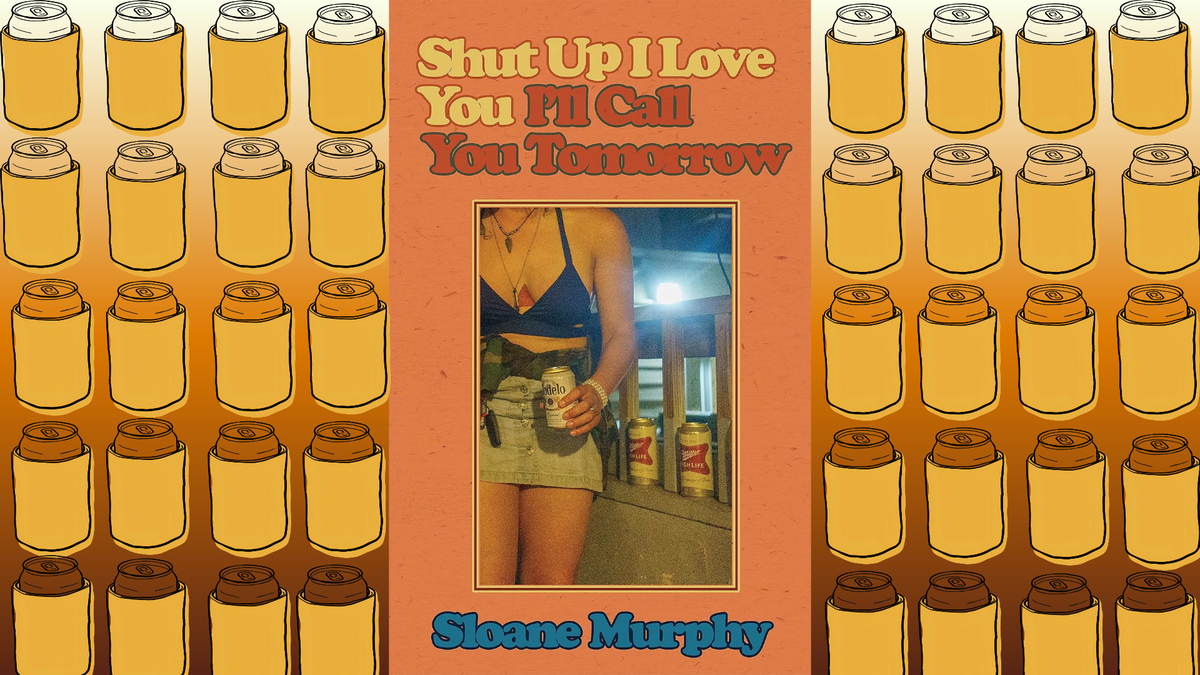
Shut Up I Love You I’ll Call You Tomorrow is a dirtbag queer book for dirtbag queer people—for those of us whose greatest life accomplishment has been becoming ourselves and not letting the world stomp us out under its jackboot.

Disclaimer: The Bookshop links in this post are affiliate links and Who Even Reads may earn a commission if you click and buy a book.
The opening story of Sloane Murphy’s debut collection Shut Up I Love You I’ll Call You Tomorrow, called “in control of the situation,” takes place at a house party, where main character Agnes is profoundly hungover and dodging her ex, a couple involved in exhibitionist blood play, a smarmy trans guy who wants her to top him, and mountains of booze and cocaine. Some of the graphic details of this story, and the narrative nonchalance with which they are conveyed, made me feel uncertain about whether this book was “for me” (what is this, Bret Easton Ellis?). But I’m glad I pushed through that initial discomfort because while this story has obviously been chosen to start the collection to prime the reader for the general vibe and deviant content they will be dealing with, the other stories, most of which are longer than this prelude, are vastly more complex and rewarding. To be clear, this first story is not skippable; it does set the tone, and like the rest of the collection, it has a lot of humor. The best bit is Agnes’s inability to remember the trans guy’s name, instead cycling through all the usual suspects ("Kai," "Collin," and "Cam") over the course of the evening. It also captures the futility of launching a self-improvement campaign when the very air you breathe is suffused with the trauma you (and everyone you know) have been swimming in since gaining consciousness.
We meet Agnes’s ex Joan in the second story, “thank you, i've been an open wound,” titled after the closing line in Joan's stand-up set. Joan moved to Chicago two years earlier and has been grinding in the comedy scene ever since, while also dating/fucking/wifing her way through the large group of other trans women that have become her social circle. Her comedy is avant-garde and aggressive, borderline performance art, but she manages to snag a slot on an upcoming national tour with (in)famous comedian Chris Panos, who is popular with the young alt-right, though he claims not to encourage this association. We will learn over the course of the rest of the book, as we meet the other women in Joan’s friend group, that she is among the most successful; the majority are subsisting on gig work and mutual aid. Over the two stories told from Joan’s perspective and a handful of others where she plays a role, we see how a modicum of fame changes her (and how it doesn’t). But this one, the second in the collection, is one of the most tightly crafted, moving, and surprising stories I’ve read recently.
Joan’s voice is also really funny:
“Once you make a group of people understand that you’re qualified to be in front of them, that they don’t have to be scared just ‘cause the tranny has a microphone, you can tell them whatever you want. One or two traditional punchlines means they don’t question you. Even when you start telling them about your recurring dreams of being in a knife fight with your mother and losing.”
In “the beer drinkers vs. the puppy mill” we meet Joan's ex-wife Carolina (aka “North,” because there is another girl in the scene named Carolina, and our Carolina is the taller of the two). In this story we see conflicting attitudes toward young trans women play out as a Socratic dialogue between Carolina and another girl, Freddie, at a dive bar called Jenny’s. Freddie complains that the clientele at Jenny’s has been skewing younger and that these girls “don’t know how to behave,” while Carolina, obviously more patient, declares, “[I]t’s our job to set an example.”
But this conversation leads to more revealing musing on Carolina’s part, as she recalls her own early transition, which occurred shortly after she was released from prison. These are details she rarely shares with others: “It doesn’t come up much. She never forgets, but she tries not to think about it.” These lines reverberate with a haunting sense of loss. A lot of the feeling in this book comes from the unsaid—a default emotional state easily recognizable by anyone who lives with trauma related to part of their identity that for a time went undisclosed.
I’m a geriatric millennial (yes, that’s really the term) and I find Gen Z patois very charming; if you feel otherwise your experience of this collection may vary from mine. But there is something so funny to me in the restrained pathos of lines like:
“She’d never talked to another trans woman before she got her jaw done. She told Peach about that once and Peach had said
‘That’s kind of crazy, diva.’"
The juxtaposition of deadpan slang with a confession of insecurity, of mid-transition anxiety, is not only humorous but so much more true to life than the maudlin depictions of the trans experience written by cis people, or for the cis gaze. Shut Up I Love You I’ll Call You Tomorrow is a trans book for trans people. It doesn’t sanitize or present a respectable facade for a cis audience. And when I think about it, that is actually what I was reacting to when I cringed away from the opening story. I am not trans but I am visibly queer and gender noncomforming and even as I work to kill the cis supremacist in my brain there is still that inner voice asking, Should she be saying this? What if THEY are reading?
Of course, that attitude just turns you into one of THEM.
The story “hello daughter” focuses on Freddie and her relationship with her mother Lori, and Murphy makes the bolder choice of narrating this story in third person limited from Lori’s perspective. Rather than reading about how Freddie experienced the inevitably changed nature of her relationship with her mother after she transitioned, we see how Lori has acclimated to Freddie becoming her daughter: as best as she could, and with the trepidation that comes with seeing someone you love make a hard choice in a world that is unaccommodating to people who make hard choices. While some of her anxieties are painfully awkward ("Sometimes I think that not having a strong male role model may have contributed to your—gender issues"), her grief is depicted sympathetically ("She called the name that Lori worked so hard to choose 'dead'"), and the alternative, reading the relationship from Freddie's perspective, would likely have been too unpleasant for those with strained maternal relationships in their own lives. Instead, for daughters in similar situations, this sort of roleplay may allow for some form of healing, or at least begrudging understanding.
Shut Up I Love You I’ll Call You Tomorrow is a dirtbag queer book for dirtbag queer people—for those of us whose greatest life accomplishment has been becoming ourselves and not letting the world stomp us out under its jackboot. Those of us who clawed our way screaming out of our hometowns and hightailed it to the nearest major metropolitan area (and especially those of us for whom that was Chicago). Sloane Murphy is exceptional at capturing the everyday details that make up a life of scraping by, of carving out a community that will catch you when you fall just because you’re you and you belong there. Hilarious and as real as it gets.
Who Even Reads is an independent publication run by two hardworking editorial professionals. We write about books from a liberation perspective, with a socially conscious focus that's both fun and serious, covering mostly new releases. Your donations subsidize what we do. Learn about us.