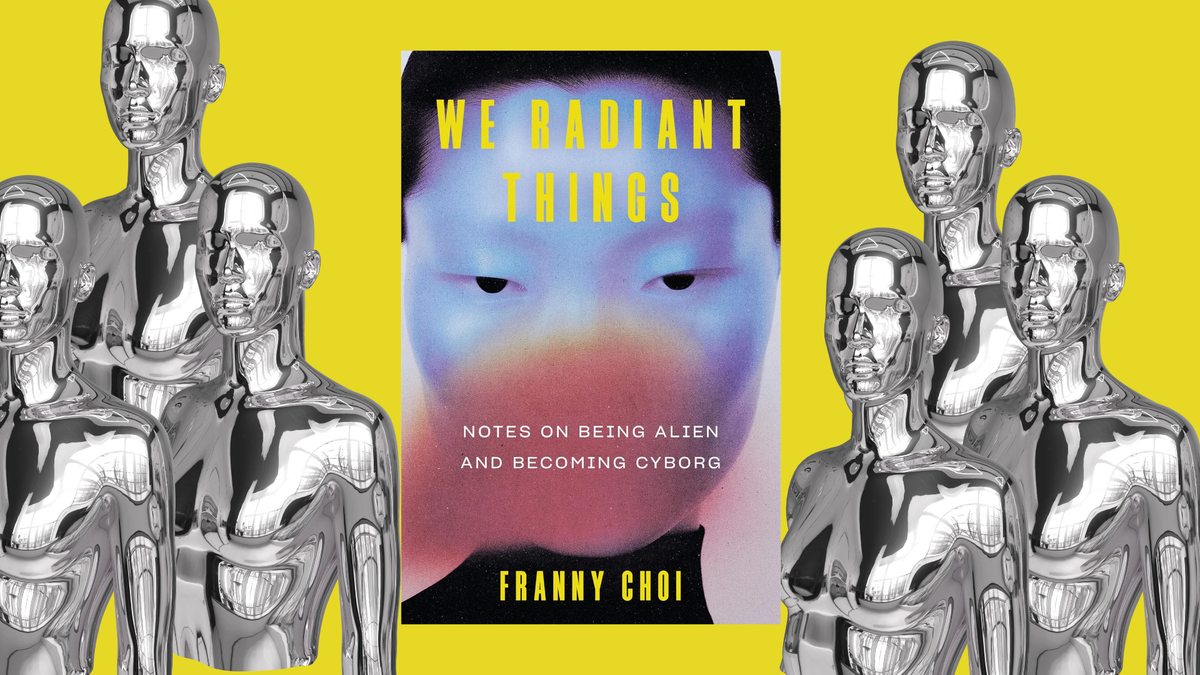
I'm in This Picture and I Don't Like It: We Radiant Things by Franny Choi and Our Cyborg Present
At a time of fascism, of AI as both a real existential threat and a specter feeding alarmist fantasies of the future, We Radiant Things doesn’t only look ahead or behind, as we are constantly urged to, but closer.

Disclaimer: The Bookshop links in this post are affiliate links and Who Even Reads may earn a commission if you click and buy a book.
“We can all agree that Arnold Schwarzenegger is not, technically speaking, Korean.” This first sentence to end all first sentences begins the fourth essay in Franny Choi’s We Radiant Things, “Artificial Allegiance: The Terminator,” calling attention in its humor and bravado to the great power of first sentences: their lack of context. But I brought my own context to that sentence. Because despite having never seen the movie Terminator 2: Judgment Day, I am familiar with the corresponding arcade game, which my father, who grew up in Korea during the war, relentlessly fed quarters into on many weekend days of my childhood, at a truck stop in Illinois where he and my brother and I often ate on our way back from hiking at a state park.
In the essay, Choi expounds on how their own Korean father’s love of the movie made it something of a shared familial tradition and Schwarzenegger a kind of honorary relative as they were growing up, and reflects on how Terminator 2—in which the titular cyborg is charged with saving humanity by fighting the T-1000, a Terminator who is 100% machine—parallels the immigrant experience, the Asian American experience, and in some ways, the Korean American experience specifically. They liken the idea of Schwarzenegger’s character (“a good machine”) to White American fears of foreign efficiency and attempts to harness it, and tie the human (and, relevantly, White woman) Sarah Connor’s mistrust of the Terminator to how American soldiers in the Korean War were unable to distinguish between “the civilians to save and the civilians who might be enemy combatants in disguise” and were ordered to kill them en masse.
I watched my father, over a matter of months and years, invest hundreds of dollars into shooting enemy cyborgs who came apart in grisly, strangely satisfying layers of metal and flesh. I remember him telling me, as we stood in that truck stop in the middle of nowhere, that if you practiced something difficult for long enough, you could get good at it, and I remember wondering what he was trying to get good at. Firing a fake machine gun? Maybe it wasn’t that deep (some people just enjoy video games), and his story isn’t mine to tell. But in reading Choi’s essay, I was struck by their use of the word “good” to refer to both skill and perceived moral goodness in the situation of the Western Asian caught in the sights of the model minority lens. This concept is also devastatingly captured in “Imitation Games: Eugene Goostman and Mitsuku,” which sets the ability of computers and AI to mimic human behavior against the ability of Asian people (whether first-gen immigrants or not) to present as non-foreign (read: human) in the West: “For those of us who have ourselves used English as the chief technology to convince others of how we should be treated, our sentences are always haunted by the precarity of our claims to be real.” As the meme goes, I’m in this picture and I don’t like it.
Again, I’ve never seen Terminator 2, and as I moved through the essays in Choi’s book, which addresses many subjects related to how the Western consciousness perceives Asianness and femmeness in relation to technology, sci-fi concepts and aesthetics, and robotics, I was surprised to find that I had somehow managed to avoid directly experiencing pretty much all of the pop culture touchstones used as a loose framework, with the exceptions of Blade Runner (“Notes Toward an Essay on Blade Runner”) which I have mostly forgotten, and the Flaming Lips’ 2002 album Yoshimi Battles the Pink Robots (“Love, Death, and Pink Robots: Yoshimi”) from which I can conjure up part of at least two radio singles but which I mostly tried to ignore when it came out. Ghost in the Shell, a Japanese sci-fi franchise that serves as a recurring reference in titles and essays throughout the book, mainly brings to mind for me the controversy around Scarlett Johansson being cast in the lead role of the live action movie based on the manga and her embarrassing comment on it (“I should be able to play any person, or any tree, or any animal”), though this comment, quoted in “Ghost in the Shell: Camouflage,” is also relevant to the film's cultural significance for Choi.
That being said, I don’t think I really need to explain why I have avoided or otherwise divested my mind of these cultural landmarks, but Choi’s reframing of them makes them feel fresh and ripe for exploration. The introductory essay, “You’re Wasting Your Time Talking to Her: Kyoko,” focuses on the 2014 film Ex Machina, in which an Asian robot maid named Kyoko turns violent. There are tropes and stereotypes here but also release. "At first, my anger about the Asian character's portrayal seared hot," Choi writes, "But as the film unfolded, and as Kyoko refused to stop haunting its background, something changed...at some point, the old hurt began to simmer and bloom, the way sugar caramelizes into something altogether familiar and new." And here, Choi urges the reader to look closer, not to turn away, as I have been doing for years. Kyoko serves as a point for Choi to conceive this collection, a point at which intimacy collides with violence, where admiration collides with love, where the idea of humanity collides with the idea of what lies outside of it.
I’m in this picture and I don’t like it. But, one cannot get out of the picture. But, as Choi suggests, everyone is somewhere in this picture. “Ghost in the Shell: Camouflage,” describing a trip Choi ostensibly took to Tokyo, comments on “the irony of being a Korean disappearing into a Japanese background.” I say “ostensibly” because the essay is written in second person, which adds a layer of perspective as the reader, whoever they may be, is made to experience this very specific scenario in a narrative that has the feel of a text adventure devoid of choice, in which gratification ultimately lies not in controlling one’s circumstances but in watching oneself:
“When, at Akihabara, you grumble ‘Sumimasen’ to get around a group of white women in hoodies blocking the doors with their enormous suitcases, you glow with the pleasure of being the background that points to the interruptive force of foreignness. It feels like revenge for something. You reach toward it like oxygen.”
The fluidity of these creative essays is key to the view they provide of a cultural landscape that they also add to and alter. A few of them are presented as “notes,” with frequent line breaks between staccato thoughts. “Imitation Games” breaks the usual nonfiction contract between reader and writer, using its own language and structure as a device to explore its theme of the genuine and the artificial, and what might happen if, once again, the roles of subject and object were changed, if the man behind the machines verifying our humanity was the one to be scrutinized.
Much of what is addressed in this collection reminded me of an interview with the poet Natalie Diaz on Between the Covers, in which she and David Naimon discussed the assumptions behind the value of being human and of humanity. “I think human is a very problematic word,” she said, and cited the writers Sylvia Wynter and Roger Reeves as asking in their work, “What do we mean by human? Who can even be human and who would want to be a human?”
Choi asks these questions while adeptly drawing intersectional maps of identity, of showing the role of Asianness in its relation to Blackness and Whiteness (as in the creation of the model minority), of queerness in relation to Asianness and foreignness to disability (relating the concept of the “glitch,” or malfunction, to living as a queer person of color, citing Glitch Feminism by Legacy Russell, or with a neurodivergence like ADHD), of multiple marginalization and the new, flexible worlds it creates. In another second-person essay, “Ghost in the Shell (Intensive Care),” Choi describes flying to Italy after their mother suffered an aneurysm and was subsisting on life support. They reflect on the neutral potential of technologies, in how “all tools hold within them the simultaneous promise of death sentence and lifeline,” but also, how “this is what technology is for…to enable the possibility of life. This is what those who have lived as cyborgs, disabled people whose lives already depend on their entanglements with technology, have long known.” At a time of fascism, of AI as both a real existential threat and a specter feeding alarmist fantasies of the future, We Radiant Things doesn’t only look ahead or behind, as we are constantly urged to, but closer. Closer to the present, its accumulation of preoccupations, prophecies, dreads, and where they come from.
This closeness, rendered in conscious language, inspires me to think carefully and transformatively about language itself. “Human” is one example, another is what I said earlier about Choi breaking the contract between reader and writer. I was writing from a default mode of certain assumptions, according to language and concepts automatically generated from this imperialist language I speak, but is that a contract that I personally agree to or hold the writer to? No, no more than I consent to being harassed by Google’s default AI assistants. As a reader, I assume the writer will do whatever they want, and I can keep reading or not. We’re making meaning, not a house that will collapse if we ignore the building codes.
Let me try again. As I read “Imitation Games,” something unexpected occurs. A curtain lifts. Previously hidden light floods in. I am being led somewhere different than I believed, and I am delighted.
Who Even Reads is an independent publication run by two hardworking editorial professionals. We write about books from a liberation perspective, with a socially conscious focus that's both fun and serious, covering mostly new releases. Your donations subsidize what we do. Learn about us.