Just "melt everything together": We Try the Sigrid Nunez "Crookie" Technique
Can you really combine two finished, flour-based products using only heat? If Jo in Nunez's "Mother-Daughter Story" is skeptical of the concept of the crookie to begin with, we were skeptical of the feat she performs with the toaster oven, though impressed by her confidence.

“Mother-Daughter Story” by Sigrid Nunez, appearing in her collection It Will Come Back to You, one of our July picks, features main character Mo, whose mother has recently passed away. Mo had a difficult relationship with her mother, whose behavior towards her was caustic and diminishing, but has a better relationship with her own daughter, Jo. As they go to clean out Mo’s mother’s home after her death, Mo and Jo pass a patisserie selling “crookies,” croissants with cookie dough baked into them, a viral food trend. Mo seems to think the crookies' popularity, the line stretching down the street, must be an indication of how good they are. Jo is skeptical. “It’s not about the taste, Mom, it’s about the hype. People always want whatever the latest viral food trend is.” But Jo wants to do something nice for her mother in this troubling time. Rather than wait in the long line for crookies, she buys two croissants and “one large, soft chocolate chip cookie,” melts the cookie together with the croissants in the toaster oven back at her late grandmother’s cottage, and lets Mo believe they are the genuine article.
We are both relatively online, but in a limited way, so neither of us had heard of the “crookie,” which we at first believed was Nunez’s own play on the “cronut.” As it turns out, crookies are a thing in the real world, having gained viral-trend status with a TikTok video in 2024 after being created by Stéphane Louvard of Maison Louvard in Paris in 2022; Nunez’s story was first published in 2025. Finding this out was kind of disappointing, as it would have been amusing if crookies were an original fictional invention.
We were still curious about whether the science of what Jo does would actually work. There are recipes for crookies online, but they generally call for cookie dough, not already-baked, fully structured cookies, for obvious reasons. Can you really combine two finished, flour-based products using only heat? If Jo is skeptical of the concept of the crookie to begin with, we were skeptical of the feat she performs with the toaster oven, though impressed by her confidence.
A while back, we started a Stories in the World series, which we intended to be about connections between fiction and real life, whether our own personal experiences (dealing with the baffling logic of not-so-straight straight girls), larger issues (the ongoing Covid pandemic), or both. But it occurred to us that while we had initially thought of this series as being more issues-based, there was no reason it couldn’t also be about whimsy and adventure. So we decided to make this installment about testing the reality of Nunez’s story and Jo’s humble, makeshift approach to the crookie: “she sliced open each croissant, placed a piece of the cookie inside, and another piece on top, and she heated the croissants in the toaster oven to melt everything together.”
Oh, so she just melted everything together. Okay. Sounds simple enough.
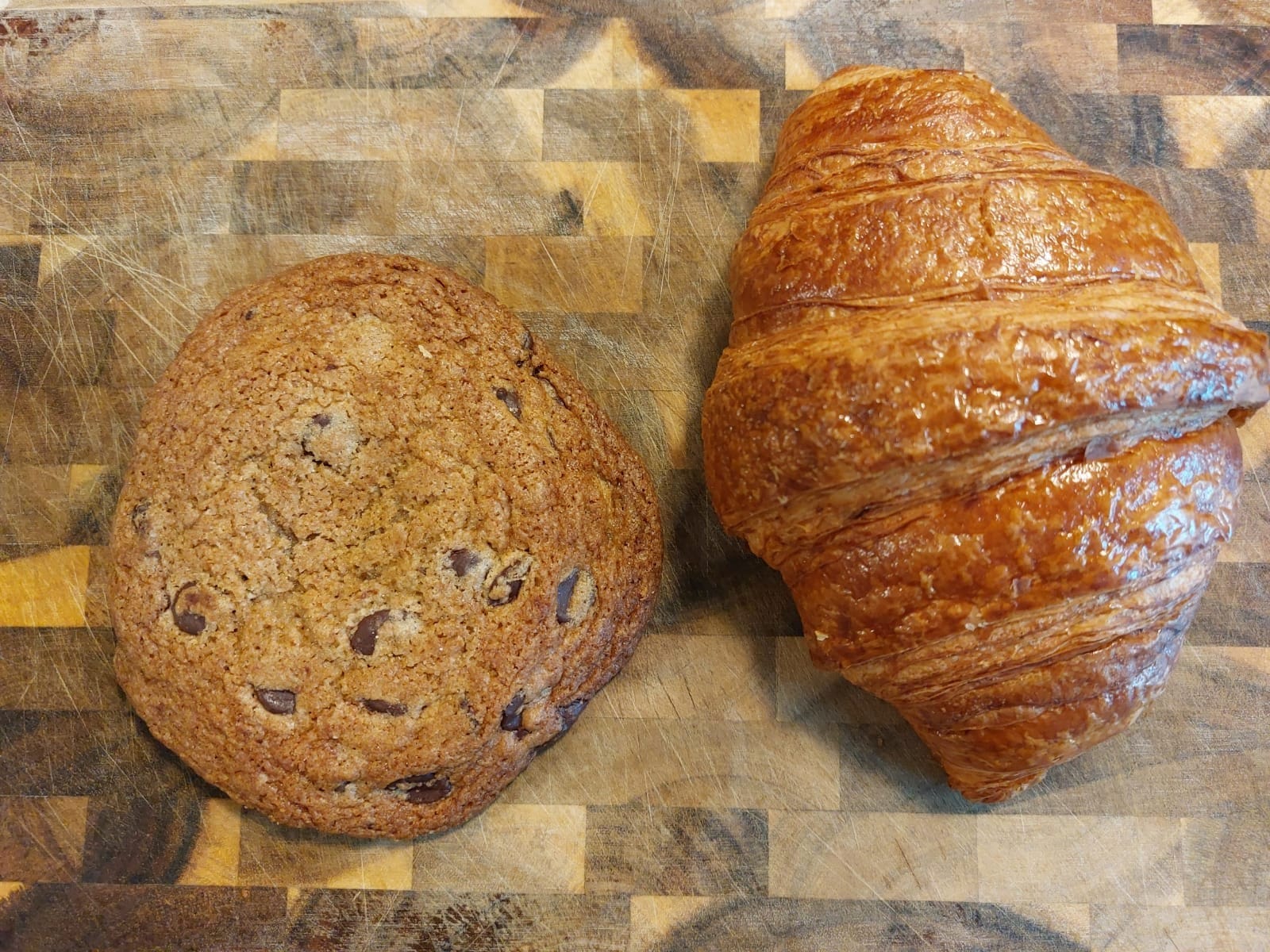
First, we went about obtaining a croissant and cookie. The chocolate chip cookie Jo gets from the patisserie is “soft,“ and it did seem to us like the cookie that would have the best chance of working for this project would be the softest and moistest possible, bringing to mind the kind of palm-oil laden doughy affair you might find in a cafeteria or grocery store.
But a patisserie participating in the “crookie” trend would undoubtedly be a bit bougie, so we thought it only fair to get what we needed from a respected local bakery, somewhere sort of upscale but with a playful penchant for excess, the kind of place where the staff might, if they felt like it, try out their own gourmet version of a croissant stuffed with cookie dough.
The cookie wasn’t as soft as we would have preferred, but as it was made with brown butter, it was softer than it might seem from the pictures. Cutting the croissant open and sandwiching a piece of cookie inside, then placing a piece on top, literally just sitting there like a little graduation cap, felt absurd. We were tempted to add something to help glue it together, like an extra dab of butter or honey, but if Jo does something like that in the story, it isn’t mentioned, and of course these two items were already decadent enough on their own, if dry.
So we just sort of pressed the cookie piece on top into a shape that conformed to the shape of the croissant. This seemed a little pathetic and we wondered, not for the first time, if Sigrid Nunez had bothered to try this herself before putting it in a story or even thought through the logistics.
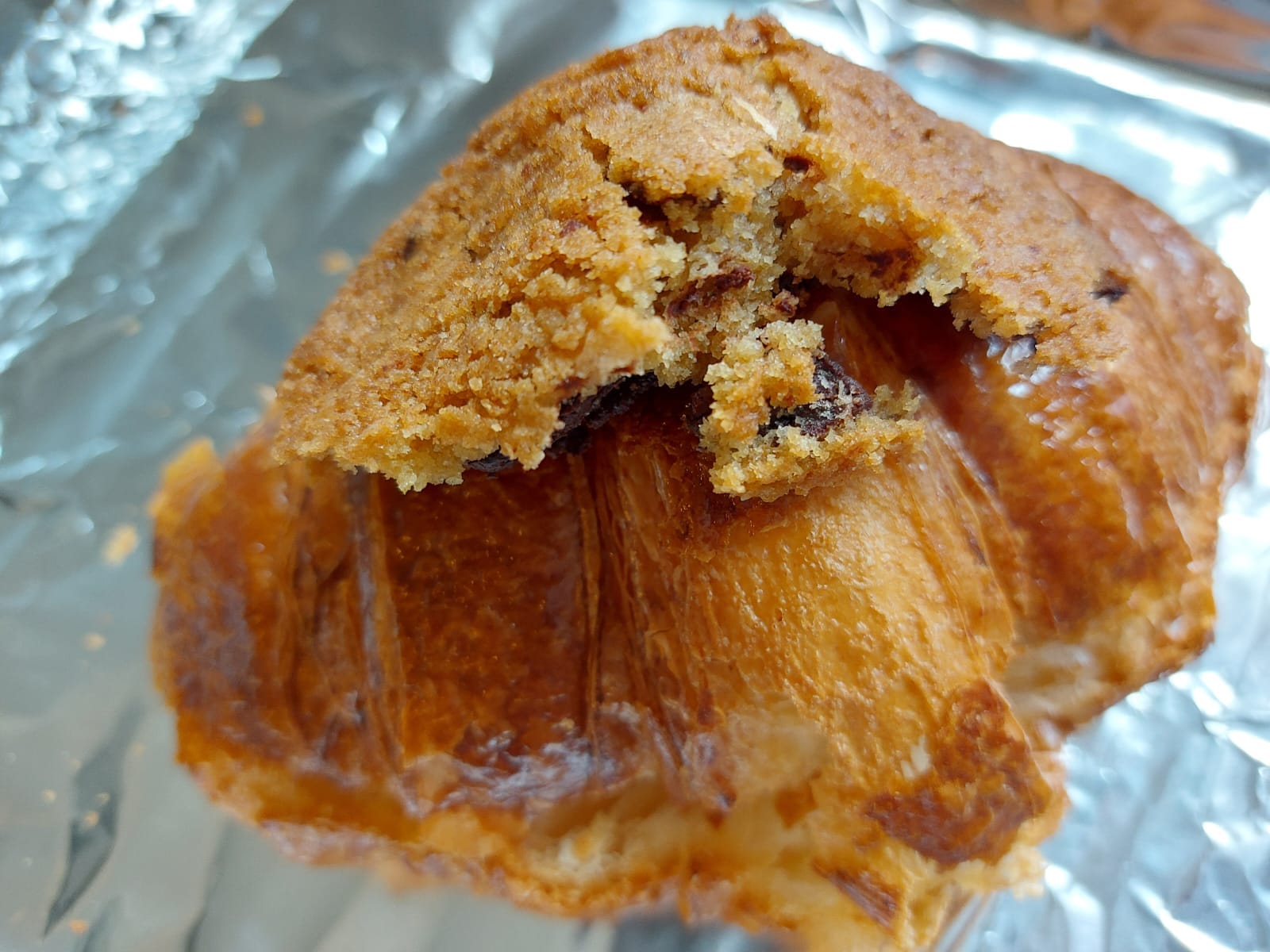
Burning or even over-toasting the croissant would ruin what was meant to be a delectable, gooey treat, so we decided to start with just five minutes at 350 degrees. It was hard to tell if anything was happening. The chocolate chips on top were softening in the heat, but melting might be putting it a bit strongly. Certainly they were not visibly melting together with the croissant. When we took the baking sheet out of the toaster oven to check on the progress, the cookie on top had not adhered to the croissant at all, and it honestly would have been shocking if it had.
We decided to give it a few more minutes at 350, but as the croissant already seemed quite crisp, we were afraid to leave it any longer than that. Besides, we weren’t going to know what was going on inside this thing until we cut it open.
After taking the croissant out of the oven for the final time, we let it rest for a short while with its little top piece, nothing more than a cookie garnish. Slightly softened now, the whole item actually looked pretty, maybe like an actual dessert of some kind, but it still mostly looked like a croissant with a bit of cookie on top.
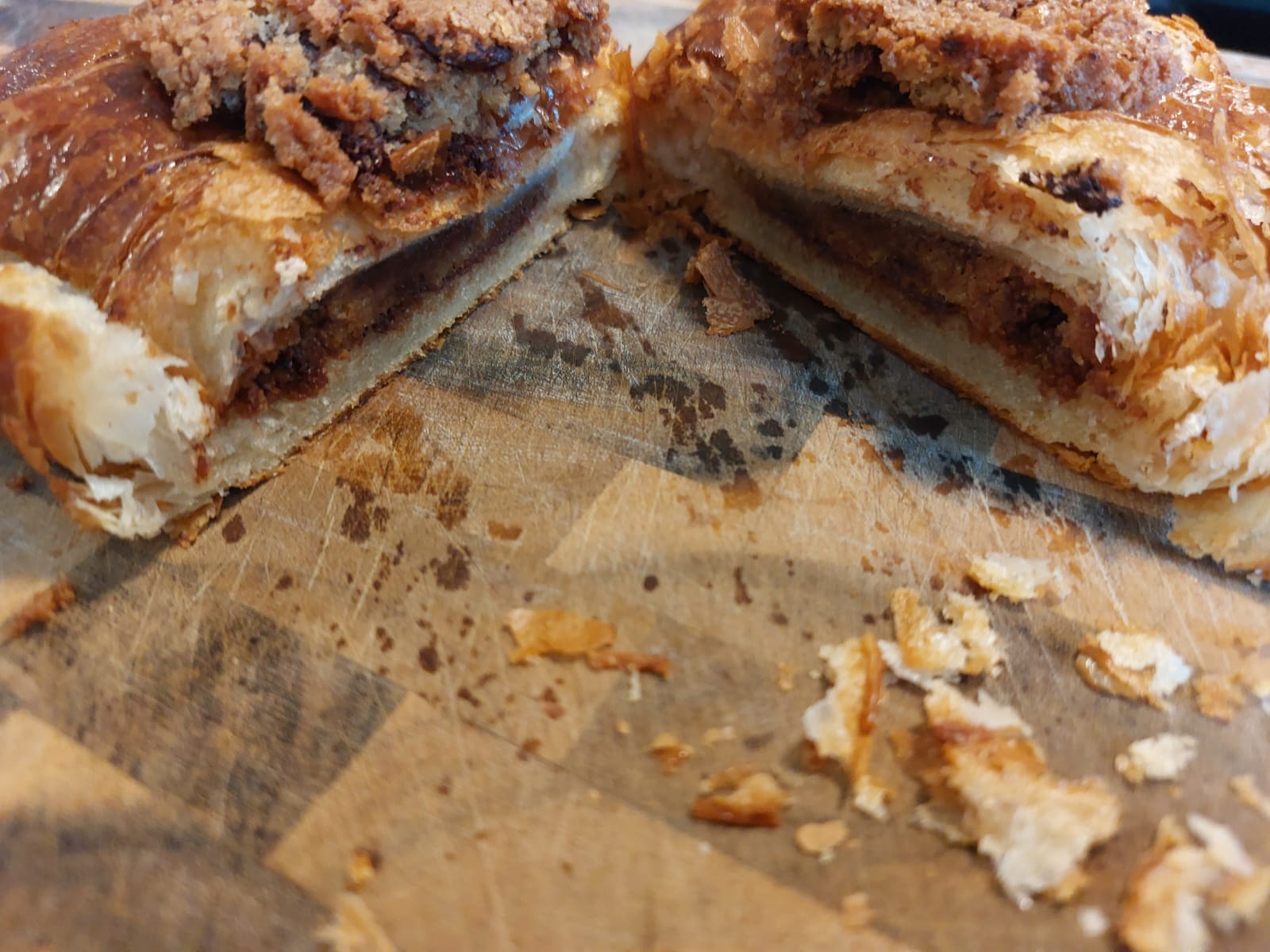
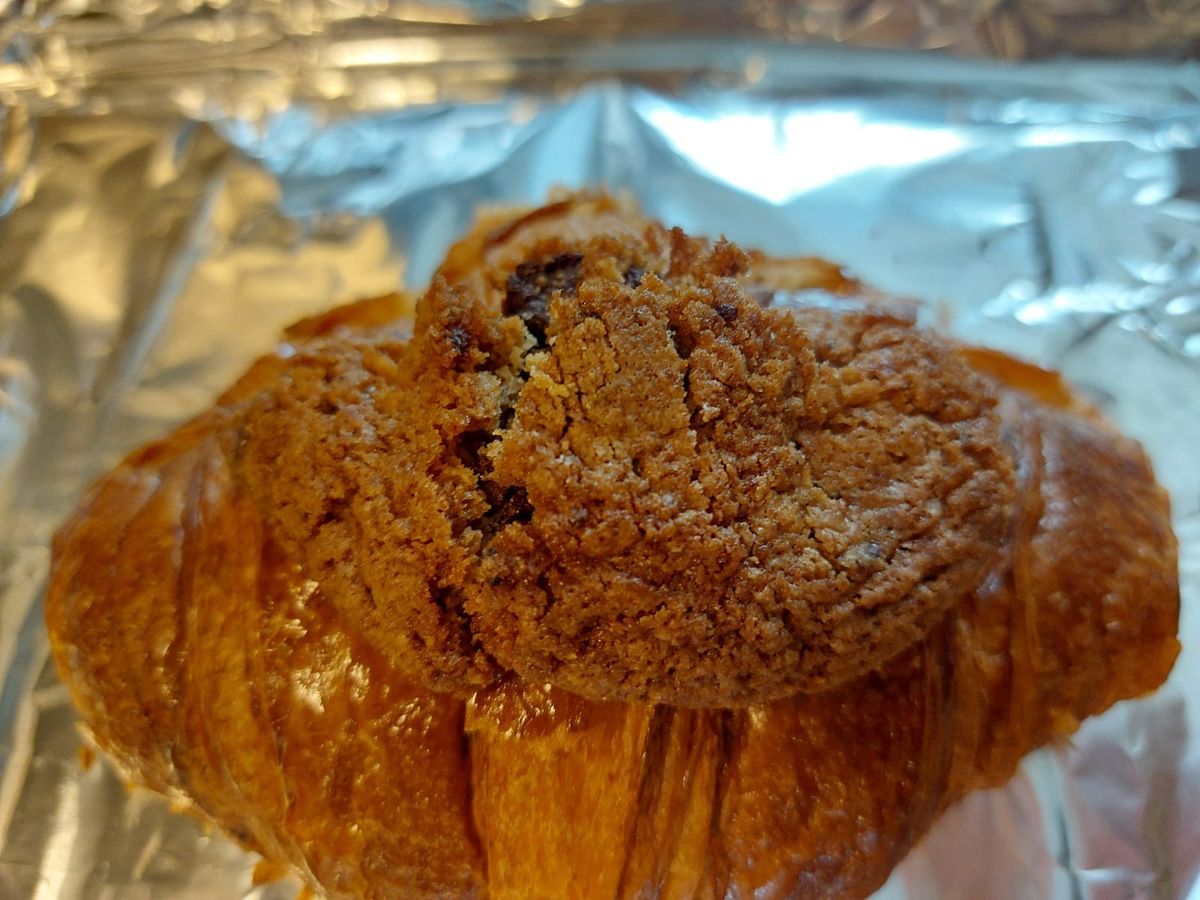
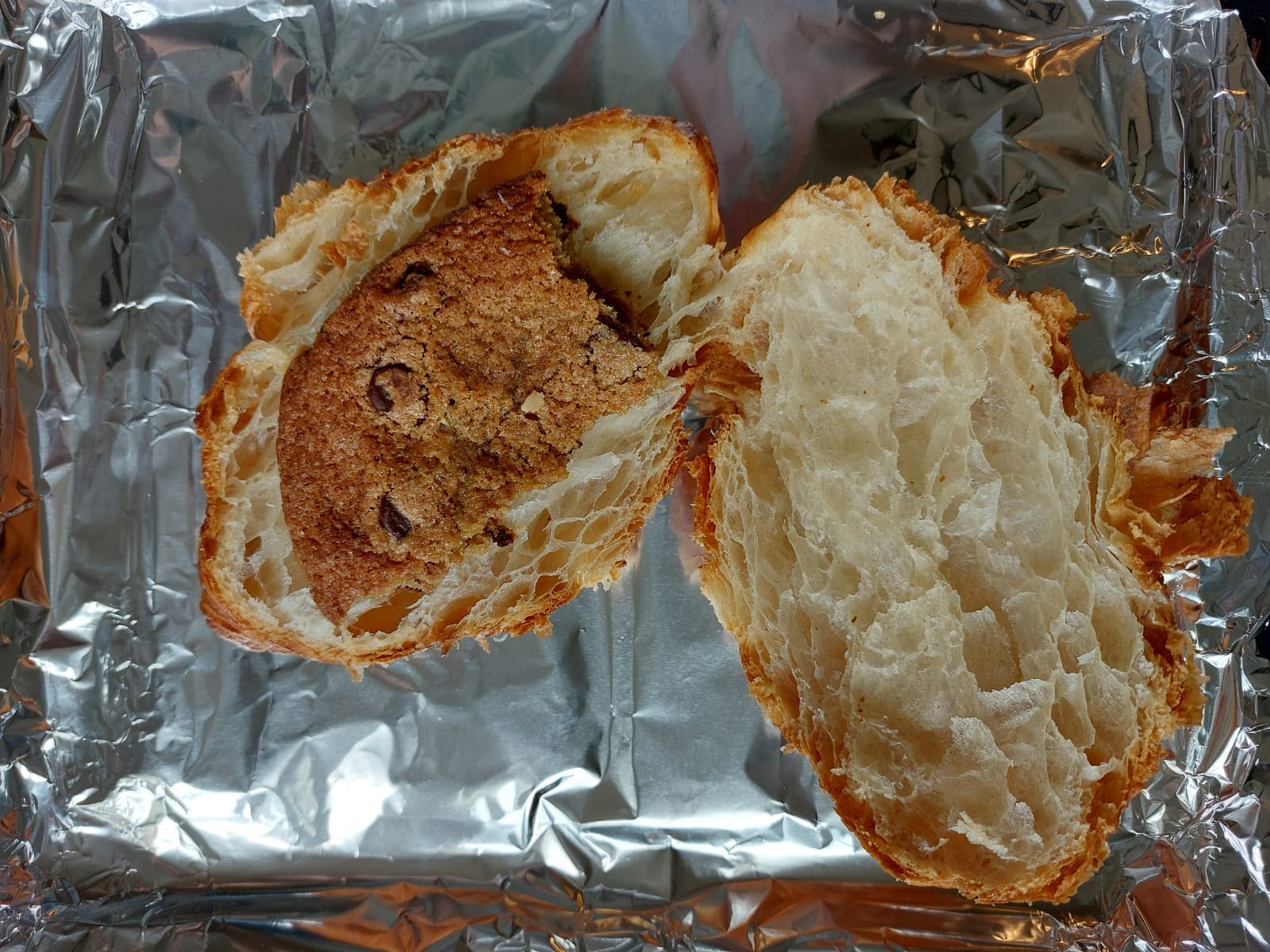
So it was genuinely surprising when we cut it in half and found that a sort of metamorphosis had occurred (appropriately, a major plot point of the story revolves around Kafka—more on this later). The cookie on the inside of the croissant had taken on the appearance of a filling rather than a separate chunk of cookie.
The whole thing was probably not truly melded together, but to be fair, neither is a layered cake, you’ll find, if you try to pick it up by only one of its layers. So the top garnish had, in a sense, failed, but the rest of the croissant looked quite legitimate. It looked like something you could call a chocolate chip cookie croissant, or that the kids might be calling a crookie.
The way this turned out seemed to be due to the croissant trapping moisture between its layers, leading to a different result with the cookie on the inside than the outside. The cookie inside must have lent some of its moisture to the croissant because the moisture wasn't able to evaporate, or something like that. This left the outside of the croissant light and flaky while allowing the inside to lightly fuse with the cookie. The inner parts of the croissant appeared moist, with something like the look of a pie crust around the layer of cookie.
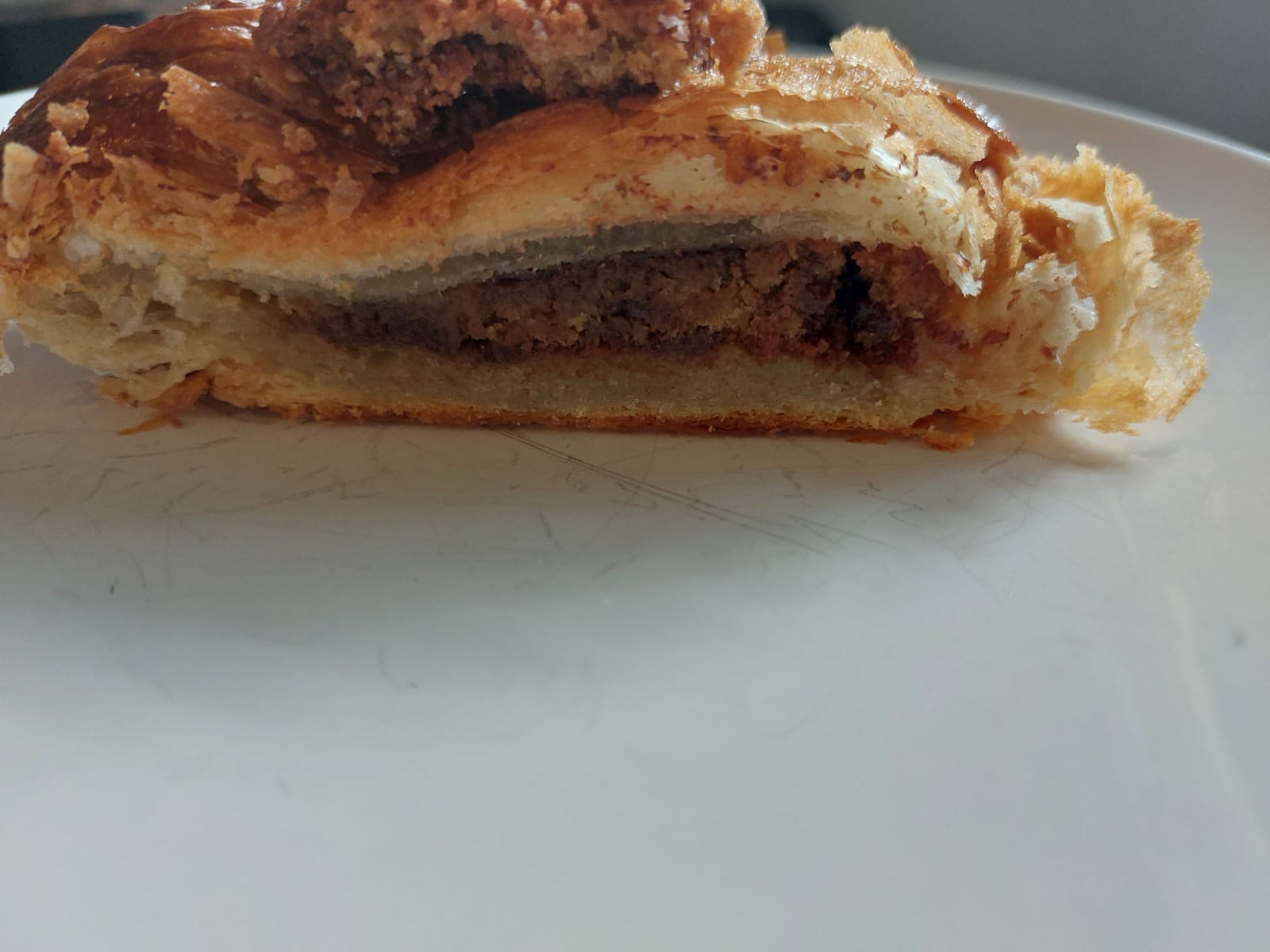
Eaten warm, it tasted like a chocolate croissant—more like a sophisticated treat and less like a simple sugary indulgence than we’d had any reason to expect. Part of this was probably down to the fact that we may have gone a little too high-end with the cookie, which used chocolate that was darker than what we had anticipated.
Again, we were operating on the assumption that the patisserie Jo stopped in at was at least a little fancy, if only Instagram faux-fancy. If specifically making a “crookie,” though, a place like this would probably have used something more akin to their own version of pre-made store cookie dough. And the kind of soft chocolate chip cookie a person looking to deceive their grieving mother might find there would really be down to the baker's style.
So Jo’s crookie experiment could have turned out something like ours, or a little different, but we have no trouble believing that she could have fooled Mo.
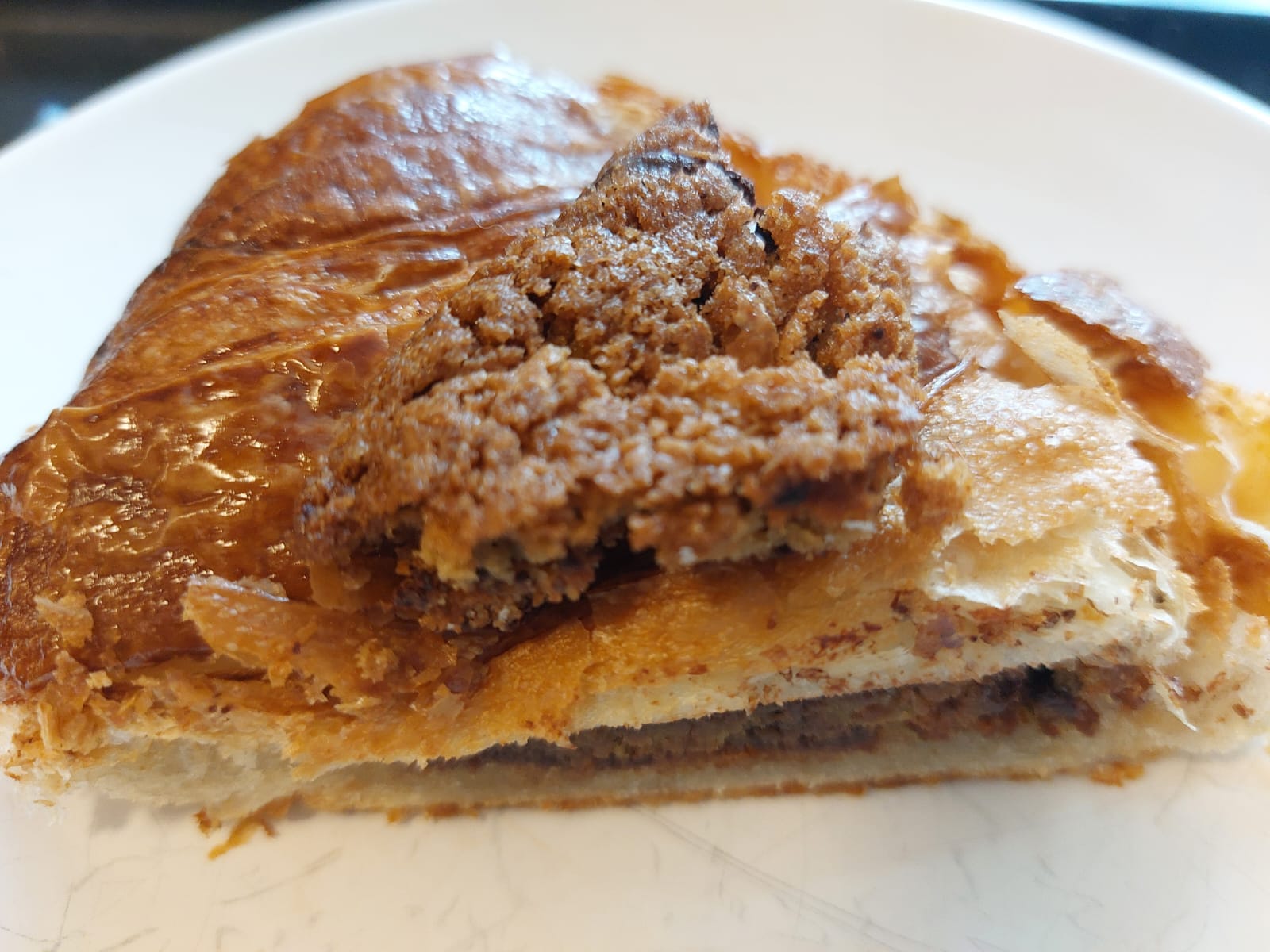
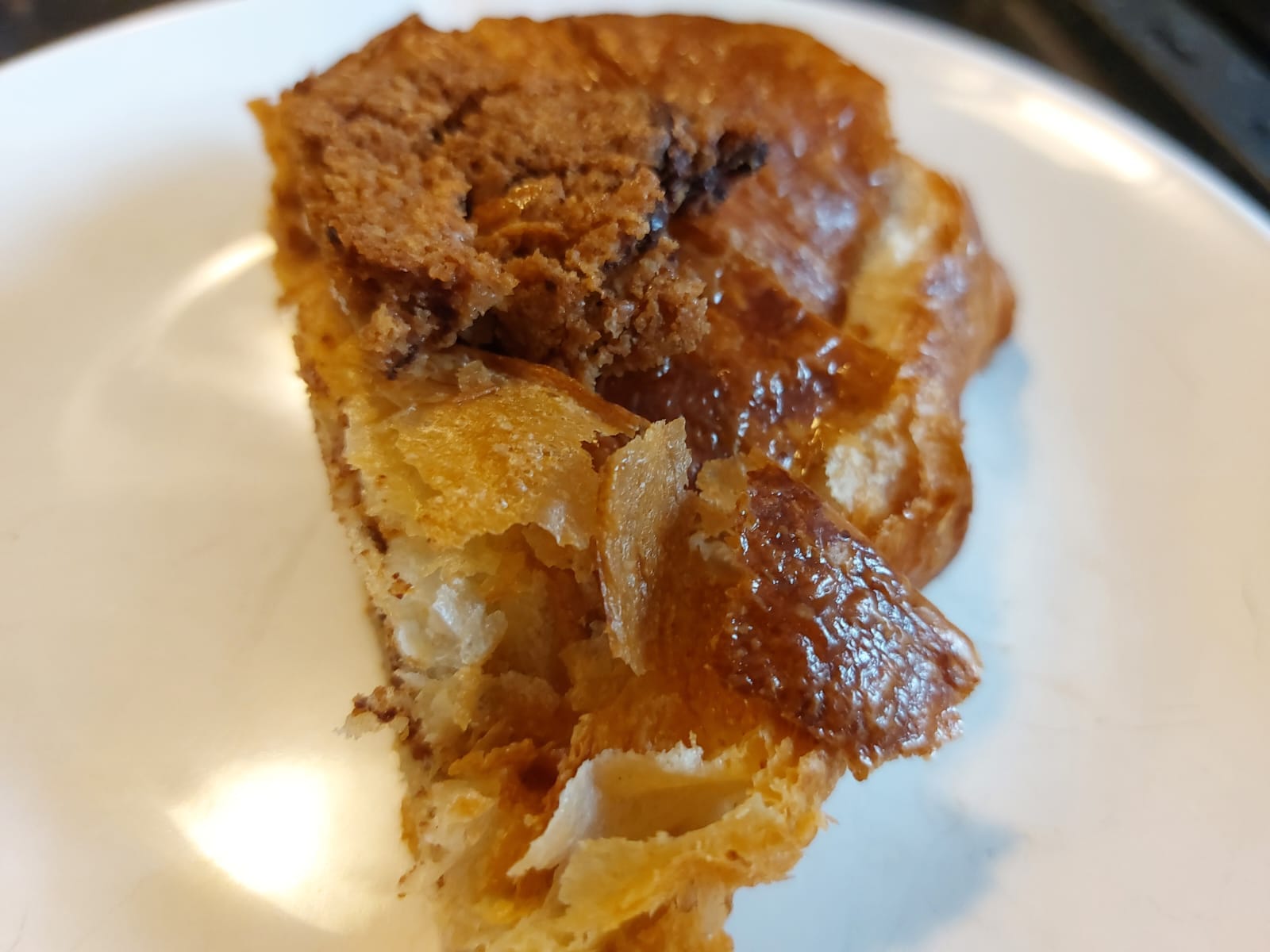
The only point on which we remain dubious is the piece of cookie on top. It seems unlikely that it would have adhered to the croissant regardless of its quality, and Mo could have become suspicious if she had picked up the croissant and the cookie had simply fallen off. But maybe the point is that Mo doesn’t care, even if she does suspect something is amiss.
Early in the story, while cleaning out her mother’s house, Mo discovers an old college assignment of her own in her mother’s nightstand, a “letter” she was supposed to write to a parent after having read Kafka’s “Letter to His Father.” There are many questions raised: Did Kafka actually intend for the letter to be read by his father, or was it supposed to be a story? Did he then intend for anyone else to read it, as he famously ordered his friend Max Brod to burn his writing? And what about Mo? Did she intend for her mother to come across her letter? Did her mother ever read the letter?
As with this drama around the existence of the letter, the “crookie” raises questions, though much more playfully, about what is “real” and made up, what the purpose of a thing is, and what, as in the case of viral trends, is actually a legitimate venture that deserves to be taken seriously. But between Mo and Jo, these questions are not so deep and ultimately don’t matter, because while the two of them have had their ups and downs, nothing is really wrong between them. Jo’s mild deception is both self-serving and well-meaning, and she entertains the idea of eventually telling her mother about the true origin of the crookies. And since this last part of the story is told from Jo’s point of view, it could be that Mo is being deceptive herself, that she is not being entirely straightforward when she says, “This is the best pastry I ever had.”
It’s also implied that Mo, while older, better understands the value of the pageantry that accompanies viral trends because her life has to some extent been emptier, and so she can appreciate the ways in which people try to fill space. When Jo assembles her version of the crookies, she’s humoring her mother, but also making an effort to create a space for her, building care through her own efforts at illusion and pageantry.
We’re sorry we doubted you, Sigrid Nunez. It all checks out.
Who Even Reads is an independent publication run by two hardworking editorial professionals. We write about books from a liberation perspective, with a socially conscious focus that's both fun and serious, covering mostly new releases. Your donations subsidize what we do. Learn about us.