A Song of Solomon Woman's "Virgo Shit": Deesha Philyaw's The True Confessions of First Lady Freeman
There is something infectiously appealing in Schar’s self-interest, in her daring to dream of what the church can do for her, and in the frankness and self-awareness she brings to the role of First Lady. Schar is so mesmerizing, so alluring, complex to the point of being unpredictable.

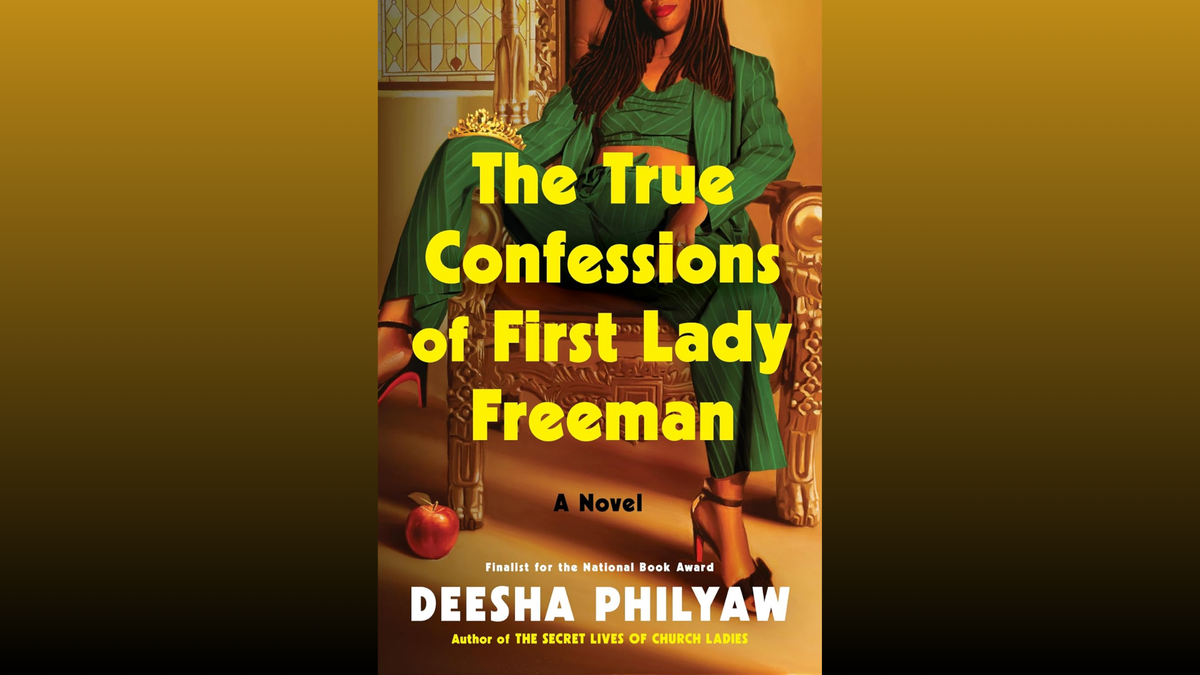
Deesha Philyaw’s The True Confessions of First Lady Freeman opens with Proverbs 31, a chapter of the Bible recounting advice to King Lemuel from his mother, including the attributes of a “wife of noble character.” In the story’s world of Black American megachurches, as in real-life Christianity broadly, this chapter is often held up as a template for the ideal Christian wife: tireless, scrupulous in “affairs of her household,” supportive of her husband.
Narrator Scharisse Freeman, aka Schar, “First Lady” to her wealthy and highly respected pastor spouse David, has devised a comedy bit about how she has given up on being a Proverbs 31 woman—“But seriously, folks, these days, my husband travels so much, I’m more of a Lamentations woman. ‘Woe is me for my man goeth afar for many days and nights and leaveth me alone in a cold bed.’” This bit is to be her performance in the talent portion of an annual First Lady pageant that for Schar represents the chance for acceptance into an elite circle of megachurch pastors’ wives among whom she has always been something of an outcast, and with whom she sullied her reputation a decade ago when she invited the women and their husbands on a couples’ retreat sponsored by a sex toy (“marital aids”) company. While the mystery of what exactly happened during the retreat is dragged out for half of the novel, what happened is not really the point; the point is that Schar feels the other First Ladies are aloof to her because she was born out of wedlock and raised in poverty. She seems to have married David in part because of the status it gives her, but this motivation bleeds into reasons of security and romance. She sees love, money, religion, family, community, and success as moving in harmony, as connecting in one long, neverending gesture. Her “favorite of all the novels by dead white people I’d been forced to read in high school” is Jane Eyre, and she’s a Virgo. She desires romance, sex, and spontaneity, yet fears leaving those things up to chance. Schar is a dreamer, but also a planner, and woe to anyone who gets in the way of her plans.
The novel is presented as Schar’s memoir and mainly related as a long flashback after we first see her onstage at the pageant, having been accused of scandalous behavior with someone else’s husband and about to let loose with some big reveal. Events of the previous year are related, including and following her fortieth birthday and mainly taking place in and around her home in Belleton, Georgia. During this time, Schar is preoccupied with the pageant, as she believes winning it will finally gain her the respect she feels she has always lacked, despite her already very cushy life with David and their teenage daughter Gabrielle. Schar’s need for more and more seems driven by what she has lost in choosing her life with David. Significantly, her former best friend Petra, who approached Schar in eighth grade to introduce herself as the child of “Abena Addo and Rocky Moore, Black British supermodel and Georgia white-boy rock star, respectively,” both deceased from heroin overdoses. Petra had heard Schar’s mother was also dead, and so proposed “we could be mates, like the Dead Mums Club or somefink.” Petra’s openness with her bisexuality and her leftist politics have come to inform Schar’s own outlook, but not enough for Schar to publicly claim her in the passively homophobic and materialist atmosphere of her marriage. And then there’s Schar’s Aunt Marie, who raised Schar after her mother’s death while regularly using crack. Schar’s relationship with her aunt is understandably complicated, but it seems she has put distance between them mostly to keep her past life from colliding with her present.
More than Proverbs 31, or Lamentations for that matter, Schar’s desires and motivations bring to mind the lyrical Song of Solomon, not just for its oft-discussed sex parts, but for its Cinderella melding of romantic love with royalty, its sensual and haunting account of a woman who rises above a life of labor through her king lover, subject to varying interpretations—ranging from an allegory signifying the relationship between God and the believer to a celebration of marital bliss. Interestingly, as Schar herself notes, some people believe that King Lemuel of Proverbs 31 and King Solomon, loosely represented as the king figure in Song of Solomon, are one and the same. Also interestingly, while Song of Solomon is mentioned in passing by Schar (with reference to the sex parts), its parallels to her own life are never addressed, but simply left to linger in the background.
There is something infectiously appealing in Schar’s self-interest, in her daring to dream of what the church can do for her, and in the frankness and self-awareness she brings to the role of First Lady. Yale-educated and shaped by her bond with Petra, Schar wears her religion loosely and frowns at exclusionary and capitalist-driven Christian viewpoints. Sometimes. She acts like she doesn’t understand Petra’s criticisms of President Obama (“Something something drones and something something about codifying Roe”), and she fawns over celebrities and the obscenely wealthy, but she is also frequently politically astute and socially openminded. When she catches Marcus, David’s cousin and their live-in private chef, having sex with a woman in the house, she remarks, “You know … some religious scholars believe that, in the Greek New Testament, ‘fornication’ is a clumsy translation of ‘porneia,’ which actually refers to other sexual sins, not premarital sex. And besides, you’re both adults.” And when Jeddah Lancaster, one of David’s fellow pastors who holds a key to Schar’s past, observes of a nearby rural area that several big chain stores will soon be moving in, “All the usual suspects that transform a hick town into a civilization,” Schar responds, “With all the Black and Native blood that’s been spilled on this land, this place will never be civilized.”
This is Deesha Philyaw’s first novel, after her excellent story collection The Secret Lives of Church Ladies (2020), which by comparison may strike readers as relatively sedate with its mostly realistic literary fiction about characters who struggle to find a way out of the constrictions placed upon them. They are Black women and girls at different ages and stages, often marginalized within their own communities and doing things their parents wouldn’t approve of but otherwise living pretty ordinary, quiet lives. If there is an exception to this, it’s “Jael,” a somewhat larger-than-life narrative, equal parts funny and disturbing, about a queer teenage girl discovering her autonomy that resonates louder and longer than any other. This story, with its verve and voiceyness and unapologetic charisma, feels like the most obvious throughline to The True Confessions of First Lady Freeman. And how delightful that this is the direction the novel takes. Schar is so mesmerizing, so alluring, complex to the point of being unpredictable. This is not typically the way “complexity” is used as a compliment, to say that characters are not just relatable and inwardly nuanced but outwardly exciting and special, but I mean it that way. And while Philyaw’s other characters and stories may come across as more sedate, they, too, have fireworks in them. She’s an author with refined literary chops who refuses to use them in boring or same-y ways, a writer who is unafraid to ride the most outrageous waves all the way back to dry land.
The True Confessions of First Lady Freeman is a book you can read on a plane or in a waiting room or anywhere. As Schar’s tell-all, it’s as entertaining as such a memoir would be if it was real, if you picked it up in an airport bookshop along with Michelle Obama’s autobiography (which Schar would love). It presents a mystery around her family and origins, and suspense in the question of what ultimately happens between her and the other First Ladies. It requires a suspension of disbelief in how much of the story of her life is rendered in dialogue, but I imagine that most readers, like me, will be fine with this for the reason that they want to see the exact reality TV version of what happens. Similarly, a lot of action and developments pile up very quickly, and the drama and speech can feel a little “1.5x speed” at times, but this does reflect the pace of a story based around gossipy, talky subjects, and this is a book you want to read fast.
The grace and perspective of The True Confessions of First Lady Freeman is in its framing, in its blank spaces. Even if you’re seeing exactly what happens, what happens is not all on the page. Schar seems like an honest narrator but is very in her own head. This is a fun place to be. You can dive into her smooth storytelling without really thinking at all. And yet Philyaw’s novel has a long, long finish. Towards the end, as the story still bubbled and fizzed and sparkled with Schar’s voice, I was conscious of the other characters on the edge of the narration. I found myself lost in thought about Petra, about how the gravity of Schar’s rejection must have hit her. And of Schar’s mother, whose story ends up being such a large part of her daughter’s, and whose secrets her daughter finally decides to tell. Taken at face value, the memoir is a wild ride; it winds up hard and down fast and leaves you breathless and off-balance, but then that’s not all. There’s more.
Who Even Reads is an independent publication run by two hardworking editorial professionals. We write about books from a liberation perspective, with a socially conscious focus that's both fun and serious, covering mostly new releases. Your donations subsidize what we do. Learn about us.