Review: Nina McConigley's How to Commit a Postcolonial Murder, Being a Biracial Asian in 1980s America, and Other Things Best Left to the Experts
In which I write about Nina McConigley's debut novel and fall far into comparisons to my own biracial childhood and adolescence in the 1980s and '90s, as well as musings on Asian American literature.
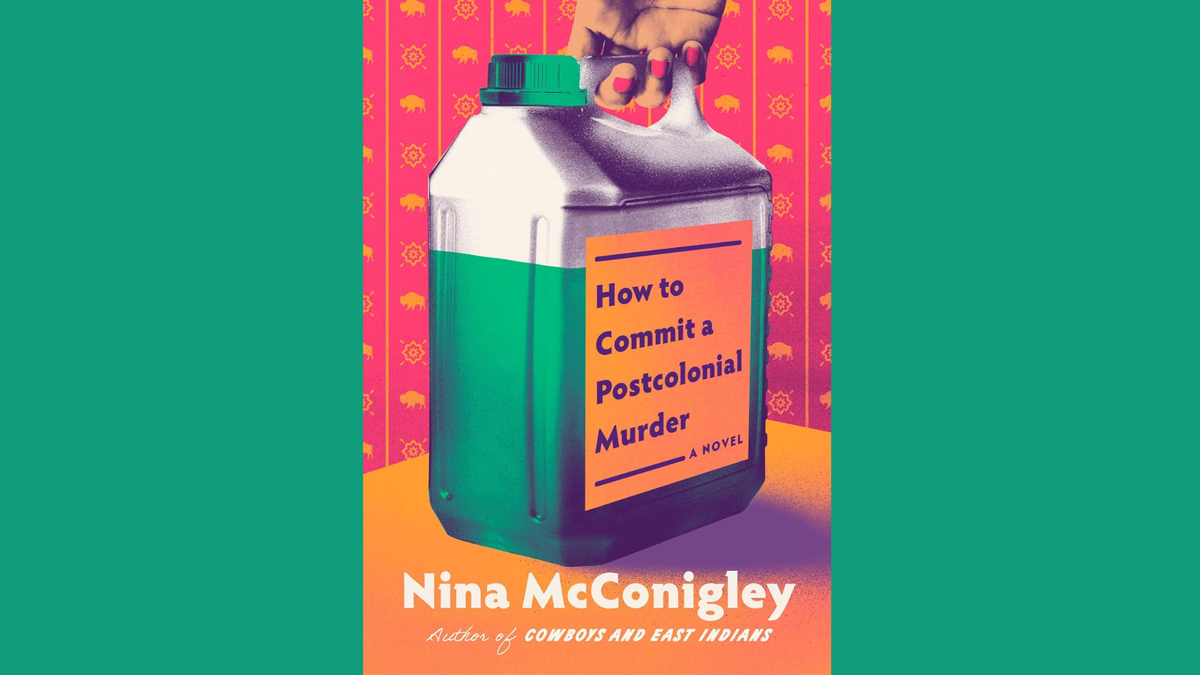
Nina McConigley’s debut novel How to Commit a Postcolonial Murder tells the story of a protagonist born in a rural Wyoming town, to an Indian parent and a white one. Reading it brought to mind the general truths of being biracial in this particular way: child of a racialized immigrant, raised in a very white area. For me it was the Chicago suburbs and a Korean father. McConigley’s main character, a preteen girl named Georgie Ayyar Creel, expounds on the difficulties of being “split” in this and other ways, and what really resonated with me were the specifics of a delicate biracial life in which no one is like you or understands your world, except maybe a sibling, maybe a cousin—someone who could be a partner in crime or someone you might avoid or come to resent (or they you) because you remind each other of the strange, narrow box of your shared existence.
For Georgie, the crime is quite literal and the someone is her older sister, named Agatha Krishna because of their Indian mother’s affinity for the British, and also because this is the kind of exuberantly quirky book where a character named Agatha Krishna sets the mood for a narrative that plays with literary tropes and a twelve-year-old’s understanding of colonialist history while also unpacking something serious about childhood trauma and belonging. The main enemy the sisters are up against isn’t (or isn’t only) the British, whom they have already figured out at their tender age can reasonably be blamed for most things, but their uncle Vinny, their mother’s brother, who has been sexually abusing them.
Vinny Uncle, as they call him, has come to live with their family, along with their Aunt Devi and their cousin Narayan. This seems to have made their mother, who before felt so isolated from India, happy. Georgie and Agatha Krishna sense the precariousness of their situation, how limited their mother’s options for connecting with her culture and family are and how pressing her need. They also likely sense who they are in this town where they negotiate their differences from others daily and don’t want to call attention to themselves in any other way. All of which makes it feel impossible to simply tell someone what is happening.
And so, resourceful, precocious young people that they are, they turn to what seems to be the only option: murder. After an antifreeze leak from the family car kills a neighborhood cat, Agatha Krishna decides to poison Vinny by putting the substance in his beverages. No one wants young people to be resourceful and precocious like this, of course, but this is where they find themselves. On the one hand, the premise is absurd. On the other hand, the girls’ situation is both horrifying and mundane. The reader is left to deal with this dissonance.
How to Commit a Postcolonial Murder is a story of stories, of a child who tells stories because she must. As narrator, Georgie relates many tales, not just the one of herself and Agatha Krishna plotting to kill their uncle, which at times comes across as nearly an afterthought. There’s the story of their town, Marley, which started as an American military base on Arapaho land, and the history of which is enacted by the local schoolchildren every year. Of her class and her family, Georgie quips, deadpan, “Most of the kids wanted to be cowboys. We were always Indians.” She tells the story of the local mall, including the history of JCPenney. She tells the story of the family home, named Cottonwood Cross by their mother, noting that “The plains cottonwood has been the state tree of Wyoming since 1947,” the year of Indian independence and partition. Pointing out every landmark, reciting and connecting facts like a tour guide of her life, Georgie understands the power of narrative, of language, and seems determined to use it as she pleases. In one early chapter, she appears to mock a mythical white reader by presenting a numbered list of elaborated-upon features this reader might seek in a narrative about an Indian immigrant family: mangoes, saris, “All the spices,” poverty, religion, colonialism. She says to the mythical reader, “You want me to perform culture in a certain way. To tell you … how hard it was to be us. When I think it must be hard to be you. Your culture so vague.”
Georgie’s confidence seems bolstered by specifics, both facts that happen to coincide with her life and the kind of specifics people (and writers) of color often recount white people telling them they are lucky to have—when we often are lucky to have them, just not in the way those people think or as part of the story they’re imagining. But her narration, purposeful and self-possessed as it feels, leaves the reader unprepared for a certain twist that occurs later in the book, a twist that serves to disrupt the previous narrative, changing the type, or even genre, of the story, and suggesting that Georgie and Agatha Krishna haven’t been as in control of the plot of their own life as they thought, even considering that it already seems very much out of their control. And more broadly—even when not planning to kill a child molester—this can be what it’s like when you’re a racially marginalized child without a larger community, navigating ground haphazardly where no previous examples have been set for you.
As a child, I clung to stories about misunderstood geniuses and sensitive, bullied kids who showed promise to the right mentor and became great artists. I thought I had to prove myself in some special way because I didn’t fit any other narrative and TV and movies told me that if I was different I had to use that difference to buckle down, do something amazing, and get revenge on the world. This led to a confusing and uninspired college experience. And yet this brand of individualism was the only impoverished way I had to understand the arc of my life, because it was the only one American culture offered that seemed like it could possibly apply to me and that I deemed acceptable. The genre of my life wasn’t working for me, or maybe I just didn’t know what it was yet. But I understand now that one could do a lot worse than having an ambiguous, meandering Part One, a lot worse than having to be the investigator in the mystery of one’s own existence.
The truth is, the story of your life is always larger than you. One of the first contemporary books by an Asian American author I ever read was Eating Chinese Food Naked by Mei Ng (1998), which now appears to be out of print. I read it while I was in college, home for the summer. My mother had given it to me, loaned from a friend of hers, whom she mentioned, as part of a preamble to giving me the book, was Japanese. I hadn’t been aware of this before, though in some sense I had been aware that this friend was probably Asian, and the only Asian woman, the only Asian adult, even, I had known in our neighborhood since my parents had divorced and my father had left. I don’t remember exactly what else my mother said or whether there was a note from her friend with the book, but I have the idea that the friend thought I might relate to or otherwise benefit from this story about a young East Asian woman, close to my age, negotiating social and familial issues, albeit from a more traditionally Asian background than me. If so, she was right. It didn’t feel revelatory to me so much as comfortable, unremarkable in a good way. The book’s dissatisfied, imperfect character did speak to me and made me, and my presence in the world, feel more real, and maybe even made me think more seriously about myself and my future.
At this point I had read Maxine Hong Kingston’s The Woman Warrior (1976), in short snatches from the bookshelf of a white family I babysat for, careful to make sure no one saw me reading it, memorizing the numbers of the pages I was on rather than marking them, being careful to always put it back in the same place. Secrecy. Crime. Investigation. Exploring my racial identity was not something that had been normalized, not something I had been encouraged to do by family or teachers, and it would have been embarrassing for someone to think that was what I was doing because I didn’t even know what I was doing. But Ng’s novel had been given to me, by another Asian person. I didn’t have to take responsibility for it. Many years later, my mother mentioned to me that when she had opposed my decision to drop out of college and move in with my boyfriend, the same friend who had asked her to give me the book had vehemently defended my choice. No one had told me about this show of support at the time, and it only occurred to me when hearing about it years later that this woman may have been looking out for me in subtle and not-so-subtle ways for a while, maybe even earlier, when I was in high school, when I felt completely alone.
To avoid spoilers, I won’t explicitly connect the anecdote above with McConigley’s book, but what I mean is that our lives are authored in ways that escape our knowledge, often by family and sometimes by others. How to Commit a Postcolonial Murder nails this truth, along with the fleeting nature of existence, which applies to everyone but may just be more starkly visible to those of us who don’t so easily blend into a shared fantasy of empowered living.
At the time McConigley’s characters are growing up in this book in 1980s America (I remember being a few years younger at the same time), books like the one they’re growing up in do not really exist, at least not that I’m aware of, and, it seems safe to say, not that they’re aware of. The Joy Luck Club by Amy Tan was published in 1989. Jhumpa Lahiri’s Interpreter of Maladies was published in 1999. These are popularly accepted landmarks of Asian American literature, not even what I mean by "books like...," and there are many earlier examples of work by Asian Americans, like The Woman Warrior and Carlos Bulosan’s America Is in the Heart (1946), but I wasn’t taught or encouraged to read any Asian American books in school, and I’m only in my forties. It's difficult to make any kind of definitive statement about Asian American literature in the past versus where we are now that isn't a vast oversimplification, but there are currently many more stories being published on a wider scale that subvert expectations for narratives written by diasporic Asians and people from racialized immigrant families, and that fact makes it all the more affecting to read, now, about these characters living during a time when this wasn’t a regular part of the cultural landscape. Georgie’s narration takes on a tone that seems fitting for her child-self, but it also sometimes seems to carry the weary knowledge of someone who is familiar with the tropes and expectations of both yesterday and today, someone who is angry about both what happened to her as a child and the way that people would have her frame her trauma and background now. This adds a deceptive, uncomfortable depth to the text, to the narration of a person whose preteen voice may be haunting her adult self, who seems both eager to relate her story and justifiably outraged.
In one part of the book, the family prepares for viewing Halley’s Comet, a nearly once-in-a-lifetime experience, only to see nothing due to poor visibility. I remember that day in 1986. I remember my parents waking five-year-old me early in the morning to see the comet. I was too tired, I simply couldn’t get up, even though I knew, because they told me, that it wouldn’t happen again until I was eighty. Such celestial events are considered precious because they seem rare, collectible when compared to many other things. According to America, capitalism, whiteness, and definitely the British, there’s usually more where that came from, you can imagine yourself into most any story. It must be strange to feel unimpeded in that fantasy, to be born into it. As Georgie says, it must be hard. It must come as a destabilizing shock when you finally realize how small and out of control your life is, yours too, when you have to accept the specificities and limitations that apply to us all, the fragility of things forever lost or temporarily retained, the many experiences you may not, or absolutely won’t, find anywhere ever again. A comet, an out-of-print novel, a kindness, a decade, a sibling, a life.
Who Even Reads is an independent publication run by two hardworking editorial professionals. We write about books from a liberation perspective, with a socially conscious focus that's both fun and serious, covering mostly new releases. Your donations subsidize what we do. Learn about us.