"Better than the best reality TV": Shannon Sanders' The Great Wherever and Its Lingering, Gossiping Dead
The Great Wherever centers the pleasures of reading and stories, the pleasures that family and community can create and preserve, and the ordinary, apparently forever-tempting pleasures of messy human drama and gossip.

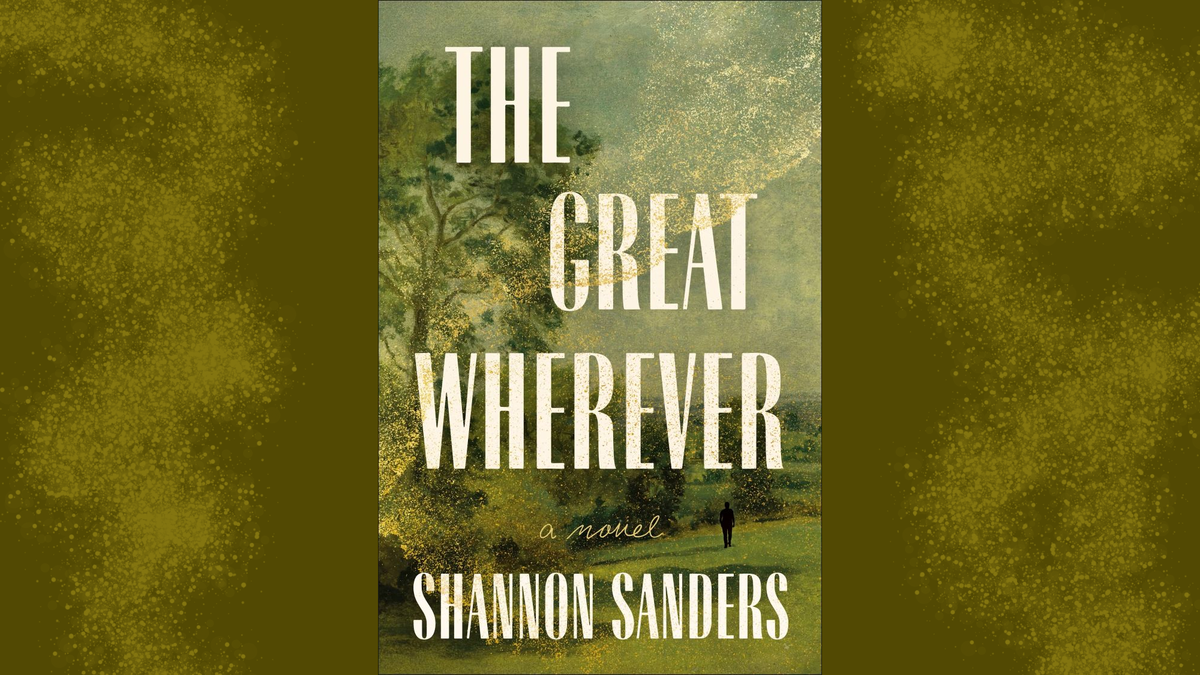
"Here, we aren't restricted by geography or the walls of our own memories," the narrator of Shannon Sanders' debut novel The Great Wherever explains of the afterlife, " ... even those of us who in life never boarded a plane, never even left western Tennessee, have nonetheless by now gotten to experience in-season swordfish meunière at the Baltimore Oceanaire by way of a living cousin of ours." The Great Wherever is a ghost story, but one in which no particular drama revolves around the fact of ghostly personas, and one with no particular horror bent aside from the fact of historical atrocities and generational trauma. Instead, the ancestors of main character Aubrey Lamb are woven into her life with nonchalant finesse, to the point where the existence of ancestors like these feels not only believable and unremarkable in the world of the story, but plausible in our own.
However, it isn’t suggested that this version of the afterlife, in which the dead can float in and out of the consciousnesses of the living, is universal. This is very much a story of Black Southern history and its ghosts are limited to four specific ancestors. The eldest was enslaved, and they all have experienced an incompleteness in their lives that keeps them rooted to a plot of family farmland in Tennessee, purchased by Aubrey’s great-grandfather, of which they are stewards from beyond the grave. They can venture off the land, but only through those connected to it. “We get to be where our people are,” says the narrator, " ... Better than the best reality TV."
Having lost her mother at a young age, and having recently lost her father, whose relations she has had limited contact with, Aubrey’s main familial connection is her sister Bellamy, who has achieved markers of successful adulthood—husband, children, house in the DC suburbs. Aubrey, meanwhile, pays more rent than she can really afford to live with roommates in the city, scrapes by with multiple jobs while pondering whether to get her paralegal certification, and has been worrying about her waning fertility, hoping that her wealthy white boyfriend Boyd is going to propose to her right up until the moment when he dumps her. It is here, having hit rock bottom, that she takes an interest in the plot of land in Tennessee she inherited partial ownership of when her father died, getting in touch with family members via email and making plans to visit them to discuss a possible sale. (They expect to turn the sale down, but encourage Aubrey to join the joint decision-making process.)
The relative narrating Aubrey’s story is unnamed at first, but we know from the beginning that she died young, not yet twenty-eight, and not so long ago. Despite this, she refers to Aubrey, thirty-two, as “the child,” and could be said to have more life experience than her, because, as she tells us, the dead are relentless gossips, and she has spent time among them and their stories spanning more than a century. She also has access to Aubrey’s thoughts and feelings, and can follow her as she moves through the world.
The book’s primary drama revolves around the potential sale of the land. As the present-day timeline shows Aubrey meeting with relatives in Tennessee, we dip into the past to learn about the history of the area and of Aubrey’s family, who lived in a Black town called Serviceberry, formed after emancipation, and later found an opportunity to buy the farmland nearby. The main conflict takes place within Aubrey, who doesn’t have the kind of security that enables her to think beyond the short-term practical implications of money, and can’t help but be tempted by the idea of selling her share of the land, whether to developers who would turn it into a Costco or to the enslaver-descended white family that her great-grandfather originally purchased it from, especially as she is soon flat broke. The ancestors, who very much do not want to live in a Costco, can’t interfere with a sale directly but they can try to change the course of events via small effects like a light breeze blowing a piece of paper along the ground.
Many contemporary historical novels use a dual-timeline or tri-timeline format, some flipping back and forth between past and present-day storylines. Sanders’ approach is much more intricate and seamless than this, and the story's supernatural premise allows her to cycle through perspectives covering generations and layer points of view on top of others, with complex and thoughtfully executed results. At one point, the narration, relating the thoughts of Zena, the eldest ancestor, refers to her daughter-in-law Darla as a “space cadet,” which seemed anachronistic until I remembered that the narration was coming from the young narrator as she reflected Zena’s perspective. And that in any case, Zena herself would have by now heard many contemporary expressions in the afterlife. It isn’t really possible to draw a line between the contemporary and historical timelines because they seep into one another, and the relative youth of the narrator emphasizes that there’s no accounting for when one becomes an ancestor.
I was fascinated with how Sanders uses the conceit of a communal family story spanning life and death to enhance and speak back to typical features of literary fiction. While the narrator has a distinct voice when she tells her own story, her observations about Aubrey and others are more often than not like straightforward third-person omniscient narration (or third-person limited with the bonus of a backstage pass), and it’s easy to forget who’s providing it and how they are able to do so. This makes the borders of the book’s contents, and of life, feel porous and engages with questions that are generally standardized out of contemporary narration, like, “Who is speaking? How do they know this? How exactly does all of this work?” These questions are not only useful for awareness of the storytelling format but also for interacting with history and considering the ways in which the present is part and parcel of the past.
The Great Wherever benefits from its grounding in the everyday, often silly details of what matters to the characters, and in these the story glows with warmth and humor. The narrator is grateful that she isn’t doomed to live for eternity in the clothes she died in, an outfit that included a Hot Chelle Rae T-shirt she says she was wearing ironically, but instead sports her favorite BCBG dress. A family recipe for chicken and dumplings is a subject of both enjoyment and controversy; the narrator’s mother disapproves of her modifications to the dish, but her grandmother informs her mother that the version she passed on contained her own modifications. When Zena realizes that one of her grandsons is gay, she is not at all shocked but excited by the emergence of this secret as one might be by an unexpected turn of events in a television series, and it revives her interest in the lives of her descendants.
The story begins as the narrator witnesses Aubrey losing her wallet outside of the restaurant where she is meeting Boyd, in the rain. The gloomy, portentous weather and the lost wallet briefly contrast with the cheerful inside of the restaurant, a quasi-upscale brunch and happy-hour place that represents the hopeful ground of Aubrey and Boyd's relationship, ground she is about to lose before finding an opportunity to gain more elsewhere. Gloomy or not, that beginning creates a palpable, immersive atmosphere that promises the reader something good. Tayari Jones calls this book “a pleasure and a treasure,” and I can’t think of a better way to describe it. Against the dull forces of slavery, capitalism, and commercialism, The Great Wherever centers the pleasures of reading and stories, the pleasures that family and community can create and preserve, and the ordinary, apparently forever-tempting pleasures of messy human drama and gossip. The narrator says of the dead, “...we can linger. Or we can leave when we want to. Or need to. When the scene is too horrifying or cringeworthy or just plain boring. But we can stay as long as we want. And we do, as long as there’s meat on the bone.”
Who Even Reads is an independent publication run by two hardworking editorial professionals. We write about books from a liberation perspective, with a socially conscious focus that's both fun and serious, covering mostly new releases. Your donations subsidize what we do. Learn about us.