Review: Rebecca Solnit and Alysa Liu Both Know, The Beginning Comes After the End
While we might be living through what is commonly referred to as late-stage capitalism, we are not at the end of anything—we are always in the middle of an unfolding story.

When Rebecca Solnit’s powerful work of willful optimism Hope in the Dark was published in 2004, the United States was three years into an interminable “War on Terror” and seven months away from the reelection of George W. Bush to a second term. It was written, in part, to counter the despair felt by many in response to post-9/11 nationalism; the devastating Operation Iraqi Freedom, waged under baseless claims of weapons of mass destruction; and the rapid erosion of civil liberties via the Patriot Act. It was, as the title suggests, a dark time.
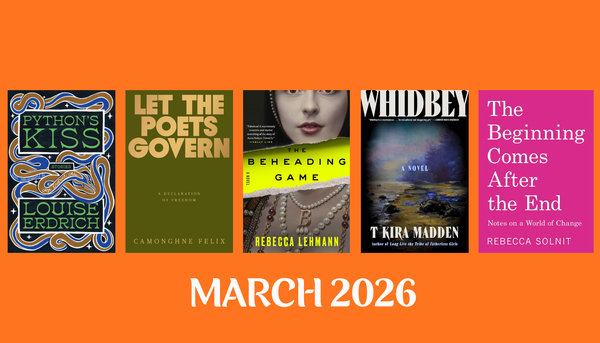
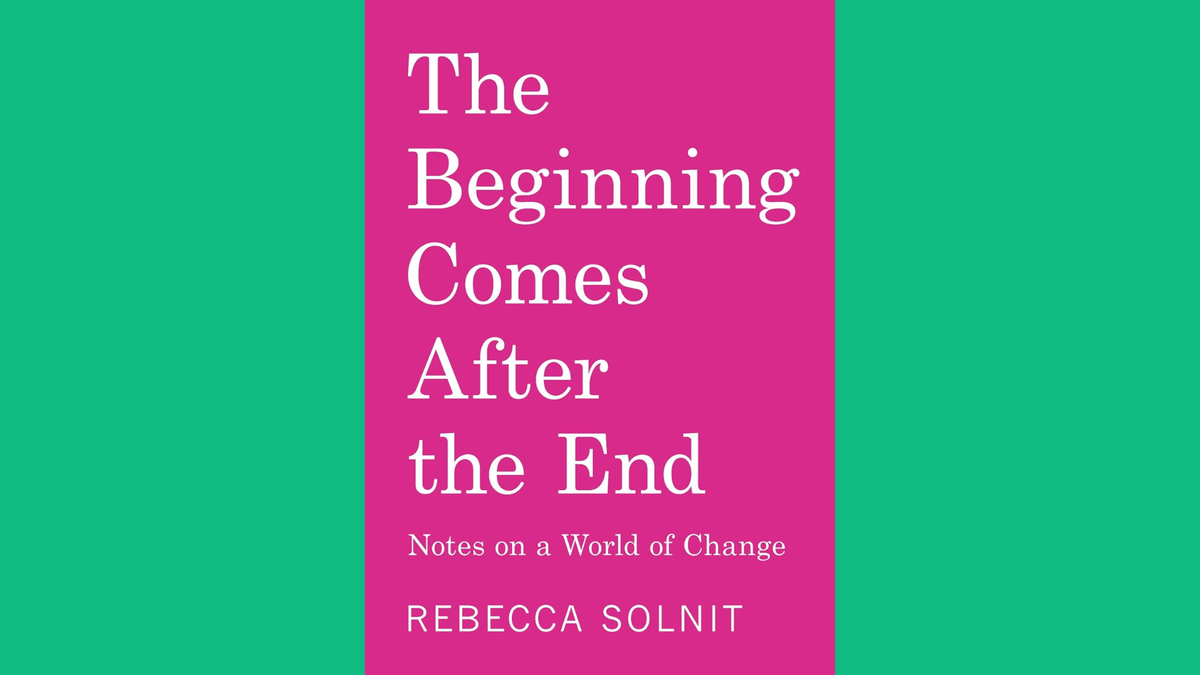
The Beginning Comes After the End, which Solnit describes as a “long essay in the form of a short book,” is marketed by the publisher as a sequel to Hope in the Dark. It comes to us in another dark time, once again with a message of hope—that, while things might appear very bleak in our current political moment, there are progressive “wins” happening every day, often at the local level where they may not be widely visible. While we might be living through what is commonly referred to as late-stage capitalism, we are not at the end of anything—we are always in the middle of an unfolding story over which we, all of us, have some measure of control (some, of course, more than others). Her message will be eagerly received by those struggling to maintain momentum and optimism in the face of a real battering of rescinded rights, ascending fascism, and the quelling of dissidence via the murder of conscientious objectors.
There is a lot here to be optimistic about. Solnit begins on an October morning in 2024, an hour north of San Francisco, at a ceremony in which a 466-acre ranch was officially returned to the Federated Indians of Graton Rancheria (a group of 1,537 Indigenous people descended from the original inhabitants of the land). This is one of many instances of land being given back to Indigenous peoples and organizations for stewardship across the country. She also highlights a quiet renewables revolution, such that solar and wind power are the fastest growing source of energy in the United States despite what the audible death rattle of the fossil fuel industry might have you believe. The rights of Black Americans, queer and trans people, and women have exploded over the past several decades in a way that would make it difficult to put the toothpaste back in the tube (though many are certainly trying). Indigenous influence on wider culture has resulted in subtle changes to the dominant (destructive) views about the Earth as a source of resources to be taken from. Influence from the LGBTQ+ community has shaken the foundations of sexual identity and belief in the gender binary. More will come.
Solnit is careful to get ahead of the most obvious critique of her analysis: that there is still so much work to be done. She qualifies her observations of the march of progress with the caveat that celebrating these victories does not mean the battle is over. Civil rights and immigration protections in particular are under continuous, vicious threat, requiring increasingly more effort to protect. People are dying in this battle every day. On the one hand, it would have been nice if a little more space had been dedicated to these caveats, and on what people who might want to fight back can do to help. On the other, that’s just not what this book is about.
Let's return to hope. I am writing this in the afterglow of US figure skater Alysa Liu’s triumphant gold-winning Olympic program, which is captivating and borderline subversive in its expression of joy, set to the ecstatic rhythms of Donna Summer’s “MacArthur Park Suite.” Seeing the Chinese American daughter of an immigrant perform athletic excellence on the world stage, choreographed to a soundtrack that for many evokes the hedonistic pleasures of queer nightlife culture was a massively uplifting experience for many. This is especially true given that excellence at the Olympic level is rarely joyful—more often you hear about the gritty, painful grind, the self-denial. Liu famously walked away from the sport at age sixteen in part because she didn’t like the way she was being controlled—her diet, her body, her self-expression—by those who saw her as a potential champion before they saw her as a person. She came back of her own accord and trained the way she wanted, created the program she wanted, with the music she wanted, wearing the dress she wanted, and won it all. For Liu, the beginning of greatness could only come after the end of abnegation, deprivation, suppression. The kids are alright.
As a person interested in books and storytelling, one passing comment Solnit makes while recounting the radical achievements of social movements of the 1960s and the backlash that followed caught my attention:
“In a different way, the mid-twentieth-century novels I read growing up now seem to have a curious coldness, an aloofness, between characters and a cynicism about human nature. Some of the characters are in love, some of them desire something from others, some have parents, children, or meaningful friendships, but there’s a lot of indifference and bystander behavior, a lot of watching people suffer with little to no urge to mitigate that suffering or to assist others by their willingness to do so.”
She goes on to explain that this kind of apathy lit was a product of the “cynicism coming out of the horrors of the Second World War...alienation from consumer culture, and...modernism’s reaction to the sentimentality of Victorian literature.” While WWII surely is the most concrete, obvious origin point, it is the second thing she mentions that has kept the literary alienation machine churning out bestsellers. We know that the CIA poisoned the well of American fiction at the source by infiltrating the Iowa Writers' Workshop in an attempt to spread anti-communist propaganda. I would argue the cynical tropes Solnit references did not emerge entirely naturally but with considerable influence from the state, which benefits from a population of individuals divorced from any communal sense of caring for one another. But the tide is turning.
We have begun to see the dawning of a new era of literature that eschews cynicism in favor of representing the kind of positive change and hope for the future that Solnit describes in The Beginning Comes After the End (and that I’ve used Liu as a crude metaphor to describe). Toward the end of last year I read Everything for Everyone (2022) by Eman Abdelhadi and M. E. O'Brien after hearing a lot of praise for it coming from friends and strangers in online leftist spaces. It’s a utopian piece of speculative fiction disguised as an academic text narrating through a series of interviews a worldwide socialist revolution occurring from the years 2052–2072. It’s a passionately optimistic book, the opposite of the typical dystopian fare that dominates the speculative genre, and it is distinctly in keeping with Solnit’s vision for the steady march of progress becoming a liberating force for all people, animals, and the planet. We are slowly emerging from a decades-long cocoon of fiction focusing on the individual and their many dissatisfactions.
Solnit is very persuasive in explaining how individualism is a scam, and how the sooner more of us realize the extent of our interconnection the better. She quotes Martin Luther King Jr.’s Letter from Birmingham Jail: “We are caught in an inescapable network of mutuality, tied in a single garment of destiny.” While King meant this in the sense of no one truly being free when some are oppressed, it is perhaps even more apt when discussing climate change—the effects of which are and will continue to be felt (albeit not uniformly) by us all. Solnit makes this connection by discussing King’s work alongside Rachel Carson’s—both were crucial architects of the world we live in now, and also widely mocked and discredited while they were living and working. “[T]he fact of climate change is offensive to isolationists,” Solnit explains, “since the climate is the great overarching system within which all life on earth exists.”
She also addresses how the Covid-19 pandemic has illuminated the obvious truth that individualism is a death cult. “The pandemic’s most essential truth was that we share the air we breathe,” she explains, noting that people who refused to vaccinate or mask out of political principle “died for their views,” which in a way is true, but fails to acknowledge that people are still dying of Covid-19, and more so because of institutional failure than personal choice. As someone who recognizes that the Covid-19 pandemic has not ended and who continues to take precautions to avoid transmission of the virus, it is also jarring for me to encounter text like the above written in the past tense from something I would otherwise consider an authoritative source. We still share the air we breathe, and people are still dying from the virus, or complications created by the virus, every day.
I was still thinking about this when I reached the end of the book, where Solnit remarks:
“The radical uncertainty of the future arises from how we’re making the future in the present by how we show up, how new ideas amplify and become realities. But it’s the past that shows us the possibilities, how the world was changed, how power can appear in places and among people assumed to be powerless and irrelevant…”
My girlfriend and I have had a lot of conversations about our feelings of powerlessness as people who continue to take precautions against the spread of Covid-19 (i.e., masking, not eating in restaurants, etc.), and I have a lot of feelings about this specific to my experience as a disabled person as well. It can be a very lonely and isolating existence, even as we know we are doing the right thing, and have in fact begun to establish a small community of people who do the same. On my most optimistic days I assume there will, at some point, be a vaccine that prevents transmission, or perhaps an antiviral treatment that eliminates the prospect of long-term illness or disability from Covid infection. But on my moderately optimistic days, I think that it is likely that people will change how they feel about masking. That it will no longer feel like an unusual choice, and that absent the stigma, a majority of people will start doing it again of their own accord.
Solnit traces queer liberation back to the 1960s, where it began, but for me personally it began in the 1990s, when I became aware of my sexuality and along with that knowledge came the understanding that it was something I was supposed to be ashamed of. I knew even then, at 13, that this was bullshit, and that the forward movement of time was on my side. If I could just withstand the exclusion, the violence, the abuse of homophobia until I got older, I knew things would change. I couldn’t have named it then, but this was a faith in progress, the steady march forward over decades and centuries (albeit with plenty of backlash and regression) that Solnit narrates in The Beginning Comes After the End. I think in a few years, if there isn’t a more effective vaccine or a major upgrade in treatment options for Covid-19, that masking will become more normalized; that it will be seen as a legitimate lifestyle choice or necessity for some, no different than being gay or a vegetarian. Disability rights is still an emergent movement. But part of Solnit’s point is that the time any one person has been alive is short and the 1960s were not so long ago—every liberation movement is still emergent.
In addition to the somewhat reductive description of Covid-19 in the present, Solnit's simplistic, laudatory remarks about nonviolence as a means of protest do not accurately reflect the world we're living in. While she’s correct that nonviolent demonstration was crucial to the civil rights gains of the 1960s, this isn’t the whole story. The Black Panthers had guns. Stonewall was a riot. Nonviolent protest is a tactic but it’s not the only one, and it might not always be the most effective.
The book’s ending strikes the right tone of cautious optimism, as Solnit remarks that while rights can be rescinded, “you can’t so easily take ideas away, including people’s belief in their own rights and the rights of people they care about.” She goes on to mention the observable “new seedlings in the return to the possibility of utopia as Afrofuturism, Indigenous futurism, Latinofuturism, each of which is the refusal to be doomed or marginal,” evoking fiction and referring to the antithesis of dystopia, as I’ve tangentially commented upon above. The Beginning Comes After the End is an orchestral ode to interconnection, a sharp rebuttal of scarcity mindset, and a generous reading of where we are and where we could be going.