Review: Race and Realisms in Quan Barry’s The Unveiling
While reading Quan Barry’s new novel The Unveiling alongside Tiphanie Yanique's "On Character," I was struck by how it reflects Yanique's expansive approach to realism for authors of color, demonstrating a way to write fiction beyond the limits of the psychological.

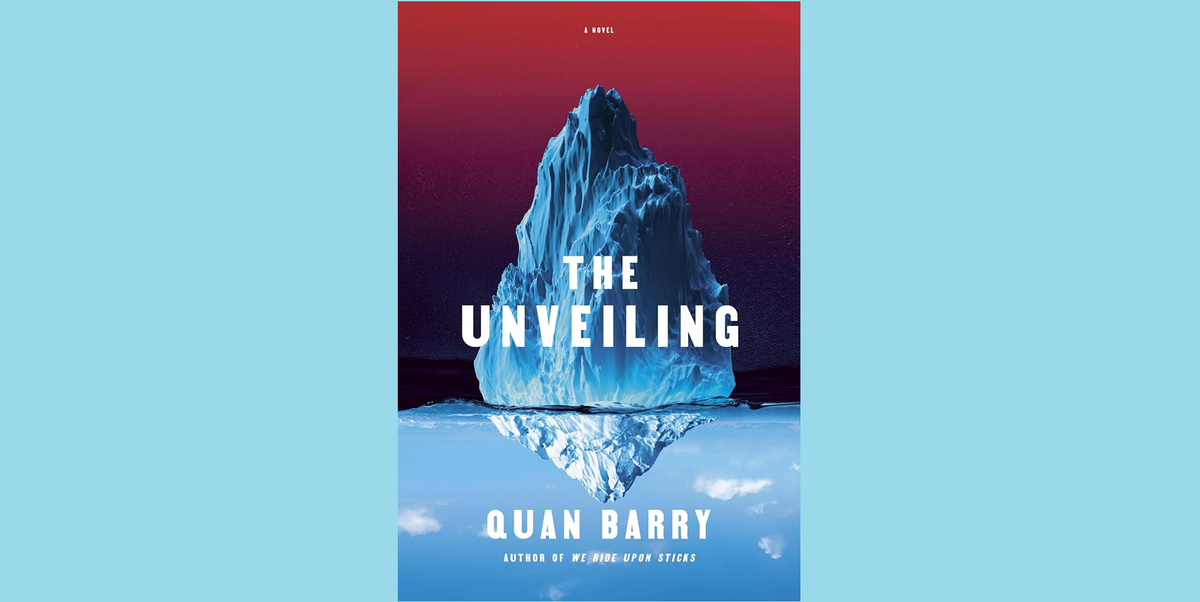
In “On Character,” appearing in the essay anthology Letters to a Writer of Color (2023), author Tiphanie Yanique points out that the common American and Western model of fiction writing relies heavily on psychological realism to the detriment of other frameworks—like social realism, which, she explains, was suppressed by the US government along with efforts to quash communism in the 1950s. Addressing how authors of color today can take a broader approach, Yanique also reflects on biological realism—the truth of bodies—and magical realism. Reading this essay at the same time as Quan Barry’s recent novel The Unveiling, in which Striker, a Black film location scout, takes an Antarctic cruise for her job and finds herself surrounded by rich white tourists, I was struck by how Barry employs all of these modes of realism in a boisterous, cinematic, and chilling novel that is also in conversation with several traditional story formats.
The book wastes no time with setup. When we first meet Striker, who will turn forty the following day on Christmas, she’s already settled in aboard the cruise ship, having had sauna sex with dashing guide Percy and developed private names for her fellow expeditioners. An older, “well preserved” duo have become la Grande Dame and the Baron, while she’s dubbed another couple Billy Bob and Bobbi Sue, having heard they’re from Texas, and outfitted them with stereotypical Southern mannerisms in her mind. She sympathizes with their teenage child, Anders, who is trying to establish their pronouns as “they/them” while their mother attempts to keep their identity open for consideration. When the group disembarks in kayaks for a short tour of the area, an unexpected occurrence splits them up and leaves several, including Striker, stranded on an uninhabited island, without Percy for direction and no clear way to contact the ship. To top it off, they soon find themselves with a possible murder on their hands. For Striker, this is all complicated by the fact that she didn’t know who in the group to trust even before one of them became a possible suspect in a killing. And now, the kind of people who benefit from race and racism the most aren’t going to spontaneously unlearn the concepts just because they’ve washed up on an Antarctic shore and suddenly have many other things to think about.
There are, of course, plenty of writers today who work in social realism, but as Yanique explains, “If we already write in this mode, it is because we have read many women and/or writers of color” and maybe “American and European literature written before the 1950s.” The way Barry’s horror feels both new and old suggests the truth of this. The novel is savvy about contemporary issues of race, sexuality, and gender, but it engages with the hard, blunt edges of class and religion in the haunting manner of early American writers like Melville and Hawthorne. It additionally brings to mind—and seems to challenge—19th-century exploration narratives that use non-European populations as a dramatic backdrop for white protagonists, such as the work of H. Rider Haggard.
This latter point is significant in light of the Antarctic location, a place whose literal whiteness metaphorically flips that narrative, and that lacks a native human population to exoticize. The human history that does exist, namely a previous expedition of presumably mostly white men who began to literally tear each other apart, serves as the face of Barry’s horror. These past inhabitants are the otherworldly “savages,” the ghosts that haunt the island Striker and her fellow contemporary humans have happened upon. The flipside of this horror is the utterly nonhuman beauty of the Antarctic region, an alternately peaceful and violent alien environment. It makes for a pristine setting precisely because it is hostile to people, yet it is still vulnerable to human interference from afar. Barry shows the dangers of melting glaciers, the irony of how gradual warming could make the ends of the earth slightly more livable for humans while making the rest of the planet less so, and how human conflict can have an effect on even the most remote places.
Adding to the external pressures of Striker’s being stranded with the group are her internal struggles. We find out early on that she experiences visions of sorts that have been unconvincingly attributed to migraine auras. She also fully blacks out at times, a phenomenon represented by blackened lines of text. And so as Striker stumbles upon ghostly horrors in the form of the island’s history, which blend with her visual episodes, and as she encounters awkward and aggravating conversations with her fellow castaways on subjects ranging from microaggressions to slavery, she is only partially present. Scenes “cut” by Striker’s perceptions provide part of the book’s ongoing humor, mixing brilliantly and effortlessly with its horror. This device also speaks to racial erasure: to how it can manifest as invisibility to others and, perhaps more crucially, as invisibility to oneself—a person’s inability to clearly see their own experiences. Interwoven are Striker’s memories of her older sister, Ama, with whom she was raised by white adoptive parents in a white neighborhood after their grandmother died. These memories become more central and disturbing as the narrative goes on, and sometimes seem to mirror the happenings on the island.
In her essay, Yanique encourages writers of color to use the realisms derived from our own observations and to share them. One that comes to mind in reading Barry’s work is environmental realism, as she shows how people are affected both by the nature around them as well as ongoing climate change—but another, and the one that interests me most, is something I might call “narrative realism” or “story realism.” What I’m referring to is an examination of where a story is coming from. Some might feel that Striker’s memories and perceptions represent the opposite of realism, especially as her experiences verge on and become indistinguishable from either mental illness or the supernatural, but we can choose to see them as simply another face of realism. Western modes of storytelling and ableism attempt to tell us what is realistic, reliable, and therefore valuable, when what might seem unrealistic or unreliable can be another truth if we’re curious enough. Rather than dismissing some stories as unsound, why not ask why any narrative exists as it is? If Striker reveals or experiences certain details to the exclusion of others, why? Why does an author or a narrator or anyone end up telling one story and not another?
This mode of realism, the kind that examines the very creation of narratives, tends to appear in metafiction or stories where a character is an author, and often from a marginalized perspective, because to be aware of oppression is to be aware of narratives and how they are used to subject—pun intended. A recent example is Michelle de Kretser’s Theory & Practice (2025), which begins with a work of historical fiction that is, unknown to the reader, being written by the unnamed narrator, a Sri Lankan-born author who emigrated to Australia in her youth. She then stops writing this novel in favor of narrating a story from her own life. This abrupt and unexpected shift reminds us that all narratives are inventions that can stop and start, be set aside or abandoned altogether. A story entirely in its own head believes only in itself. Whereas a story that acknowledges its invention is participating in a realistic understanding of how it exists in the world. In Maria Reva’s Endling (2025), a version of the author appears as a character in her book, which depicts Russia’s invasion of Ukraine, and certain parts of the novel’s construction are laid self-consciously bare to grapple with ideas of authorship—of whose story a war is to tell, for example.
The Unveiling, though, isn’t metafiction, and Striker—as far as we know—isn’t a writer. She isn’t even the narrator of the book, which unfolds in the third person. Yet Barry creates an eerie sense that the plot moves in tandem with her protagonist, that taut strings connect narrator and character and story. Striker is, unsurprisingly, something of a filmic observer—she has an eye for detail, for color and shape, that brings us into her perspective. That perspective is, consistent with her career, one of both art and appraisal, of appreciation and creation and also of attaching value to things and people. This could indicate a desire for control, for regulation, yet within that perspective the plot unspools at a jarring, unchecked pace that doesn’t feel altogether disconnected from Striker as a person, either. The narrative remains an uncomfortable half-step ahead of the reader—it employs the sensibilities of a thriller, a classic adventure story, a whodunnit, but doesn’t linger too long on any one of these. The comfort of genre is that it allows us to run our hands over familiar contours, to settle in for the ride. Barry’s novel doesn’t give us that space. There’s no getting used to the action. Which isn’t to say that we don’t enjoy it.
Similarly, Striker is not exactly one to slow down to savor the moment, but she bears a marked willingness to do what pleases her, to get comfortable in any situation. As the rest of the group dines with some resistance on penguin eggs and broth while bickering amongst themselves, she sits out the conversation and relishes the weird delicacy: “In SoHo, people would pay big bucks for a meal like this.” In another scene, after following a mysteriously vacated sailboat into a rocky enclosure, she takes the opportunity to swim in a stretch of remarkably (if concerningly) blue water with Vadim, a member of the ship’s Russian crew, while Kevin, a wealthy consultant who may have been fired from his job for being racist, hangs back, Striker chalking his hesitance up to “white humanity’s bottomless hatred of their own bodies up close and personal.”
We begin to see, as we linger longer in her memories, that a past trauma informs Striker’s current life. But in putting us into her perceptions, in showing how she sees and acts inside her body in response to and alongside the trauma that lives there, Barry creates a story much richer than a narrative in which psychological logic is the only logic, in which a past event is a tumor to be rooted out, a “gotcha” that exposes motivation and everything about someone. As her initial assessments of some other characters crumble, Striker’s perceptions of her own experiences broaden, too. She has suffered, and her suffering has meaning, but not as a spectacle or a final puzzle piece. Instead of a tidy ending, we journey into increased depth, complication, and opacity, into a truth that provides more questions than answers, and there is a beauty in this that echoes the boundless inscrutability of the Antarctic wilderness.
Who Even Reads is an independent publication run by two hardworking editorial professionals. We write about books from a liberation perspective, with a socially conscious focus that's both fun and serious, covering mostly new releases. Your donations subsidize what we do. Learn about us.