Review: Lizzie Borden and Anne Boleyn Topple the Patriarchy in The Age of Calamities
A work of quirky alternative history gives agency to women who struggled under the yoke of patriarchy, including Anne Boleyn, Nellie Bly, and Joan of Arc.
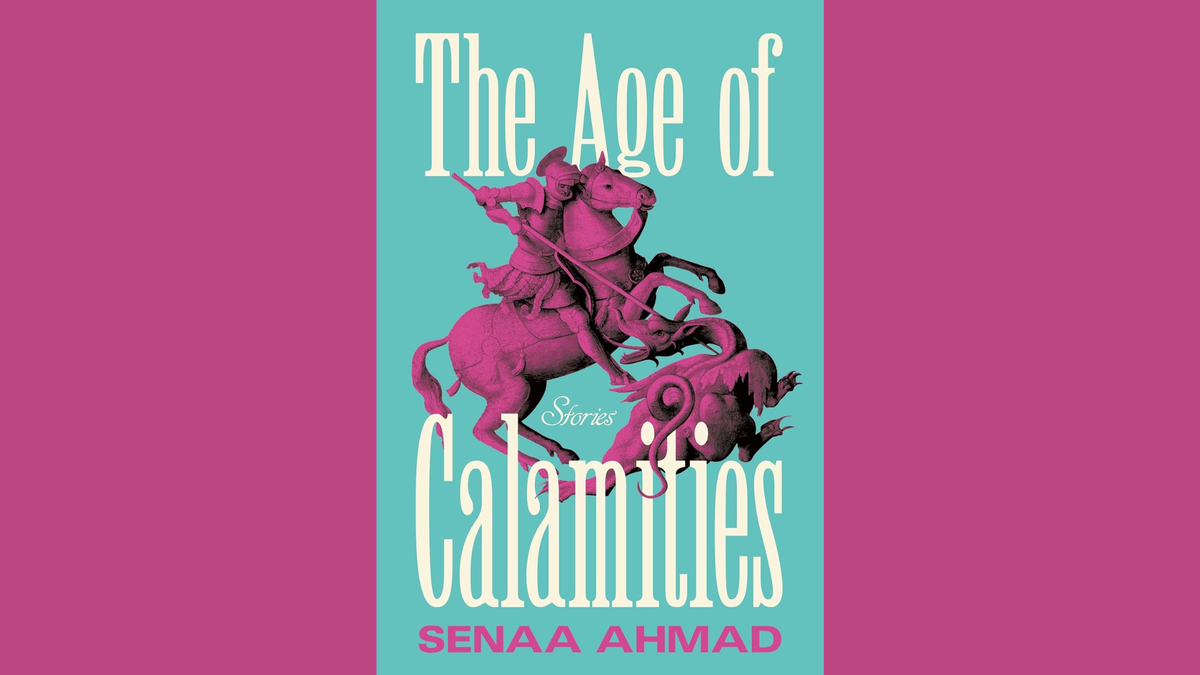
In an interview with Nerd Daily, debut author of The Age of Calamities Senaa Ahmad laid out her intentions for this collection, stating, “For years I’d wanted to write a short story that gently tugged a historical figure out of their expected environment and into someplace new and fantastical.” Each story in this collection does exactly that, albeit some more gently than others. Alternative history is often used as a means of righting a historical wrong—in this case, Ahmad largely attempts to secure justice for women who struggled under the yoke of patriarchy. The Age of Calamities is a deeply feminist project. It elevates Anne Boleyn from victim to warrior, and gives barrier-busting journalist Nellie Bly the story of a lifetime. Joan of Arc (“A farmer’s daughter, a Domrémy girl”) is reincarnated into a sleeping woman's body, superimposed over the mundane landscape of 1926 Ohio. Lizzie Borden finds redemption as a cherished cinematic antihero. While each story has a worthy (and often fun) conceit, where the collection soars is in its subtle emotional heft, its humanity.
“It Was Probably a Very Nice Day” features an alt history version of the execution of the Romanovs after the Bolshevik Revolution in Russia in July 1918. In real life, of course, the entire family was murdered, along with their domestic servants, in a basement in Yekaterinburg, their bodies mutilated to prevent identification. In Ahmad’s version, Nicholas II, Empress Alexandra, and their hemophiliac son and heir escape via ship, leaving the daughters—Olga, Tatiana, Maria, and Anastasia—behind to die. It’s a haunting reversal, literally, as at several points the veil between the living and dead is lifted and the survivors see or hear the ghosts of the dead. In a purgatorial, liminal space, the girls move between the ship, the Winter Palace in St. Petersburg, the scene of their murder, and other conjured, hallucinatory settings, their presence torturing their mother with guilt.
My personal favorite in this collection is “The Houseguest,” in part because it is reminiscent of “I Can See Right Through You,” my favorite story by Kelly Link (who, it's worth noting, blurbed The Age of Calamities). An actress contends with the peculiarities of fame while starring in a trilogy of cult classic films in which she plays Lizzie Borden, who was suspected but acquitted of killing her father and stepmother in a grisly case from 1893. The specificity of the details Ahmad inserts into the lore of the franchise is remarkable, and very funny. A scene in which Lizzie intentionally bashes her head against a door becomes a widely circulated meme. A woman going by the name Dolores Hecuba writes a series of fan fiction stories consisting of obituaries for the nameless murder victims that tend to pile up in a horror movie (i.e., "Asylum Attendant" and "Crying Inmate #2").
Favoritism aside, the third story in the collection, “The Wolves,” is unquestionably the most impactful (while the final piece, “Choose Your Own Apocalypse,” about a woman working with J. Robert Oppenheimer on the atom bomb in New Mexico, is perhaps the best in terms of technique and imagination). The former is a visceral snapshot of the effects of war on civilian populations, set during Genghis Khan’s campaign against the Khwarazmian Empire in the early 13th century, and narrated through the interpretive framework of a werewolf story. Khan’s army is depicted as men who have turned into wolves.
The violence is unfathomable, and the indescribable is nevertheless described by the narrator, who is telling the story of her survival as a teenager of the siege on her city to her grandson many years later: “Here is one grandmother, with her legs splayed in a doorway, her throat cut. Here is a man with a smudge for a face,” and later, “My parents, slit open like lovely silk purses.” This recollection comes just before the narrator describes how the wolves collected the city’s men at the town square, slaughtering them one at a time as the others watched. While the story is about a specific historical event (even if the details are ambiguous), it is hard not to draw parallels to the invasion of Gaza and the meticulously organized campaign of brutality inflicted by the Israeli occupying forces.
At a certain point, in the town square, the slaughter ends, the wolves begin to ask the other men, “Will you die or will you live,” and the majority of the city’s men choose to live and become wolves themselves. The narrator is one of a small group of women who survive and flee.
The Age of Calamities is the latest release in a micro-genre that has been growing in popularity in recent years, what one might call “performatively quirky alt history.” It typically involves a historical event, personage, or era depicted realistically but with a splash of the supernatural or fantastical, conveyed humorously, and typically with a (sometimes hard to pin down or sanitized) social or political message. The opening story in this collection, for instance, depicts Ann Boleyn surviving the guillotine, and then many, many more attempts on her life, in what is clearly meant to be commentary on domestic violence against women. But what is the commentary? That domestic violence is bad and pervasive, and that some women nevertheless get good at surviving it?
But overall, Senaa Ahmad’s contribution to this micro-genre is one of the more impressive I’ve encountered. Most of the stories in The Age of Calamities are complex and multifaceted, considering, among other subjects, the literal and figurative ghosts unearthed by artistic representations of historical events; personal responsibility when one’s passion intersects with violence; human connection and interconnectivity across space and time. The past is always a breath away from the present, and vice versa. May we all be lucky enough to one day be gently tugged out of time and placed somewhere beyond the reach of our own age's mundane calamities.
Who Even Reads is an independent publication run by two hardworking editorial professionals. We write about books from a liberation perspective, with a socially conscious focus that's both fun and serious, covering mostly new releases. Your donations subsidize what we do. Learn about us.