Review: Aoife Josie Clements' Persona and the Horror of Being
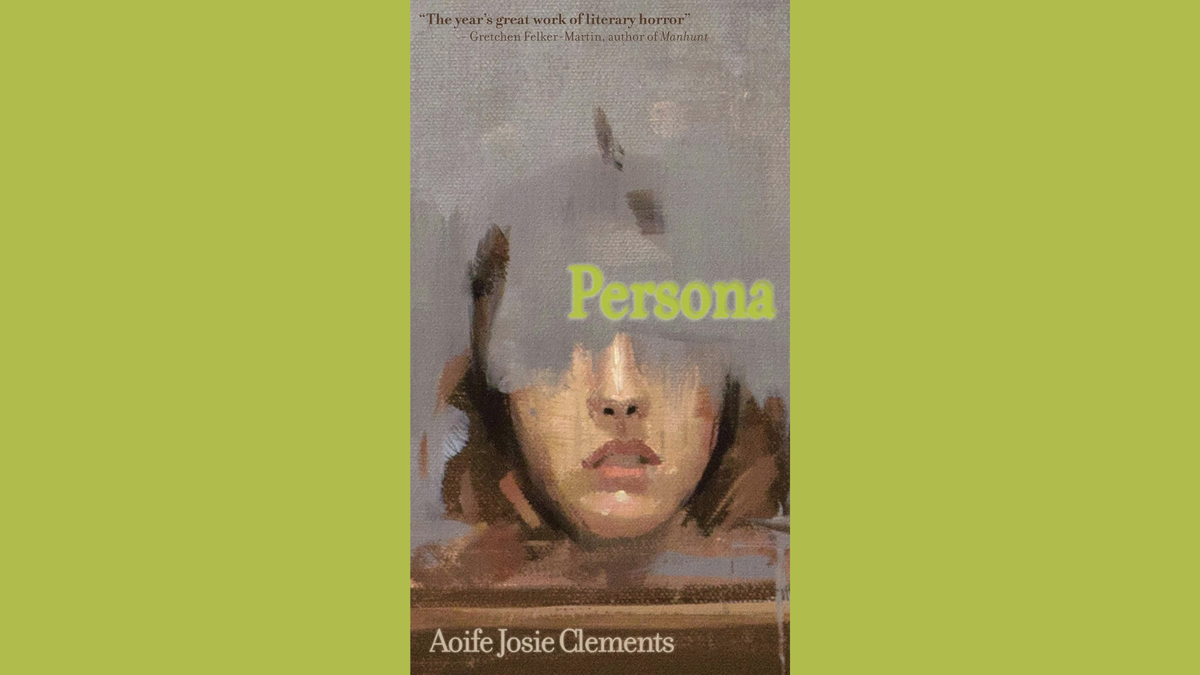
Persona’s title and premise of two women who seem to share some aspects of their identities is evocative of the Bergman film of the same name, but it is also a rich exploration of technological isolation that centers on what one character calls the Default Persona.

I have a running joke with my girlfriend that my favorite genre of book is “woman alone in a room.” It’s not really a joke. I like a woman alone with her thoughts. I like being privy to the little systems of survival and logic that people invent in isolation, and I like it when women, who are often seen as the obligatory social glue holding society together, who are not supposed to be able to choose to be alone, find ways to do it anyway, even if these ways are ill-advised and self-destructive.
Aoife Josie Clements’ Persona opens on one woman well-versed in her particular mode of isolation. A trans woman technically living in Vancouver but more accurately living in her Vancouver apartment, she holds a punishing remote job that involves taking surveys for a company called Chariot Marketing Solutions, making just enough (or occasionally enough) to pay for rent, hormones, and delivery orders of cigarettes, instant ramen, and wine. (My girlfriend, who is actually also an avid fan of the “woman alone” genre, wanted to know the precise breakdown of these details. “So how much does she make per survey?” she asked, her tone betraying raw curiosity as she did the mental math.) As she works, she lurks in a chat room ruled by a voice she calls the Default Persona—“a white male, approximately eighteen to thirty years old, who has been gifted with historically miraculous comforts but whose shameful masculine pride bristles against him”—a profile one doesn’t necessarily have to fit themselves to speak through, she explains. Her apartment is full of bags of garbage. Before this state of affairs, she tried to live as a trans woman in the world. She had a job at a restaurant and, until recently, a boyfriend named Sam, who bullied her before he decided he wanted to be in a relationship with her. Others’ scrutiny of her body and identity became too much, and she disappeared into the life she has now.
Despite the carefully controlled existence she has devised for herself, one that enables her to get by while only minimally giving to and taking from the outside world, when she does lose control, she does so in a major way. Since she was a child, she has been prone to sleepwalking and waking up in strange places. She tries to lock herself in, but this proves to be only partially effective. Her bubble of solitude is also soon pierced by an online porn video she sees that features a woman who looks exactly like her, a creepy mystery that disrupts her numbing routine.
We eventually find out that this initially unnamed narrator is called Annie, and the book shifts to include the first-person point of view of another character named Amy. Amy is also a trans woman living in Vancouver, who supplements online sex work with a position at Chariot Marketing Solutions, not taking surveys but in “customer service,” assisting (or rather redirecting) the people who take the surveys. Unlike Annie, she has friends and a social life, and seems more like a typical young person trying to figure herself out. She has a fraught and effectively nonexistent relationship with her mother, who appears to have disowned her yet keeps sending her regular amounts of money, not responding to requests for more, or any of Amy’s other messages. Like Annie, Amy becomes aware of the existence of another woman who looks exactly like her, and the reader can guess at least partly where this is going, but the larger mystery of how Annie and Amy are connected and what it all has to do with Chariot Marketing Solutions looms menacingly.
Persona’s title and its general premise of two women who seem to share some aspects of their identity is evocative of the Bergman film of the same name, but it is also a rich exploration of technological isolation that centers on Annie’s conception of the Default Persona. It captures how, in the internet age, the kind of isolation that is imposed on trans people, people of color, disabled people—those who may have very good, logical reasons for not wanting to go outside—ironically comes with an increased exposure to the Default Persona and therefore, perhaps, an increased belief in it—a wish to be eaten by it. Amy admits, “I still occupy the Default Persona online most of the time … I just wanted to listen to people talk about video games, or anime, or whatever else they felt like passionately tearing each other apart over, without having to expose myself to the judgments of the real world, where I was a human being, with limitations and with an identity that could be pinpointed at a glance.”
People chased out of physical society will encounter similar violence in public virtual spaces, and it will sometimes be worse, not even necessarily because of the lack of accountability surrounding online hate, but because of the uniformity it can take on that can’t be replicated in “real” life. As Annie puts it, “You might expect, as many people once expected, that fungible anonymity would allow for more fluid and sincere personal expression than the limitations of a singular identity. In reality, though, in the chat room, anonymity instead boils down the chaos of a conversation with multiple participants into a single voice, shouting at itself into eternity.” Yet people become addicted to it, numbed by the trauma of it, like they become addicted to the regularity of instant ramen, of cigarettes, of garbage and poison crisply packed into neat predictability. This reminded me of similar issues explored in Tony Tulathimutte’s National Book Award finalist Rejection (2024)—in which characters get themselves supremely messed up in a variety of ways through the deadly combination of isolation and the internet—but with more of a focus on suspense and horror than humor (though Clements' novel is also very funny at times). Those living in old apartments with old radiators may find Persona, which flits rapidly between passages of everyday realism, flashbacks, and nightmare sequences, especially disturbing to read before going to bed.
When the novel takes a turn from the perspectives of two women alone to Amy and Annie figuring things out together, it loses some of the edge of its eerie, gripping prose to frothy dialogue that floats above the substance, which isn’t to say that this plot shift itself shouldn’t happen, or that the characters’ meeting and growing closeness is a problem. Especially for a story that explores sinister, cynical aspects of human social interaction, Persona is admirably unafraid of romantic sincerity, of queer joy, of letting its characters have things even as it spins towards terrifying revelations.
One of the more fascinating aspects of Persona—and one I wish was explored more deeply—is its interactions with racial identity, and specifically how whiteness ties into the power and accessibility of the Default Persona. As trans women, Annie and Amy belong to a group habitually abused by society. They are also white, living in a Canadian city where a majority of residents identify as ethnically non-European, many of them Asian. This combined with the prevalence of East Asian culture in the types of online spaces Annie probably frequents makes it unremarkable that there are many background references to generally Asian elements in a story in which there aren’t any significant characters explicitly identified as Asian. But the role of some elements seems more deliberate than this. In one scene, Amy attempts to relax with a yoga video to recover from her soulless, morally questionable job at Chariot Marketing Solutions. Intermittent excerpts from the video running in the background call attention to the Western commodification of “wellness” traditions (as explored in Fariha Róisín’s Who Is Wellness For, 2022) that have been extracted from racially marginalized groups. This phenomenon is often spoken of in terms of wellness culture sold to wealthy white people, but this scene shows how it also exists as one of the few readily available possible antidotes to other marginalized people in the West who need relief from their exploitative daily grind (often both exploitative of them personally and achieving an exploitative end) in order to keep doing it. Then there’s how sex work fits into Western existence and whose identities—trans and Asian women, among others—are sexualized, particularly online. It’s like that tweet, “are you a pornhub category or are you privileged.”
All of this connects back to Annie’s Default Persona and the novel’s overarching exploration of identity—what it means, whether it can be manufactured, whether it can be sold, whether it exists if not shared with others. At one point, Amy asks Annie how she can stand to spend time around people with politics like those in her preferred chat rooms, saying, “you don’t sympathize with those guys’ politics at all, right?” To which, Annie replies, “Oh no, I’m not really political at all,” the absurdity of which Amy either ignores or accepts. At another point, Amy tells Annie, while trying to convince her that it is worth living openly and boldly, “why not just take the stares, take the passive aggression, thank god you were born white and with a little money, you’re not in any real danger.” We know what she means, of course, that Annie's life is already hard enough, but that not everything is stacked against her. And it is clear that Annie needs encouragement and support, and attempting to give her these things is primarily what Amy is trying to do in this moment. But is this particular minimizing of Annie's lived experience as a trans woman (and her own) through the lens of whiteness not the dehumanizing Default Persona seeping into Amy’s voice, too? Is it not an example of how whiteness—in its disembodied way, as in the chat rooms Annie frequents—seeks to dismiss the reality of the physical, the political?
Tied to the book's theme of identity is its haunting examination of memory. Annie and Amy both have memories of their lives before we meet them in the present timeline, and these memories seem to define them, to inform their current actions. But when those memories are called into question, so is their relationship to them. How much of what we are and how we view ourselves and our own limitations is memory, individual or collective?
Persona leaves many questions unanswered, but it is not the kind of novel that is more philosophy than plot, and not the kind of horror story that is more vague darkness than concrete revelations. It is highly physical and visceral, gross in a way that is less about gore and more like the travesty of Joyce Carol Oates’ keyboard, to drop another reference that may be familiar to the chronically online crowd to which this book will probably appeal. It is solidly, tantalizingly structured, with satisfying details to balance out the ambiguity required for suspense. On the edges of the larger horror of the nefarious Chariot Marketing Solutions are the everyday horrors of work culture and capitalism, and how they are interwoven with identity. Who is able to work and forced to. Who gets to exist in what body and how.
Who Even Reads is an independent publication run by two hardworking editorial professionals. We write about books from a liberation perspective, with a socially conscious focus that's both fun and serious, covering mostly new releases. Your donations subsidize what we do. Learn about us.