The Transformational Power of Heated Rivalry, Revenge Fantasies, and "Escapist" Reading
There is a pervasive idea that serious fiction is purely a pursuit of the mind, meaning it is not of the body, of desire, of pleasure, of satisfaction and relief. It is not meant to be therapeutic or healing.

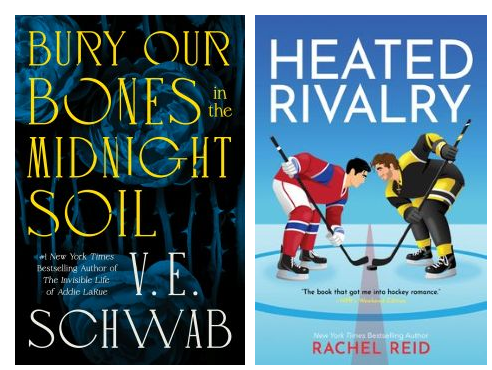
A while back, in a conversation about current events that had turned especially bleak, a friend of mine remarked, “This is why I read fiction.” She went on to say that she needs to read stories about queer women killing bad people, revenge fantasies that don’t occur in real life, with a recent example being Bury Our Bones in the Midnight Soil (2025) by V. E. Schwab, a multi-timeline work of feminist vampire fiction. As someone often drawn to realistic literary fiction, I jokingly replied that I read a lot of things that don’t allow for escape from the real world. But is needing to see something in your reading that is missing from this world “escapist”? And is reading about realistic scenarios necessarily not an escape? Personally, I would much rather experience someone else’s stressful life than deal with my own.
I also began to think about how Schwab is an author taken seriously in literary fiction circles, and it seems that to a greater and greater degree, stories with speculative elements are being accepted into the contemporary literary world outside of genre fiction. I think this is partly because, more and more, people can’t deny the need to see, feel, and imagine a world different from the one we live in—or to see, feel, and imagine things happening in this world that haven’t (or haven’t yet) happened. Imagination isn’t necessarily only an escape, it’s also a kind of conjuring; it’s not reality (or not yet reality), but it is a kind of transformative potential.
Sometimes what people need to see might be a revenge fantasy, like Schwab’s. Other times it might be a romance, like Heated Rivalry, the 2024 book in Rachel Reid’s Game Changers series or the hugely popular television adaptation of that series, which so many people have turned to this year during a time of fascist violence that is ongoing. It depicts a secret sexual relationship and love story between two professional hockey players in North America: Ilya Rozanov, from Russia, and Shane Hollander, who is Japanese Canadian. The story and its telling invite legitimate criticism and concerns. (Full disclosure: I've only seen the TV series.) Despite resonating with queer people, it has been marketed heavily to straight women, and its male characters broadly adhere to conventional standards of masculinity. It takes place in a world where the protagonists are disgustingly rich and probably don’t spread it around enough. Shane’s Asianness is gestured to in a way that feels sketchy and performative. Still, Heated Rivalry has become beloved among a wide audience that includes many queer and otherwise marginalized people.
There is a pervasive idea that serious fiction is purely a pursuit of the mind, meaning it is not of the body, of desire, of pleasure, of satisfaction and relief. It is not meant to be therapeutic or healing. Most people probably wouldn’t deny that many forms of reading can be therapeutic, yet a stubborn binary persists: the difference between reading for intellectual fulfillment and reading for escape. I’m sure a lot of people do read purely for escape, not to see or imagine the world differently but simply to imagine being somewhere or someone else, maybe even to deny or shut out reality. But I can’t see a definite, universally applicable line between these things.
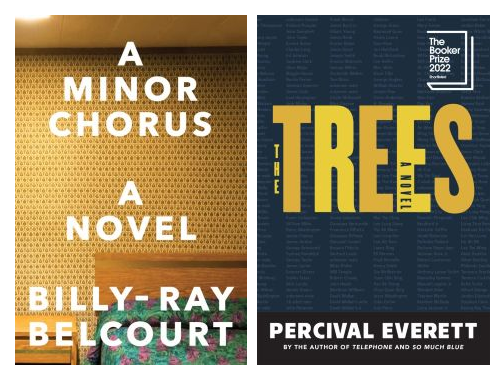
Around the time I was watching Heated Rivalry earlier this year, I was also rereading Billy-Ray Belcourt’s A Minor Chorus (2022), and writing an article for another publication reflecting on its depiction of people’s bodies being encroached on by the carceral state. I considered a scene in which the main character, a young gay Indigenous man seeking ways of being and embodiment in a world hostile to his physical existence, has sex with a presumably bisexual white man named Graham. Graham is mourning his relationship with his ex-wife, the marriage having fallen apart when she realized he was attracted to men. As is noted in the story, this part of his identity existed not as something that would take him away from her, but as potential or speculation. The way Graham now chooses to live, in the same house where he and his wife were together, keeping himself tethered to this past while he has anonymous sex with men in hotel rooms, is a method of policing his own physicality in a state where this is expected of him. I was thinking of this while watching the ICE occupation unfolding in Minneapolis, thinking of how people’s bodies are valued and devalued in a state that above all seeks to control them. But Belcourt’s depiction of Graham’s experience in his marriage also shows something else that occurs to me now: the very real power of physical potential.
The first two episodes of Heated Rivalry are largely based on sex, as that is the main feature of Ilya and Shane’s connection at that stage. You could be forgiven for thinking there isn’t going to be much else to it. Sex is often spoken of in this way: “It’s just sex, nothing serious.” Or, “That’s not love, it’s just sex.” Sex is, according to puritanical culture, either a fantasy to indulge in or a reward, something fluffy and insubstantial but fun that you get to have only after having built a relationship on something “real.” Sex is also often portrayed as something to be harnessed to serve the practical purposes of deepening intimacy or procreation in an already established relationship, necessarily transformed beyond “just sex.” But sex itself can be a transformation. In Heated Rivalry, rather than a relationship being built on “more than” sex, sex is the foundation of a relationship. Sexual attraction is potential. Sex is not only fantasy but the stuff of potential reality. Something that you aren’t punished for, that you don’t have to earn but that can build on itself, bringing more and more beautiful and pleasurable things into existence. In his newsletter The Querent, Alexander Chee notes, “Some of the most amusing memes for the show mock the real estate that gets nicer and nicer the more they have sex but this landscape is a metaphor for the sex they are having, the world it is building between them.”
It makes sense that at a time when conservative extremist and fascist ideals have taken hold, when demonstrations of fascist and conservative violence are being acted out in very real ways against people’s bodies, through ICE’s detainment and murders, through ongoing police violence, through legislation that violates the bodily rights of trans people, through indifference to sexual violence committed against children, through genocide and weaponry that literally evaporates human beings, that people would crave a positive expression of bodies existing and interacting. An escape, yes, but also a straightforward depiction of consensual pleasure and bodily autonomy. In a world where those in power are trying to destroy possibility through physical violence, here is a story where physical pleasure, physical expression, physical joy builds possibility.
Sex, of course, isn’t the only mode for these types of physicality. In Heated Rivalry, Olympic figure skating is cast as a counterpoint to hockey. While they are both intensely physical sports, hockey is an overtly masculine space where queerness seems forbidden. By contrast, a hockey friend of Shane’s casually and benignly assumes that a figure skater friend of Shane’s is gay. Coincidentally, the big hopeful for this year’s Milano Cortina Olympics in men’s figure skating was an Ilia with an “i”—Ilia Malinin, an American skater known as “the quad god,” a nickname gesturing to his technical prowess and athleticism. Far from being representative of how Shane’s friend sees the sport, Malinin came under fire in 2023 for making comments implying that as a heterosexual skater he would be discriminated against in his artistic marks. It’s worth noting that Malinin was a teenager when he said this, and later apologized, but many felt that it was a kind of karmic justice when he flubbed his final skate after a strong start, missing the podium entirely while Mikhail Shaidorov won the first-ever gold medal in figure skating for Kazakhstan. For me, it was refreshing to see Shaidorov win with a consistent, beautifully and joyfully executed program in what was supposed to be a technical slaughter. And it was amusing how the American commentators seemed stunned and saddened by Malinin’s loss and Shaidorov’s win, with the coverage suggesting that something unnatural had happened since the apparently most impressive skater had not won, since what was supposed to be the reasonable, likely, decided possibility within a rigid, predetermined structure was not what actually occurred. Sometimes, what we are told is realistic turns out to have been the fantasy.
It was equally delightful when, in the women’s competition, Chinese American skater Alysa Liu took the gold with a similarly impressive free skate, lightly skipping past others who ostensibly had more technical prowess under their belts but lacked her execution and physical confidence. Liu and Shaidorov’s programs both were the kind that would have still won had the judges' panel been made up of a bunch of amateurs who knew nothing about the technical side of skating. Theirs were the obvious crowd pleasers, performances that reveled in the joy and freedom of physical existence, and there is a power in this. While figure skating is not fiction, not exactly, it is art and performance even as it is also athleticism, and it is, in the way of athletic competitions and their coverage, a fantasy, a dream the rest of us can feel.
Another neat binary related to fiction or performance that is sometimes evoked suggests that violence, like the horrifying, sickening real-world violence enacted on oppressed or marginalized people, is one kind of physical power, and that the shimmering beauty of figure skating, or the sexually charged physicality of Heated Rivalry, for example, is the only kind of creation that is a legitimate means of fighting that violence, of transformation. That resistance, or even resistance fantasy, must always be pretty and peaceful and must keep the moral high ground. This binary is also an illusion.
One of the most significant examples of a revenge fantasy in contemporary literary fiction is Percival Everett’s The Trees (2021), an extraordinary novel that portrays the American history of lynching and racist hate crimes as well as broader state-sanctioned and culture-sanctioned violence through the lens of a zombie apocalypse. The Trees in its very construction is both fantastical and transformational. It revolves around the premise that the ancestors of those who committed past (and not-so-long-past) violent assaults on Black people and other marginalized people are being gruesomely murdered by corpses come back to life. Crime scenes become tableaux of historical crimes in reverse, leaving it to the reader to piece together what event is represented by each. This creative reversal, along with the book’s crass humor, extreme violence, and merciless, humiliating insults levied against racists and bigots and the culture that actively produced them, leaves no room for performative white tears, for spectator pity, and the participatory nature of the structure allows those still reading past the first few chapters the opportunity to take part in its reconstruction, not just to witness history but to encounter it in unexpected ways and be changed by it.
To be changed is different than to change. The point of The Trees is not that the revenge that happens in the story, or its non-fantastical equivalent, will or even can happen. The book exists in a strange in-between universe that is part wild, raucous fantasy, part sobering, straightforward documentation of events that can never be reversed or compensated for. In an interview with NPR, Everett said, “The fantasy part of this novel should not go without note. The justice that comes is not one that I think we can expect. I don't know if justice comes as much as acquiescence.” In a different interview with the Booker Prize Foundation, he said something else that struck me: “There’s a reason that oppressive regimes often resort to burning books. No one can control what minds do when reading; it is entirely private. We make of literature what we need to make.” The first part of this is a commonly asserted sentiment; we often talk about how the “personal is political,” and this is often interpreted as meaning that the material circumstances of one’s life are tied to systemic causes. But also, the private is political.
The idea that a person can be influenced directly, simply by being told what to think, is one with limited utility in reality; it is perhaps even entirely fictional. Political transformation happens inside of people. Inside the things we do when we’re alone, the things we think about, the things we do to soothe and reorient ourselves, the things we want, the things we do so we can get out of bed the next day, the things we need to see. Nothing is exempt from that realm of ourselves—no desire, no fantasy—and nothing is exempt from that realm of ourselves in our interactions with the rest of the world; it pervades everything we do.
Heated Rivalry has seen all kinds of success, and has been embraced by people who are very conscious of violent realities. I’ve seen it mentioned in the Guardian but also seen it emerge in leftist BIPOC and Covid-conscious circles; it is still unsurprisingly all over the queer internet. Shortly after the murder of Alex Pretti, Angela Schwesnedl of Moon Palace Books in Minneapolis, which has become a stronghold for ICE resistance, was interviewed by Lit Hub’s James Folta, who asked if she had noticed people coming into the store for different kinds of books to read in this era of occupation—”political theory for inspiration? History, to search for echos? Poetry, as a balm?” Schwesnedl responded, “I don’t know if people are buying differently necessarily … I mean, Heated Rivalry. There’s a lot of that, you know … A copy of Heated Rivalry and a free whistle … that’s the revolution there.” In the context of the piece, this was obviously said with humor. I don't need to read Heated Rivalry to know that it is hardly a revolutionary text, and there is also a general danger to suggesting, in the vein of rainbow capitalism, that consumption is activism, as there is a danger to conflating the intentions and qualities of the various performances, media, and texts mentioned in this article. But it’s interesting to note that this is what people buying from this very politically active indie bookstore in Minneapolis have been choosing to read. The story has become widely beloved, or at least widely accepted as a product of leisure, among people doing real work, and among marginalized people who are the most likely to have legitimate reasons to criticize it (and still often do).
This may be partly because people doing and experiencing serious things need to read very non-serious things to decompress, but I think it also has to do with the conversations, the humor and memes, the fandom; the point isn’t only what it is, but the opportunity for interaction it presents, what people have made of it. There’s value to it simply being a positive, not-that-deep story of queer love and sex, but it has also been intentionally steered beyond its original vision and politics. You can now easily find merchandise with multiple designs featuring the phrase or some variation of the phrase, “The only ice I like is the ice that my two gay boyfriends skate around on.” At the end of his piece on the show, Alexander Chee writes of the characters, “The world they keep building between them changes this one too.”
To be changed is different than to change, but the two may not be so far apart, even if vast worlds of cynicism exist in the small gap between them. Fantasies are, by definition, not reality, not stories that can necessarily ever exist in the real world, not anything that can necessarily ever make up for a terrible, unacceptable reality. But what happens when a person sees something they need to see, something that exists somewhere, if only in the mind of another person? And what happens if they are changed? Who can control what minds do?
Who Even Reads is an independent publication run by two hardworking editorial professionals. We write about books from a liberation perspective, with a socially conscious focus that's both fun and serious, covering mostly new releases. Your donations subsidize what we do. Learn about us.