Max Delsohn's "All Time Low" and the Straight Girl Paradox
Stories in the World is a series in which we explore a particular element of a piece of writing in a broader context. Here, Lisa looks at the phenomenon of women who become involved in relationships with queer women while self-identifying as straight, as featured in Max Delsohn's "All Time Low."

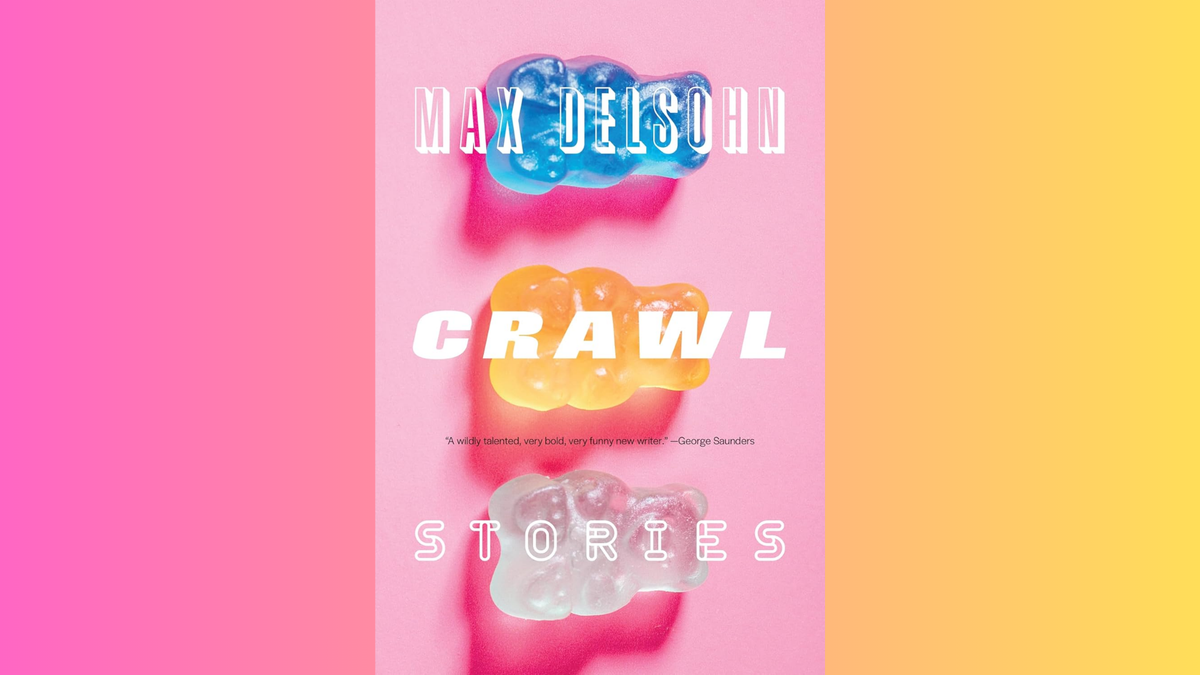
The second story in Max Delsohn’s trans masc-focused debut collection Crawl, called “All Time Low,” is an almost unbearably funny romp through undergraduate sexual confusion and self-loathing—an absolute tour de force representation of a milestone experience in queer coming of age. The narrator is a butch lesbian in her sophomore year of college who becomes romantically involved with a girl named Julie, who identifies as straight, much to the narrator’s consternation. The two have one-sided sexual encounters, the details of which will be painfully familiar to many who have grown up queer with a penchant for the unattainable (this last part perhaps goes without saying when discussing this particular population). The narrator tries to explain the situation in conversation with her ex-girlfriend, Leigh:
“Do you guys have sex?”
“We just do her.”
“Excuse me?”
This exchange highlights Delsohn’s exceptional flair for comical brevity, especially in dialogue. He also imbues this story with detailed specificity that ratchets up the cringe factor, such as Julie’s appreciation for ska music. In one especially funny scene, the narrator has agreed to go to a Reel Big Fish concert, and must watch in horror as Julie demonstrates how to “skank” while they are riding public transit:
“Julie got up and started skanking, right there on the bus. I wanted her to stop; at least half the people on the 3 had turned around to see who was stomping and jumping behind them. My mortification curdled to anger—she was afraid to be seen holding hands with me on campus, but not afraid to be seen on a city bus skanking?
The drunk guy yelled, ‘You get it girl!’”
Coincidentally, I had a crush on a straight girl named Julie in high school. I don’t remember anything else about her now other than that she was blond and her boyfriend worked at a gas station near my house. I would go there to buy sodas and snacks and make insinuating remarks to him about how his girl was flirting with me, which he ignored. I thought at the time that he was a pushover cuck, that I was humiliating him by making out with his girlfriend. In reality, I think he knew everything and had no problem with it because he didn’t see me, a queer woman, as any kind of threat. This only became apparent to me after the exact same thing happened again with a different woman. The boyfriend wasn’t stoically suffering my taunts in silence, he was sneering at me, like I was a creature of a different species.
In “All Time Low,” Leigh, the narrator’s ex, is now dating a trans man named Rodney and passing as heterosexual. While this surely brings with it a certain amount of privilege, as a woman who identifies as queer, passing is not entirely welcome for Leigh. She tells the narrator, “I miss being a lesbian. It’s not the same, queerness. And being seen as a straight woman fucking sucks.” It’s interesting that here we see a lesbian changing her sexual identity in deference to the fact that she started dating someone that made her previously chosen label no longer apt—this likely further frustrates the narrator, who doesn’t understand why Julie won’t do the same.
This is the crux of the conflict in the story: the narrator can’t understand why, despite being romantically and sexually involved with her, Julie still claims to be straight.
“‘But I’m not into women,’ Julie said. ‘I’m just into you.’
I reminded her that, despite my leather jacket and strong jawline, I was a woman she seemed to be into.”
When I was nineteen I got involved with my thirty-three-year-old poetry professor (forgive the polite euphemism for my sexual exploitation by an authority figure), who identified as straight. She had enough self-awareness to note on at least one occasion that she understood her relationship with me was in conflict with that identification but she took great pains to tell me, as often as possible, that she still strongly preferred men. This situation, which was unsurprisingly short-lived, initiated a spell of madness rather akin to the narrator’s frustration in “All Time Low.” I did not, in this or any other relationship with a straight woman, have the narrator’s problem in which sex acts performed were not reciprocated, but The Professor made sure to let me know, while I was going down on her, that she had “trained herself” to have vaginal orgasms, with the implication being that she did not care much for oral sex and she was doing me a favor by receiving it. She dumped me as soon as the next available man came along. Even at nineteen I knew that saying during sex that you wished someone else was doing something else to you was fucking gauche.
There is a moment in “All Time Low” when Julie tells the narrator she likes her even though she isn’t typically attracted to women because the narrator is “special.” This is, of course, the great lure of the straight woman for the young, approval-seeking sapphic. The fantasy isn’t being able to “turn” a straight girl gay, it’s to be accepted by heteronormative society via the affection of its native daughter. To be a part of this world, even if by extension, even if one knows that world is shitty and not where one belongs. It’s to be “special”—hot enough, charming enough, interesting enough—to break the boundaries someone has placed around their desires, or more likely, that society has placed for them. None of this is real though, or none of it has real meaning, and that is why most queer women stop courting (at least this particular brand of) unavailability in their youth. It’s desire built on self-loathing, as the narrator of the story ultimately recognizes. When she explains the confines of her relationship with Julie to Leigh, Leigh declares, “Of course you’re in this situation. You’re like obsessed with being unhappy.”
The happiest characters in “All Time Low” (besides perhaps the narrator’s roommate Ally, who binges uppers) seem to be Rodney and Julie, both of whom have decided who they are going to be in the world (a man, and a straight woman, respectively) and will be sticking to that decision despite anything anyone else might have to say about it. What bothers the narrator is not really that Julie claims to be something she is not, but that in doing so, she refuses to claim the narrator, to identify with her, to give her the acceptance and validation she is seeking, to be in community with her. For a straight woman sleeping with a queer woman, to continue to identify as straight is to say, “I want something from you, and I will take it, but I am not like you.” It’s not, and never could be the same as, for instance, a lesbian-identifying woman with a boyfriend still identifying as a lesbian, because in this case she is renouncing privilege, an easier life. It is almost an inherently self-hating act to try to be with someone who won’t claim you in this way (when I heard the words “vaginal orgasm,” believe me, I hated myself). It’s demonstrative of Delsohn’s immense skill and depth of feeling that this story can be so funny while capturing an experience that is really so dark.
There is an implication that the narrator goes on to transition later, or at least no longer has the exact same gender and/or sexual identity in the present when they are telling the story. This narrative distance—the indication that everything turned out alright—is necessary to maintain the humor in what is actually a pretty bleak situation. One hopes the narrator took away from this experience that they are deserving of better things—at the very least, never having to attend a Reel Big Fish concert again.
Who Even Reads is an independent publication run by two hardworking editorial professionals. We write about books from a liberation perspective, with a socially conscious focus that's both fun and serious, covering mostly new releases. Your donations subsidize what we do. Learn about us.